
Introduction
CCTV installation cost in Australia varies more than most people expect. "A CCTV system" can mean two Wi-Fi cameras stuck on a carport for under $400, or a 16-camera commercial install with cable trenched across a yard for well over $15,000. Ask three installers for a quote and you can easily get three very different numbers.
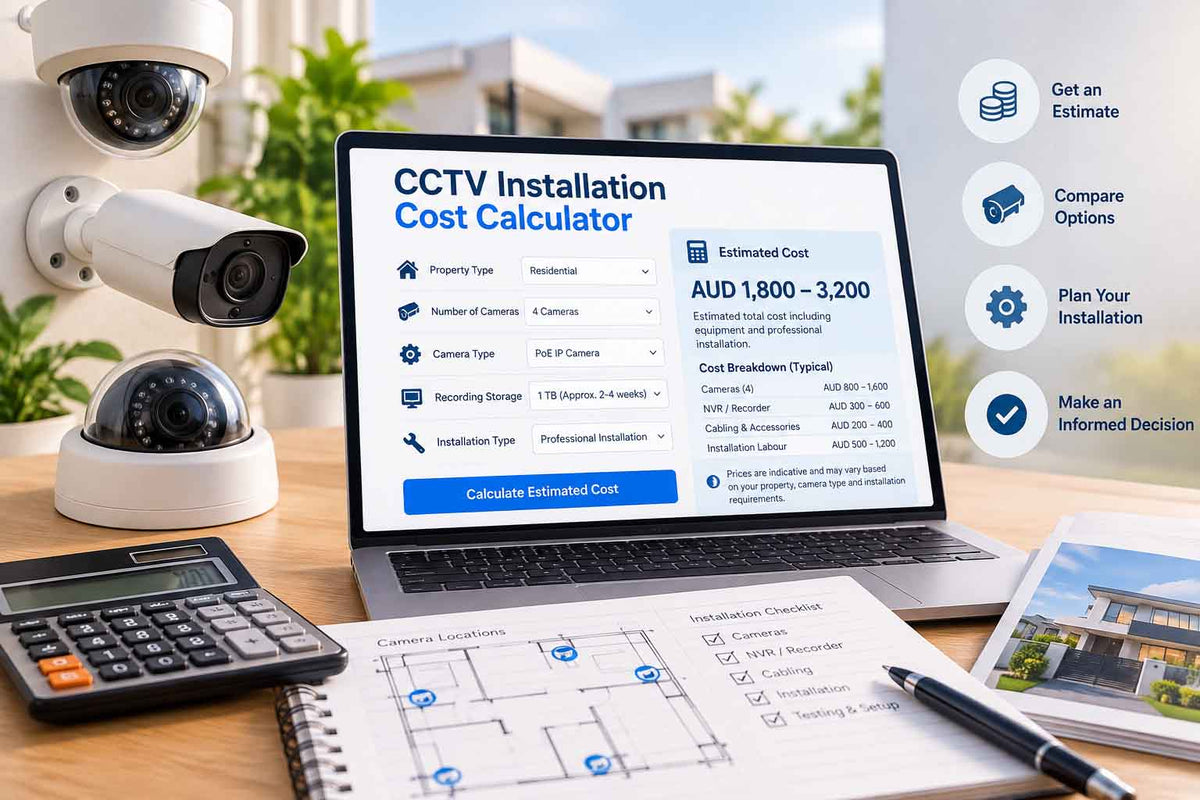
The calculator below breaks the price into the same lines an installer uses: cameras, recorder, storage, cabling, labour and any ongoing fees. Set it up for your property and it shows a realistic range, plus the recorder and hard drive size your system actually needs.
CCTV installation cost calculator
Build your system below. The estimate updates as you go, in Australian dollars including GST.
Estimates only, based on CCTV Importers retail prices and typical Australian installer rates of $110 to $180 an hour (October 2026). Actual quotes vary with site access, travel, after-hours work and cable distances. Hardware ranges assume buying as a kit; buying parts separately usually costs more.
TL;DR
• Typical 4-camera home, professionally installed: about $2,150 to $3,900 with 8MP cameras, or $1,750 to $3,400 with entry-level 6MP.
• Same system, DIY: roughly $970 to $1,640, because labour is often 40 to 50% of the total.
• Installer labour: usually $110 to $180 an hour in metro areas, around 1.5 to 2 hours per wired camera plus setup time.
• Hidden costs: hard drives, Cat6 cable and junction boxes are often not in the kit price. Cloud subscriptions add $4 to $8 per camera per month.
• Best value: a wired PoE kit has no ongoing fees and the lowest five-year cost for most homes.
How the CCTV Cost Calculator Works Out Your Price
The calculator adds six cost lines, each worked out from your answers. Here is exactly what goes into each one, so you can check a quote against it line by line. All figures are AUD including GST, based on our retail prices and typical Australian installer rates as of October 2026.
1. Cameras
Cameras cost = number of cameras × price per camera for the type and quality you pick.
|
Camera quality |
Wired PoE |
Wi-Fi |
Battery / solar |
4G |
|
Entry (6MP, infrared) |
$70 to $130 |
$60 to $120 |
$150 to $250 |
$250 to $400 |
|
Standard (8MP, AI detection) |
$150 to $230 |
$120 to $200 |
$230 to $350 |
$350 to $550 |
|
Premium (colour night vision or active deterrence) |
$240 to $450 |
$200 to $320 |
$350 to $550 |
$500 to $900 |
The ranges assume you buy cameras as part of a kit, which is usually cheaper than buying each piece separately. 4G cameras cost more because they include a mobile modem and usually a battery and solar panel.
2. Recorder (NVR)
Wired systems need a network video recorder (NVR) with at least one channel per camera. The calculator rounds your camera count up to the next standard size.
|
Cameras |
NVR size |
Price range |
|
1 to 4 |
4-channel PoE |
$170 to $300 |
|
5 to 8 |
8-channel PoE |
$300 to $550 |
|
9 to 16 |
16-channel PoE |
$550 to $1,100 |
Wi-Fi, battery and 4G cameras usually record to a microSD card inside each camera instead, so the calculator swaps the NVR and hard drive for one card per camera at $35 to $80 each.
3. Storage: sizing the hard drive
This is the line most quotes get wrong, in either direction. The calculator works out how much footage your cameras produce, then picks the smallest standard surveillance drive that fits it.
Storage (TB) = cameras × bitrate (Mbps) × 86,400 × days ÷ 8,000,000 × 1.1 × recording factor
• Bitrate: 3 Mbps for a 6MP camera and 4 Mbps for 8MP, using H.265 compression on continuous recording. These are typical real-world averages; busy scenes such as roads or trees in wind use more.
• 86,400 is the number of seconds in a day. Dividing by 8,000,000 converts megabits into terabytes (8 bits per byte, 1,000,000 MB per TB).
• 1.1 adds 10% headroom so the drive is not running completely full.
• Recording factor: 1.0 for 24/7 recording, 0.4 for motion events only (a typical home records around 40% of the day on motion).
Worked example: 4 cameras at 8MP, 24/7, kept for 14 days: 4 × 4 × 86,400 × 14 ÷ 8,000,000 × 1.1 = 2.7TB. The calculator picks a 4TB drive ($390 to $430). Drop to motion-only recording and the same system needs about 1.1TB, so a 2TB drive does the job.
|
Drive size |
Price range |
|
2TB |
$300 to $340 |
|
4TB |
$390 to $430 |
|
6TB |
$460 to $500 |
|
8TB |
$750 to $970 |
|
10TB |
$830 to $900 |
Above 10TB, the calculator stacks multiple 10TB drives. That needs a recorder with two or more drive bays, which it flags in the notes.
4. Cabling and mounting
• Wired PoE: $40 to $90 per camera for Cat6 cable (an average run of 20 to 30m), RJ45 plugs and a weatherproof junction box.
• Wi-Fi: $10 to $30 per camera for brackets and power adaptors.
• Battery, solar and 4G: $15 to $40 per camera for mounts and solar panel brackets.
5. Installation labour
If you choose a professional installer, labour is worked out from hours on site multiplied by the hourly rate:
Labour hours = (cameras × hours per camera + setup hours) × property factor
Labour cost = labour hours × hourly rate
|
Cable access |
Hours per wired camera |
Hours per wireless camera |
|
Easy (roof space, short runs) |
1 to 1.5 |
0.5 to 0.75 |
|
Moderate (some long or tricky runs) |
1.5 to 2 |
0.75 to 1 |
|
Difficult (masonry, flat roof, trenching) |
2.5 to 3.5 |
1 to 1.5 |
• Setup hours: 1.5 to 2.5 hours for a wired system (mounting the NVR, configuring the drive, setting up AI detection, the phone app and a handover). Wireless systems take 0.75 to 1.25 hours.
• Property factor: 1.0 for a single-storey home, 1.15 for a shop or office, 1.25 for a double-storey home (ladders, second-storey eaves, more wall penetrations) and 1.35 for a warehouse or yard (elevated work platforms, long runs, site rules).
• Hourly rate: $110 to $180, which covers most metro installers during business hours. Expect more for after-hours work, regional travel or call-out minimums.
Worked example: 4 wired cameras, moderate access, single-storey home: (4 × 1.5 + 1.5) × 1.0 = 7.5 hours at the low end, and (4 × 2 + 2.5) × 1.0 = 10.5 hours at the high end. At $110 to $180 an hour, labour comes to $830 to $1,890.
Choosing DIY removes labour entirely, but adds $60 to $120 for a crimp tool and cable tester if you are running your own Cat6.
6. Extras and ongoing costs
• UPS battery backup: $150 to $350. Keeps the recorder and cameras running through short blackouts.
• Dedicated monitor: $150 to $300, useful at a shop counter or office.
• Cloud recording: $4 to $8 per camera per month. The calculator shows this as a yearly cost and adds a five-year total, because a subscription can overtake the hardware cost over time.
The calculator then adds the lines together, rounds to the nearest $10, and divides by the number of cameras to give an all-in cost per camera. That number is the easiest way to compare quotes of different sizes.
What Moves the Price of a CCTV System
Five decisions move the total far more than brand choice does.
Camera count
Camera count multiplies almost every line: hardware, cabling and labour. Going from 4 to 8 cameras roughly doubles the total, and pushes you into an 8-channel recorder and a bigger drive. Before adding cameras, check whether one well-placed 8MP or panoramic camera can cover what two cheaper ones would.
Resolution and features
Moving from entry 6MP to standard 8MP adds about $80 to $100 per camera. Premium features such as full-colour night vision or active deterrence (lights and a siren built into the camera) add more again. Higher resolution also means more storage: 8MP footage takes about a third more space than 6MP, which can bump you up a drive size.
Wired vs wireless
|
|
Wired PoE |
Wi-Fi |
Battery / solar |
4G |
|
Upfront hardware |
Moderate |
Lowest |
Higher per camera |
Highest per camera |
|
Installation |
Highest (cable runs) |
Low |
Lowest |
Lowest |
|
Ongoing fees |
None |
Optional cloud |
Optional cloud |
Data plan + optional cloud |
|
Records 24/7 |
Yes |
Usually |
No, motion clips |
No, motion clips |
|
Best for |
Homes and businesses |
1 to 3 cameras, renters |
Sheds, farm gates, rentals |
Building sites, rural blocks |
Wired PoE costs more upfront because of cabling and labour, but it has no subscription, records continuously, and is not affected by Wi-Fi dropouts. Over five years, a wired system is almost always the cheaper option for a home with four or more cameras.
Professional installation vs DIY
Labour is usually 40 to 50% of a professionally installed system. DIY makes sense for a single-storey home with easy roof access and someone comfortable on a ladder and terminating Cat6. Professional installation is worth paying for on double-storey homes, tiled or flat roofs, masonry walls, and any business where cameras need to be positioned for insurance or compliance.
In most Australian states, anyone installing CCTV for payment needs a security licence. Cabling connected to your home network may also need a registered cabler. Ask any installer for both licence numbers before you book.
Storage and retention
Keeping footage longer costs more drive space. For 4 cameras at 8MP recording 24/7, going from 14 days to 30 days moves you from a 4TB drive to a 6TB drive, adding roughly $30 to $110. At 8 cameras, the same jump goes from 6TB to two 10TB drives (or one larger drive), which costs far more. Switching to motion-only recording is the cheapest way to extend retention, though you lose continuous footage.
Real Pricing Anchors from Current Kits
To ground the estimate in real numbers, here is what complete kits cost on our site as of October 2026. These are hardware prices only; add cabling and installation using the calculator.
|
Kit |
What's included |
Price |
|
2 × 6MP cameras, 4-channel NVR, 1TB drive |
$488.25 |
|
|
4 × 6MP cameras, 4-channel NVR, 2TB drive |
$782.25 |
|
|
4 × 6MP IP67 cameras, WizSense AI NVR, 2TB drive |
$919 |
|
|
Up to 8 × 8MP colour cameras, 8-channel NVR, HDD |
$1,184 |
|
|
Mixed DarkFighter and ColorVu cameras, 8-channel AcuSeek NVR |
From $2,280 |
The HiLook kits sit at the budget end. The Dahua EZ-IP kit is a solid mid-range 4-camera option, with a 2TB drive, AI human and vehicle detection and metal IP67 cameras rated from -40°C to 60°C. The Hikvision custom kit shows what a full-featured 8-channel system costs before any labour is added.
Worked Examples: What Australians Typically Pay
These are calculator results for four common setups, so you can see how the lines stack up.
|
Setup |
Hardware |
Labour |
Total upfront |
Per camera |
|
4 entry 6MP cameras, wired, single-storey, DIY, 14 days |
$970 to $1,640 |
$0 |
$970 to $1,640 |
$240 to $410 |
|
4 standard 8MP cameras, wired, single-storey, installed, moderate access, 14 days |
$1,320 to $2,010 |
$830 to $1,890 |
$2,150 to $3,900 |
$540 to $980 |
|
8 standard 8MP cameras, wired, double-storey, installed, moderate access, 14 days |
$2,280 to $3,610 |
$1,860 to $4,160 |
$4,140 to $7,770 |
$520 to $970 |
|
16 premium cameras, wired, warehouse, installed, difficult access, 30 days |
$7,520 to $12,440 |
$6,160 to $14,220 |
$13,680 to $26,660 |
$860 to $1,670 |
Two patterns stand out. First, labour roughly matches the hardware cost once a system is professionally installed. Second, the cost per camera barely changes between 4 and 8 cameras, because the savings on a shared recorder are offset by the extra storage and the double-storey install. If a quote comes in well above these per-camera ranges, ask the installer to itemise it using the six lines above.
Six Ways to Bring the Price Down
1. Buy a kit, not separate parts. Kits bundle cameras, recorder and often a drive for less than the parts bought one by one. Our CCTV kits under $1000 are a good starting point for most homes.
2. Supply your own hardware. Many installers will fit customer-supplied gear for a labour-only price, which removes the markup on equipment.
3. Run the cables yourself, then get a pro to finish. Pulling Cat6 through an easy roof space is the slowest part of the job. Some installers will terminate and commission DIY cable runs for a few hours' labour.
4. Record on motion where 24/7 isn't needed. It can drop you a whole drive size.
5. Use fewer, better cameras. One 8MP panoramic camera can replace two standard cameras on a wide backyard.
6. Skip the subscription. A wired PoE system records locally, and the phone app is free with Hikvision, HiLook, Dahua and TP-Link VIGI.
CCTV Installation Cost FAQs
How much does CCTV installation cost in Australia?
A typical 4-camera wired system costs about $2,150 to $3,900 professionally installed with 8MP cameras, or $970 to $1,640 for an entry-level DIY setup. An 8-camera system on a double-storey home typically runs $4,000 to $7,800 installed.
How much do installers charge per camera?
Most Australian installers work out to roughly $200 to $470 in labour per camera on a standard home job, based on $110 to $180 an hour and 1.5 to 2 hours per camera plus setup time. All-in, including hardware, expect about $500 to $1,000 per camera installed.
Is DIY cheaper than hiring a professional?
Yes, upfront. Labour is often 40 to 50% of the total, so DIY can roughly halve the cost. Professional installation is still worth it for double-storey homes, tiled or flat roofs, masonry walls, businesses, and any job needing long cable runs through roof cavities.
Does more cameras always mean better security?
Not necessarily. Correct placement usually outperforms simply adding more cameras. Two well-positioned 8MP cameras covering the driveway and front door will catch more useful footage than six cheap cameras pointed at the garden.
What hard drive size do I need?
For most 4-camera homes recording 24/7 for two weeks, a 2TB drive suits 6MP cameras and a 4TB drive suits 8MP. The calculator works this out for you using the formula above.
Are there ongoing costs with CCTV?
Wired PoE systems have no required ongoing fees. Wi-Fi and battery cameras often push cloud storage plans at about $4 to $8 per camera per month, and 4G cameras need a mobile data plan. Budget for a replacement hard drive every four to five years on a system that records 24/7.
The Bottom Line
CCTV installation cost comes down to six lines: cameras, recorder, storage, cabling, labour and any subscriptions. Use the calculator to set a realistic budget, then hold any quote up against those six lines so you know exactly what you are paying for.
Once you have an estimate, compare our CCTV kits and network video recorders to match real product prices to your calculated setup. If your property is unusual, send us the details through our custom kit request and we will price a system for it.


