
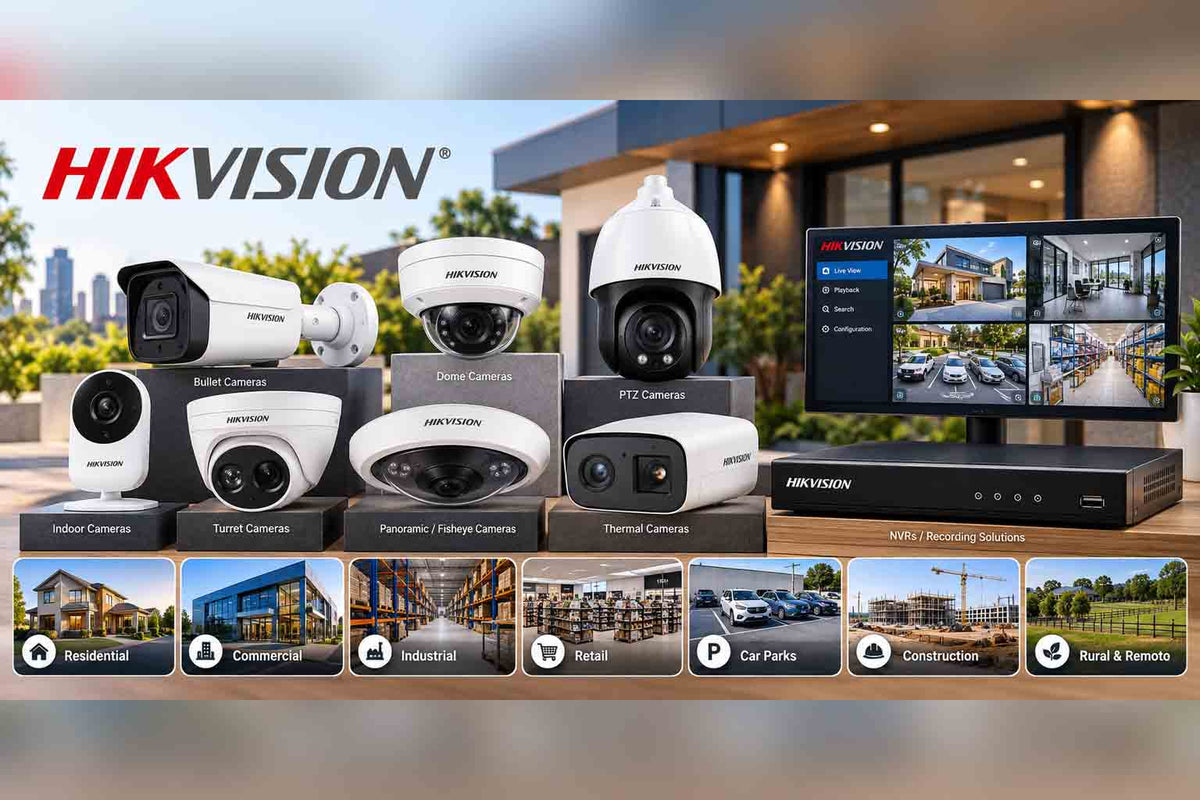
Hikvision makes thousands of products, and the model numbers look like someone fell asleep on a keyboard. DS-2CD2387G2-LU means a lot to an installer and nothing to a homeowner. Roughly 6,600 Australians search "hikvision" every month, and most of them are trying to work out which camera, which series and which recorder they actually need.
This page translates the range. We stock Hikvision across residential and commercial lines, and below is how we explain it to customers at the counter.
TL;DR:
For most homes, a Hikvision 8MP AcuSense or ColorVu turret camera on an AcuSense NVR is the sweet spot. ColorVu gives full-colour night video. AcuSense filters alerts to people and vehicles. Pro series adds stronger AI and deterrence for businesses. PanoVu and PTZ suit large areas. Every Hikvision system works with the free Hik-Connect app and records locally, with no subscription.
Hikvision camera technologies in plain English
|
Technology |
What it does |
Best for |
|---|---|---|
|
ColorVu |
Full-colour video at night using a large-aperture lens and soft warm light |
Driveways, front yards, streets with poor lighting |
|
AcuSense |
AI that filters alerts to humans and vehicles |
Homes tired of false alerts from cats, trees and rain |
|
Smart Hybrid Light |
Infrared by default, switches to white light when a person is detected |
Neighbour-friendly night coverage |
|
Active deterrence |
Strobe light and siren triggered by intrusion |
Side gates, rear yards, sheds |
|
AcuSeek |
Natural-language search through recorded footage |
Businesses reviewing long footage |
|
DarkFighter |
Strong low-light performance for PTZ and bullet cameras |
Car parks, large commercial sites |
Go deeper with our guides to ColorVu vs AcuSense, ColorVu 3.0 and AcuSeek.
Hikvision camera series: which line is which?
|
Series |
Positioning |
Typical buyer |
|---|---|---|
|
HiLook (sub-brand) |
Budget, core features |
Price-conscious homes, rentals |
|
Value / EasyIP |
Reliable everyday cameras |
Homes, small offices |
|
Pro series (G2, G3 and newer) |
Stronger AI, better optics, deterrence |
Family homes, retail, trades |
|
DeepinView |
Dedicated deep-learning cameras |
Commercial sites, perimeter protection |
|
PanoVu |
Multi-sensor panoramic |
Car parks, warehouses, schools |
|
PTZ / TandemVu |
Pan, tilt, zoom tracking |
Large yards, farms, commercial |
If you want the budget sub-brand, read our HiLook guide. For the latest Pro models, see our G3 range guide for Australia and NZ.
Choosing a Hikvision camera shape
-
Turret: our default for homes. No IR reflection inside the dome, easy to angle, and spiders do not nest on the lens as readily as on bullets.
-
Bullet: long-range views down driveways and fence lines; visible deterrent.
-
Dome: vandal-resistant, better for low mounting in shops and car parks.
-
Fisheye / panoramic: one camera covering a whole room or yard.
Resolution: what we recommend
We no longer recommend 4MP as a general choice. 6MP is entry level and 8MP (4K) is the standard we recommend for most Australian homes. The exception is dedicated number plate capture, where 2MP or 4MP ANPR cameras with the right lens and mounting work best.
Hikvision NVRs and kits
Every Hikvision camera needs somewhere to record. An NVR (network video recorder) with a surveillance hard drive is the standard.
|
NVR channels |
Suits |
Our tip |
|---|---|---|
|
4-channel |
2 to 4 cameras |
Buy 8-channel if you might add cameras later |
|
8-channel |
Typical family home |
Most popular size |
|
16-channel |
Large homes, small businesses |
Plan for 6TB+ storage |
|
32-channel+ |
Commercial sites |
Use RAID-capable models |
Choose an AcuSense NVR if your cameras are not AcuSense, because the recorder can add human and vehicle filtering. Browse Hikvision NVRs or start with a ready-made Hikvision 4-camera kit.
Beyond cameras: the wider Hikvision range
-
Intercoms and door stations: 2-wire and IP video intercoms. See Hikvision door stations.
-
AX PRO alarms: wireless alarm system that integrates with Hik-Connect.
-
Access control: card, PIN, fingerprint and face terminals.
Is Hikvision safe and legal to use in Australia?
Yes. Hikvision is legal for homes and businesses in Australia. It is restricted from US federal procurement under the NDAA, and some Australian government sites have removed it. If your project has compliance requirements, read our Hikvision NDAA guide. For everyone else, the practical security steps matter most: unique passwords, updated firmware and no open ports.
Frequently asked questions
What is the best Hikvision camera for home use?
An 8MP AcuSense or ColorVu turret camera. ColorVu suits poorly lit areas; AcuSense suits areas with lots of motion like trees and passing cars.
Does Hikvision need a subscription?
No. Hikvision cameras record to an NVR or SD card and use the free Hik-Connect app for remote viewing and alerts.
What is the difference between Hikvision and HiLook?
HiLook is Hikvision's budget sub-brand. It covers the essentials at a lower price, while Hikvision models add newer AI features, better optics and wider options.
Can I use Hikvision cameras with another brand's NVR?
Usually, via ONVIF. Basic recording works, but smart features such as AcuSense events work best on a Hikvision NVR.
How long does a Hikvision system last?
A quality installation typically runs 7 to 10 years. Plan to replace the hard drive around year five to seven.
Find your Hikvision setup
Start with what you need to see: faces at the door, cars in the driveway, or the whole back yard. Then match the technology and size the recorder.
Browse all Hikvision products or go straight to Hikvision IP cameras.


