
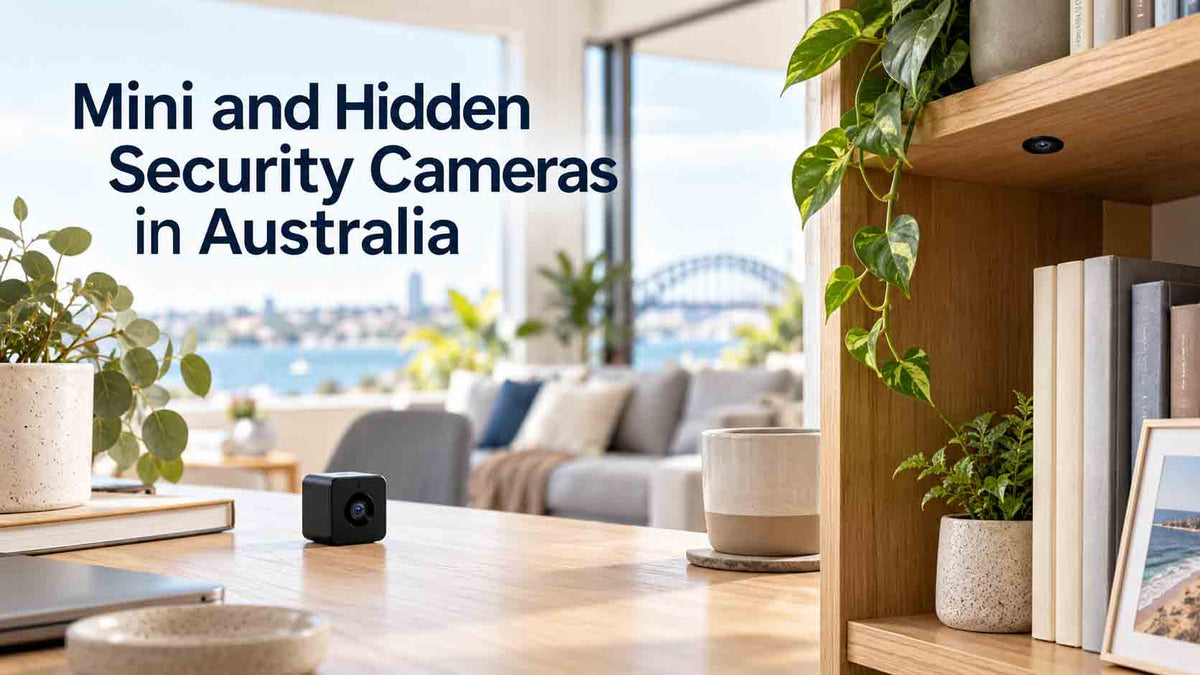
A retailer suspects stock is walking out the back door. A parent wants to check in on a new nanny. A tradie wants to know who keeps raiding the ute tray overnight. All three end up searching for a mini camera, and roughly 2,900 Australians type that phrase into Google every month.
Small cameras are legal to buy. How you use them is where people get into trouble. This guide covers the law in each state, sensible use cases, and the specs that separate a useful mini camera from a gimmick.
TL;DR:
Owning a mini or hidden camera is legal in Australia. Recording audio of private conversations without consent is illegal in every state and territory. Victoria, WA, SA and the NT also restrict video recording of private activities without consent. Never place cameras in bathrooms, bedrooms used by others, or change rooms. Use hidden cameras for your own property and common areas, keep audio off, and get advice for workplace use.
What counts as a mini or hidden camera?
|
Type |
Typical size |
Common use |
Power |
|---|---|---|---|
|
Pinhole camera |
Lens under 5mm |
ATMs, counters, door frames |
Wired (PoE or 12V) |
|
Covert dome or cube |
3 to 6cm |
Shops, offices |
Wired or USB |
|
Mini Wi-Fi camera |
2 to 4cm |
Home, car, temporary use |
Battery or USB |
|
Disguised camera |
Varies (clock, charger) |
Nanny cams, small business |
USB or mains |
For permanent installs, a professional pinhole camera wired into an NVR records reliably for years. Battery mini cameras are fine for short-term monitoring but usually run for hours, not days. Our look at Dahua pinhole cameras shows what a commercial-grade option looks like.
Are hidden cameras legal in Australia?
There is no single national law. Each state and territory has its own surveillance or listening devices legislation. The pattern is consistent on audio and varies on video.
|
State / territory |
Main law |
Audio of private conversations |
Video of private activities |
|---|---|---|---|
|
NSW |
Surveillance Devices Act 2007; Workplace Surveillance Act 2005 |
Consent required (limited exceptions) |
Restrictions on installing devices on premises without consent; workplace notice rules |
|
VIC |
Surveillance Devices Act 1999 |
Consent required |
Prohibited without consent of the parties |
|
QLD |
Invasion of Privacy Act 1971; Criminal Code |
Consent of a party required |
Offences for recording people in private places or acts |
|
WA |
Surveillance Devices Act 1998 |
Consent required |
Prohibited without consent |
|
SA |
Surveillance Devices Act 2016 |
Consent required |
Prohibited without consent |
|
TAS |
Listening Devices Act 1991 |
Consent required |
Covered by general and criminal law |
|
ACT |
Listening Devices Act 1992; Workplace Privacy Act 2011 |
Consent required |
Workplace notice and consultation rules |
|
NT |
Surveillance Devices Act 2007 |
Consent required |
Prohibited without consent |
As Arts Law Centre of Australia notes, every state and territory prohibits recording a private conversation with a listening device without consent, while Victoria, WA and the NT go further by restricting optical recording of private activities.
This table is a summary, not legal advice. If you are using covert cameras in a workplace or to gather evidence, speak to a lawyer first.
The audio trap most buyers miss
Many cheap mini cameras record sound by default. That is the single biggest legal risk. Turn the microphone off unless everyone being recorded has agreed. Our guide to security cameras with audio in Australia and NZ explains the rules in more depth.
Legitimate uses for hidden cameras
-
Retail loss prevention: covert cameras near registers and stockrooms, with general CCTV signage at entrances.
-
Home security inside your own house: a discreet camera in the hallway or living room covering entry points.
-
Monitoring carers or babysitters: keep it to shared areas, video only, and the safest option is to tell them cameras are in use.
-
Vehicles, sheds and job sites: catching repeat theft from utes, tool sheds and site containers.
-
Short-term investigations: under legal advice, for example suspected internal theft.
Places you must never put a hidden camera
Bathrooms, toilets, change rooms, bedrooms used by guests or tenants, and any lactation or shower area. Several states make workplace surveillance in these spaces a specific offence, and recording people in private acts is a criminal matter everywhere in Australia.
Renting out a room or a holiday home? Hidden cameras inside occupied areas are off limits. Platforms such as Airbnb ban indoor cameras entirely.
Choosing a mini camera that actually works
-
Resolution: 2MP to 4MP is normal for pinhole lenses. Small sensors trade detail for size.
-
Low light: check the lux rating. Many tiny cameras need room lighting to see anything.
-
Power: battery models last roughly 1 to 4 hours of recording. Wired is better for anything permanent.
-
Storage: look for microSD support, or a wired camera that records to an NVR.
-
Remote viewing: Wi-Fi models need a stable 2.4GHz signal.
-
Field of view: a 90 to 120 degree lens covers a small room; pinholes are often narrower.
Installer tip: in retail, a visible dome camera plus a hidden pinhole works better than either alone. The visible camera deters, the hidden one catches the person who thinks they have found the blind spot.
How to find a hidden camera (for renters and travellers)
Around 390 Australians a month search for a hidden camera detector, and it is a fair concern. Check smoke detectors, clocks, chargers and air purifiers facing beds or showers. Turn the lights off and scan with your phone torch for lens reflections. A Wi-Fi scanner app can also list unfamiliar devices on the network.
Frequently asked questions
Is it illegal to have a hidden camera in your house?
No, you can install cameras in your own home. Recording audio of other people's private conversations without consent is illegal, and filming private activities of others can be illegal in several states. Avoid bathrooms and bedrooms used by others.
Can I use a nanny cam in Australia?
Generally yes in shared areas of your own home, with audio switched off. Telling the carer cameras are in use removes most legal risk, particularly in Victoria, WA, SA and the NT.
Can I put a hidden camera in my business?
Yes, with care. Display CCTV signage, follow workplace surveillance notice rules in NSW and the ACT, and never place cameras in toilets or change rooms. Get legal advice for covert workplace monitoring.
How long do mini spy camera batteries last?
Most run for about 1 to 4 hours of continuous recording. Motion-triggered recording stretches that to days. For ongoing use, choose a wired or USB-powered model.
Can footage from a hidden camera be used as evidence?
It can be, but unlawfully obtained footage may be excluded and could expose you to prosecution. Legally recorded video, without audio, is far more useful to police.
Use small cameras the smart way
Mini and hidden cameras are useful tools when they protect your own property and respect other people's privacy. Keep audio off, stay out of private spaces, and use a wired system for anything long-term.
Browse our tiny and spy cameras or pair a covert camera with a complete CCTV kit for full coverage.


