
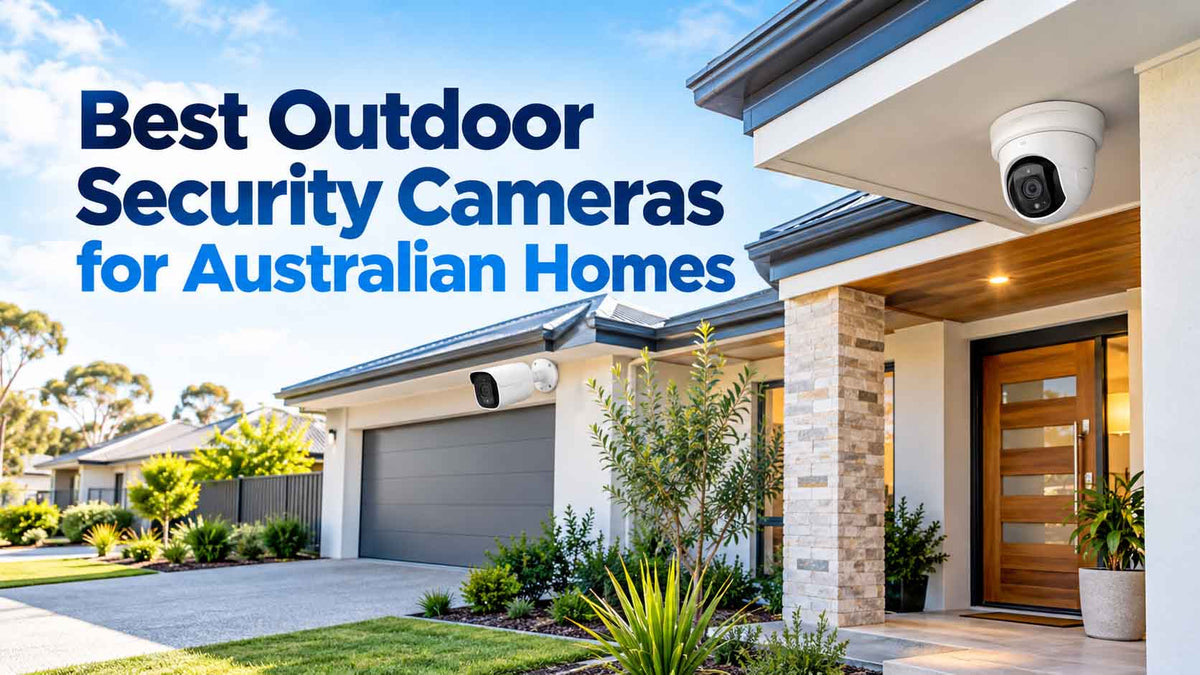
Introduction
Plenty of outdoor security cameras are sold as "weatherproof" and still give up within two summers in Australia. A camera that copes with a mild European climate is a different proposition on a west-facing Adelaide wall at 42 degrees, or under a north-facing Melbourne eave copping sideways rain every winter.
We see the results on the bench: fogged lenses, cracked plastic housings, IR footage turned to mush by spider webs, and cameras mounted so high they record the tops of heads. Most of these failures come down to three decisions made before the camera ever goes up.
This guide covers those three decisions: weatherproofing (what IP66 and IP67 actually mean), night vision (infrared, full colour or hybrid), and placement. Then we match real CCTV kits from our range to the spots around an Australian home where each one works best.
TL;DR
• Weatherproofing: IP66 is the minimum for any exposed outdoor position. Choose IP67 with a metal housing for coastal, tropical or low-mounted cameras, and check the operating temperature reaches 60°C.
• Night vision: Light-assisted full colour (HiLook Hi-Color, Hikvision ColorVu, TP-Link Full-Color) is the best pick for driveways and front entries. Standard infrared still wins on rear boundaries and anywhere a bright light would annoy neighbours. Smart hybrid cameras give you both.
• Resolution: 6MP is the entry point, 8MP is what we recommend for most homes.
• Placement: Mount at 2.4 to 3m with a slight downward tilt. Cover the driveway and front door first, side gates second, rear boundary third.
• Quick pick: The HiLook Pro Hi-Color 6MP kit (from $418) for front-of-house colour footage, or the HiLook Pro Smart Hybrid Light kit (from $336) for mixed positions.
Weatherproofing Outdoor Security Cameras for Australian Conditions
The IP rating is the first number to check, but it only tells half the story. Heat, UV, salt and humidity kill more Australian cameras than rain does.
What IP65, IP66 and IP67 actually mean
The first digit is dust protection and the second is water protection. A 6 for dust means fully dust-tight, which matters in dusty inland towns and on properties next to unsealed roads.
|
Rating |
Water protection |
Where it works on an Australian home |
|
IP65 |
Low-pressure water jets |
Sheltered spots only: deep eaves, carports, verandahs |
|
IP66 |
Powerful water jets, including storm-driven rain |
Minimum for any exposed wall or fascia |
|
IP67 |
Temporary immersion up to 1m |
Coastal, tropical, low-mounted near garden beds or reticulation |
|
IK10 (separate rating) |
Impact resistance, not water |
Cameras mounted within reach, gates, rental properties |
There is plenty of overlap between IP66 and IP67 in practice. The bigger difference between a camera that lasts and one that does not is usually the housing material and the operating temperature range.
Heat is the real test
A camera on a west-facing wall in Perth or Adelaide can sit well above the air temperature by late afternoon. Cheap plastic housings go brittle and yellow under UV, and the seals behind them dry out.
Check the rated operating temperature on the spec sheet. Quality IP cameras are rated to 60°C at the top end; the HiLook IPC-T561H-MU used in the Hi-Color kit below, for example, is rated from -30°C to 60°C with a metal body and cover (manufacturer datasheet). Anything without a published upper limit is a gamble.
Installer tip: where you have a choice, buy the white housing for walls in full sun. Black cameras look sharp on dark render, but they absorb noticeably more heat.
Coastal and tropical properties
IP testing is done with fresh water, so an IP67 badge does not mean salt-proof. On the Gold Coast, the Mornington Peninsula or anywhere within a few kilometres of the surf, choose metal housings, use stainless brackets and screws, and give cameras a fresh-water rinse when you wash the windows.
In Darwin, Cairns and Townsville, humidity is the enemy. Look for a humidity rating of 95% non-condensing and mount under eave cover so the housing is not cycling between direct sun and afternoon storms.
The weak point is usually the cable, not the camera
Most water damage we see starts at the RJ45 joint behind the camera. Terminate the cable inside a matching junction box rather than leaving the plug hanging behind the mount, and leave a drip loop so water runs off before it reaches the connector. A proper camera bracket or junction box costs far less than a replacement camera.
Night Vision Security Cameras: Infrared vs Colour vs Hybrid
A camera spends roughly half its life recording in the dark, and that is when footage is hardest to use, so night performance deserves as much attention as daytime sharpness. There are now three main approaches, and each suits a different part of the property.
|
Night mode |
How it works |
Total darkness |
Colour at night |
Visible light |
Best position |
|
Standard infrared (IR) |
Invisible IR LEDs, footage switches to black and white |
Yes |
No |
Faint red glow only |
Rear boundaries, side passages, next to neighbours' bedrooms |
|
Light-assisted full colour (HiLook Hi-Color, Hikvision ColorVu, Dahua Full-Color, TP-Link Full-Color) |
Wide-aperture lens plus a built-in white light |
Yes, with the light on |
Yes, all night |
Yes, steady white light |
Driveways, front entries, carports |
|
Smart hybrid light |
IR by default, white light switches on when a person or vehicle is detected |
Yes |
Yes, during events |
Only when triggered |
Side gates, backyards, mixed positions |
Infrared: still the quiet achiever
IR works in pitch black and throws no visible light, so it suits rear fences, laneways and spots where a bright light would start an argument with the neighbours. The trade-off is that you lose colour, which matters when you need to describe a car or a jacket to police.
Installer tip: IR LEDs attract insects at night, and insects attract spiders. A web across the lens lights up under IR and triggers endless motion alerts. Wipe the dome every few months, and avoid mounting IR cameras right next to a porch light that draws moths.
Full colour: worth the premium out the front
Older colour night cameras needed a streetlight nearby to produce colour. Current models such as the HiLook Hi-Color and Hikvision ColorVu range pair a large sensor and an F1.0 lens with their own white light, so they record colour even in total darkness.
The catch is that the light is visible. That doubles as a deterrent at the front door, but it can annoy neighbours if the camera faces their windows. It also gives away exactly where the camera is.
Hybrid: the sensible middle ground
Smart hybrid cameras run on IR until the AI detects a person or vehicle, then flick on the white light to capture that moment in colour. You get colour evidence when it counts, without a floodlight burning all night. For most side gates and backyards, this is the option we reach for first.
Resolution and Lens Choice
For outdoor cameras in 2026, 6MP is the entry point and 8MP (4K) is what we recommend for most homes. The extra pixels let you zoom into recorded footage and still make out a face or clothing detail.
Lens size matters just as much. Using the published DORI figures for the 6MP HiLook IPC-T561H-MU as an example:
|
Lens |
Horizontal view |
Identify a face up to |
Best for |
|
2.8mm |
108.8° |
8m |
Front doors, patios, wide yards |
|
4mm |
93.3° |
10m |
Driveways, gates, long side passages |
The takeaway: a wide 2.8mm camera covering a 20m backyard will tell you someone was there, not who. Put it where people pass within about 8m, or choose a 4mm lens for longer runs.
Number plates are a separate job. A wide overview camera will not reliably read plates at any resolution. A dedicated plate camera needs to sit 0.5 to 2m high, within 15 to 20 degrees of head-on, 3 to 8m from where vehicles slow down.
Where to Place Outdoor Security Cameras
Mount outdoor security cameras at 2.4 to 3m. That height is out of easy reach, but low enough to capture faces rather than the tops of caps and hoods.
Priority order for a typical Australian home
1. Driveway and front entry. This is where parcel theft, car break-ins and most visitors happen. Colour footage pays for itself here.
2. Side access and gates. The usual route into the backyard. A hybrid or deterrence camera works well.
3. Rear boundary. Priority rises if the property backs onto a laneway, reserve or creek track. IR is usually the right call.
4. Sheds, garages and boat or caravan parking. Add these once the entry points are covered.
Angle, sun and eaves
• Tilt down slightly. A gentle downward angle captures faces; a level or upward angle captures sky and glare.
• Avoid facing east or west into the horizon. Sunrise and sunset will flare the image at exactly the hours people leave and come home. Wide dynamic range helps, but it cannot fix a lens pointed at the sun.
• Keep the eave clear of the lens. An eave or gutter edge inside the frame bounces IR straight back and washes out the night image. Use an extension bracket if needed.
• Mount under cover where possible. Even an IP67 camera lasts longer out of direct sun and rain.
Respect your neighbours' privacy
Never aim a camera into a neighbour's windows, pool area or private yard. Household cameras are generally covered by state and territory surveillance laws rather than the federal Privacy Act, councils and strata by-laws can add rules, and cameras with audio recording face stricter limits in some states. The OAIC guidance on security cameras is a good starting point. Most cameras in this guide also support privacy masking, so you can black out part of the frame.
Best Outdoor Security Cameras: Kit Picks by Position
These are the outdoor CCTV kits we would match to each part of a typical Australian home. All are PoE systems, so one network cable carries power and video to each camera and footage records locally to the NVR. Prices are starting prices at the time of writing (October 2026) and vary with camera count and storage.
|
Kit |
Resolution |
Night vision |
Weather rating |
Best position |
From |
|
6MP |
Full colour, 30m white light |
IP67, metal body |
Driveway, front entry |
$418 |
|
|
6MP |
IR plus white light on detection |
IP67 |
Side gates, backyards |
$336 |
|
|
8MP |
Dual IR plus smart hybrid light |
IP67 |
Wide backyards, corner blocks |
$369.60 |
|
|
8MP |
Full colour |
IP67 |
Front-of-house on a budget |
$350 |
|
|
6MP |
AI full colour plus active deterrence |
Outdoor rated |
High-risk entry points |
$698 |
|
|
6MP |
Mix of low-light IR and ColorVu |
Outdoor rated |
Larger homes, up to 8 cameras |
$2,280 |
1. HiLook Pro Hi-Color 6MP Kit: best for driveways and front entries
This is the kit we point most homeowners to for the front of the house. Each IPC-T561H-MU camera pairs a 1/1.8" sensor with an F1.0 lens, which gathers far more light than a typical F1.6 CCTV lens, plus a white light that reaches 30m for colour footage in complete darkness.
The weather spec suits harsh sites: metal housing, IP67, and a rated operating range of -30°C to 60°C. AI person and vehicle detection cuts out alerts from swaying trees, and dual microphones record audio alongside video. Choose the 4mm lens for long driveways and the 2.8mm for wide front yards. It comes with 1 to 4 cameras on a 4-channel PoE NVR, in white or black.
Watch for: the white light is always visible at night, so angle it away from neighbouring windows.
2. HiLook Pro Smart Hybrid Light 6MP Kit: best all-rounder for mixed positions
The IPC-T363H-MU runs infrared by default, then switches its white light on when it detects a person or vehicle. That makes it the easiest camera to recommend for side gates and backyards near neighbours, where an all-night light would cause friction but you still want colour evidence of an intruder.
It is IP67 rated, has a built-in microphone and supports line crossing and intrusion detection. At $336 for a starter kit, it is also the cheapest way into a proper 6MP PoE system.
3. HiLook 8MP 180° Panoramic Kit: best for wide backyards and corner blocks
One IPC-T289PH-MU/SL covers a full 180°, which can replace two standard cameras on a wide rear fence line or a corner block. It adds dual IR, smart hybrid light, two-way audio and active deterrence, in an IP67 housing.
Keep the earlier lens rule in mind: a panoramic view spreads its 8MP across a very wide scene, so faces need to pass reasonably close. Pair it with a narrower camera at the gate if identification matters.
4. TP-Link VIGI InSight S485 8MP Full-Colour Kit: best budget 8MP colour
If you want 8MP colour footage across the front and sides without stretching the budget, this 4-camera kit with the VIGI NVR1004H-4P recorder is hard to beat at $350, with a hard drive available as an option. The S485 turrets are IP67 rated with smart detection. An 8-camera version with HDD included suits bigger blocks.
5. Dahua 6MP AI TiOC Kit Builder: best for active deterrence
Dahua's TiOC cameras combine a colour night vision camera, a speaker for warnings or a siren, and red and blue flashing lights in one housing. When someone crosses a set line after hours, the camera challenges them on the spot rather than just recording. This suits homes that have already had an incident, or properties left empty for long stretches. Browse more options in our active deterrent cameras range.
6. Hikvision 6MP DarkFighter / ColorVu Custom Kit: best premium system
For larger homes that need up to 8 cameras, this kit lets you mix DarkFighter cameras (strong low-light IR performance) for boundaries with ColorVu cameras for the front, all on one 8-channel PoE NVR. It is the most flexible setup here and the one we would choose where IR and colour positions are split roughly evenly.
What about solar and Wi-Fi cameras?
They have a place where running cable is impractical: a farm gate, a detached shed or a rental where you cannot drill. Many are only IP65 rated, though, so treat them as sheltered-position cameras and mount them under an eave or carport roof. Our solar-powered camera range covers these. For main entry points, a wired PoE camera is still more reliable.
Common Outdoor Camera Mistakes We See
• Mounting too high. Cameras on second-storey eaves record roofs and hats. Drop to 2.4 to 3m wherever a ladder can reach.
• Buying for daytime only. Check sample night footage before you buy. Daytime images all look good on the box.
• Leaving the RJ45 plug exposed. Use a junction box and a drip loop every time.
• Pointing IR cameras past an eave or wall edge. The reflection blinds the camera at night.
• Too little storage. Plan for at least two to three weeks of footage. Incidents are often noticed days later, by which time a small drive has already recorded over them.
• No backup power. Put the NVR or PoE switch on a UPS so cameras keep recording through a blackout or a tripped circuit.
Outdoor Security Camera FAQs
What IP rating do outdoor security cameras need in Australia?
IP66 is the minimum for any exposed outdoor position. Choose IP67 for coastal and tropical properties or cameras mounted low near garden beds. IP65 cameras should only go in sheltered spots like deep eaves and carports.
What is the difference between IP66 and IP67?
IP66 withstands powerful water jets, including storm-driven rain. IP67 also survives temporary immersion up to 1m. Both are fully dust-tight. In practice, housing material and operating temperature matter as much as the second digit.
Does colour night vision work in complete darkness?
Yes, if the camera has a built-in white light. HiLook Hi-Color, Hikvision ColorVu and similar cameras switch on their own light to record colour in total darkness. Cameras without a light need some ambient light, such as a streetlight, to stay in colour.
How high should I mount an outdoor security camera?
Around 2.4 to 3m with a slight downward tilt. That keeps the camera out of easy reach while still capturing faces. Higher mounts tend to record the tops of heads.
Can Australian heat damage security cameras?
Yes. Direct afternoon sun on north and west walls can push housings past their limits, and cheap plastic degrades under UV. Choose a camera rated to 60°C, prefer a white housing in full sun, and mount under eave cover where you can.
Is 4MP enough for an outdoor security camera?
We now recommend 6MP as the minimum and 8MP for most homes. Higher resolution gives you usable detail when zooming into recorded footage, which is where 4MP often falls short.
The Bottom Line
The best outdoor security cameras for Australian homes are the ones matched to the spot they protect. Go IP67 and metal where the weather is harsh, full colour out the front, IR or hybrid along the boundaries, and mount everything at 2.4 to 3m with a slight downward tilt.
For most homes, a 6MP HiLook Hi-Color kit at the front plus hybrid cameras down the sides covers the essentials without overspending. If you are still weighing up a full system, our guide to the best home security camera systems in Australia covers the bigger picture.
Ready to choose? Compare our HiLook Hi-Color outdoor CCTV kit, or call our team on 0400 391 455 for help planning camera positions around your property.


