
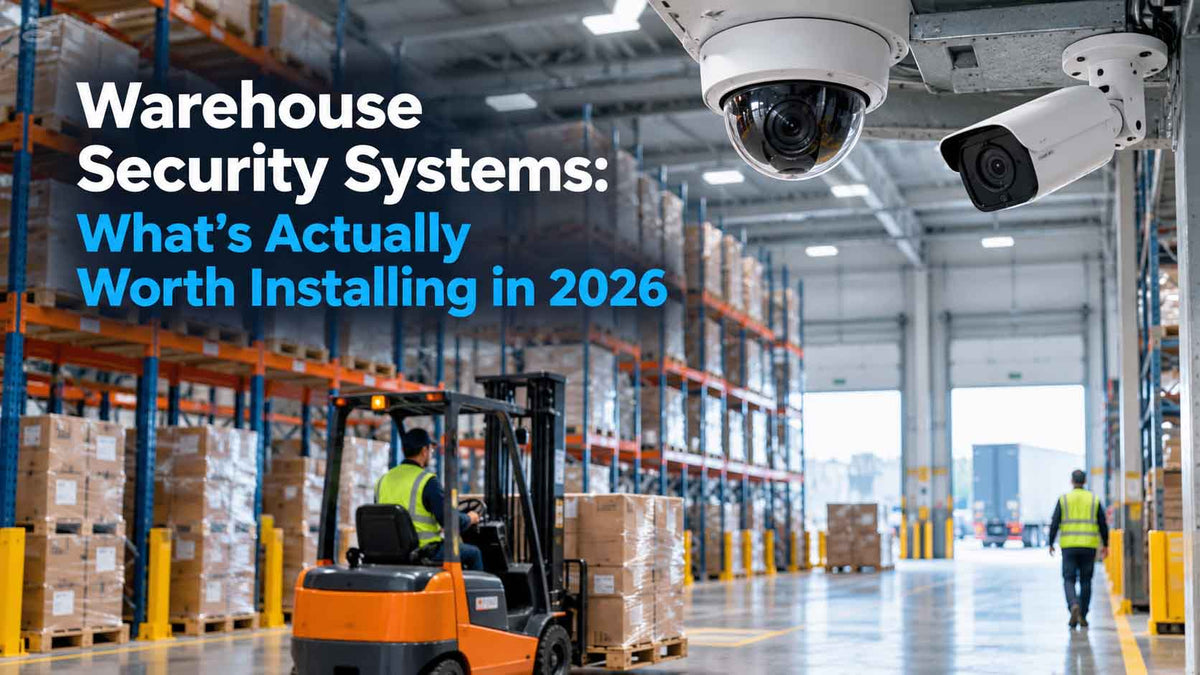
Warehouse security has changed shape. Cargo theft is more organised, forklift and pedestrian incidents carry heavier liability exposure, and AI analytics that were a premium add-on a few years ago are now standard on mid-range cameras. The real 2026 question is not whether to install cameras, but which camera type, how much storage, and whether to monitor in-house or outsource.
Whether you run a distribution centre in western Sydney, a cold storage facility in Dandenong South or a freight yard near the Port of Brisbane, the fundamentals are the same: secure the perimeter, watch the docks, and keep footage long enough for investigations that rarely start the same day.
|
TL;DR: Perimeter and loading dock coverage stays the top priority, but the decisions worth getting right in 2026 are storage duration (60+ days for cargo theft investigations), camera type by zone (fixed bullet for perimeter, PTZ as a supplement for open yards, not a replacement), and which AI analytics actually earn their cost. Use 8MP cameras on docks and gates, and put the NVR, switches and router on a UPS. |
Camera Type by Zone
Perimeter fencing. Fixed, high-resolution bullet cameras with strong IR or colour night vision, set up with line-crossing and intrusion detection. Run them along fence lines rather than across them to cover more distance per camera.
Loading docks. Perimeter and loading docks need fixed, high-resolution cameras, since footage needs to hold up weeks later. Cover each dock door from inside, so you see pallets going in and out, plus one external camera covering trucks at the dock.
Gates and vehicle entries. A dedicated number plate camera at the gatehouse logs every vehicle in and out. Remember that wide overview cameras cannot reliably read plates, so plate cameras need their own mounting: low, near head-on, and close to where vehicles slow.
Open yards. A PTZ camera suits large open yards but only looks one way at a time, so it supplements fixed cameras rather than replacing them. Newer PTZs with auto-tracking can follow a person or vehicle automatically after an alarm.
Internal aisles and racking. Usually well served by fixed cameras at aisle ends covering main thoroughfares. High racking creates long, narrow sightlines, so a varifocal lens set to the aisle length gives much better detail than a wide 2.8mm lens.
Storage Sized to How Theft Is Actually Discovered
Cargo theft and stock discrepancies are rarely noticed same-day. Investigation timelines routinely stretch weeks, and 14-day retention has already been recorded over the footage an investigator needs. Sixty days is the realistic minimum.
To give you a feel for the numbers, here is a rough guide for continuous recording with H.265 compression:
|
Cameras |
Resolution |
Approx. storage per day |
Approx. storage for 60 days |
|---|---|---|---|
|
8 |
8MP |
~345GB |
~21TB |
|
16 |
8MP |
~690GB |
~41TB |
|
16 |
6MP |
~520GB |
~31TB |
These are estimates based on around 4Mbps per 8MP camera and 3Mbps per 6MP camera. Recording on motion or smart events can cut the total dramatically in quiet areas, so many warehouses record continuously on docks and gates and on events elsewhere.
Monitoring Model
Sites with 24/7 on-site staff can rely on next-day footage review. Sites with reduced overnight staffing benefit from a monitored alarm response tied to perimeter-breach alerts, so a real person can respond in real time.
Pairing your cameras with a professional alarm kit lets perimeter and building intrusions trigger a monitored response, while the cameras provide the visual verification that stops guards being sent out for a possum on the fence.
AI Analytics: Worth It vs Not
Worth paying for: line-crossing and intrusion detection on perimeter fencing, and vehicle/person filtering that cuts false alarms from wind, rain or animals. Smart search that finds every forklift or person that entered a zone over a date range is a major time saver for investigations.
Usually not worth it: facial recognition across the whole site, and retail-style foot traffic dashboards that do not apply to warehouse operating patterns.
Safety Coverage, Not Just Security
Camera systems increasingly do double duty as safety infrastructure. Coverage of forklift thoroughfares and pedestrian crossings gives usable footage after a near-miss, useful for WorkSafe reporting and internal review, worth specifying upfront rather than treating as an afterthought.
Network and Power for Large Sites
Large warehouses often have cable runs longer than the 100m Ethernet limit. Plan for fibre links or network extenders between buildings, and outdoor wireless bridges for gatehouses or remote yard poles where trenching cable is not practical. The networking range covers switches, bridges and access points for multi-building sites. Put the NVR, core switches and router on a UPS so a storm-related outage does not leave a gap in recording at exactly the moment someone is testing your fence.
What's Genuinely Different for 2026
AI analytics that used to be a premium tier are now standard on most mid-range commercial cameras, so there is less reason to pay extra for a "smart" tier. Storage costs have dropped enough that 60+ days is a realistic default, not a premium reserved for high-security sites. 8MP has become the standard recommendation for docks and gates, with 6MP as the entry point for general coverage.
FAQ
How much storage does a warehouse actually need?
60 days minimum for most sites, since theft is often discovered weeks later.
Is a PTZ camera better than fixed for a warehouse yard?
Not on its own; it works best supplementing fixed perimeter cameras.
Should we monitor ourselves or use a monitoring service?
Depends on overnight staffing; reduced overnight coverage benefits from a monitored perimeter-breach response.
What resolution should warehouse cameras be?
8MP is recommended for docks, gates and anywhere you need identification. 6MP is fine for general aisle coverage.
Can CCTV help with WorkSafe compliance?
Yes. Footage of forklift and pedestrian areas helps investigate near-misses and incidents, and supports safety reviews.
Secure Your Warehouse Properly
Browse PoE cameras for perimeter and loading dock coverage, PTZ cameras for open yards, and alarm kits for perimeter breach alerting.


