
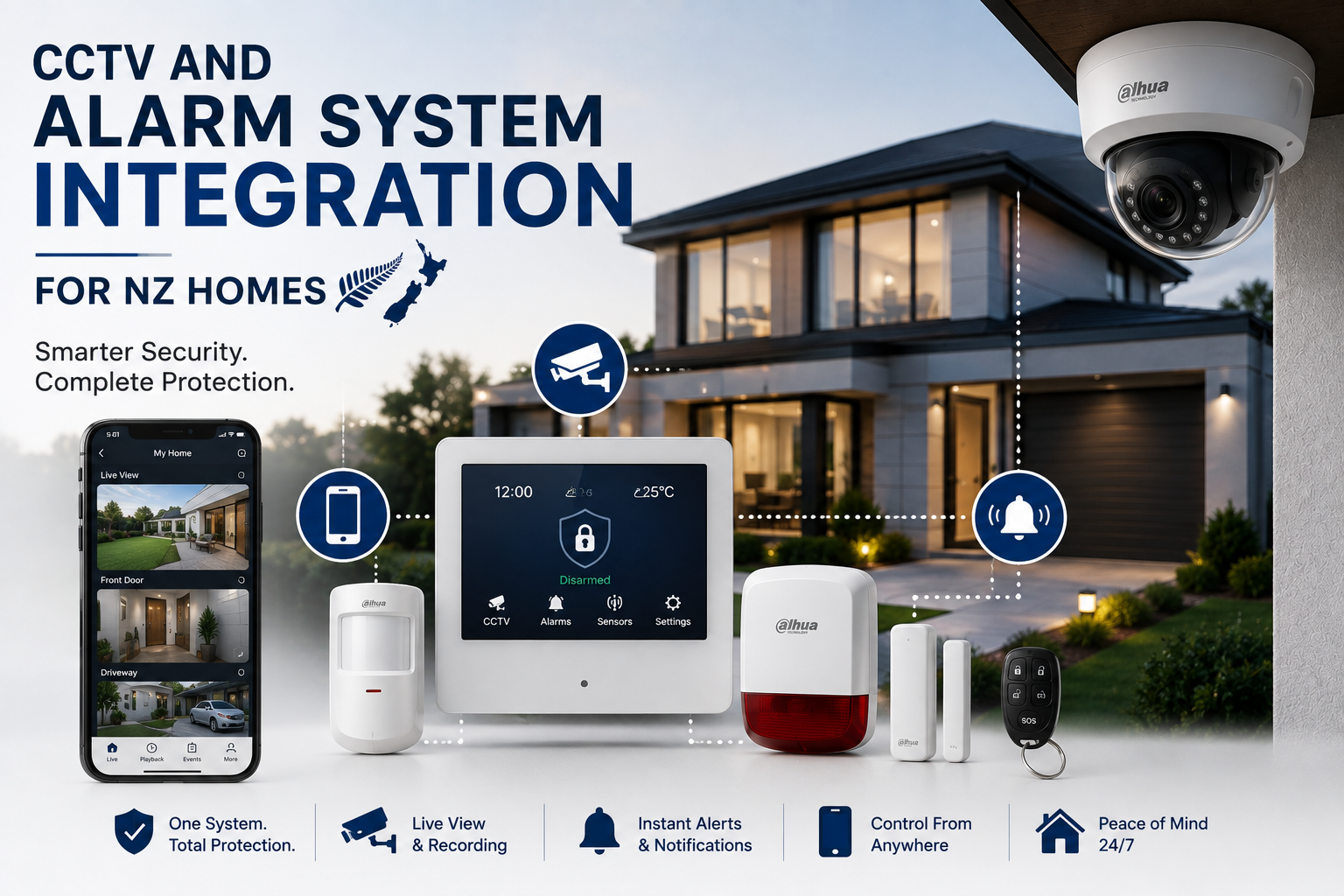
Most New Zealand homeowners buy a camera system, then an alarm, then wonder why the two don't talk to each other. It's a reasonable assumption. In practice, integration depends entirely on which brands you pick and how the install is done, and getting it wrong usually means paying twice.
TL;DR
CCTV and alarm systems in New Zealand homes can operate separately, share event triggers, or connect through a single integrated platform. For most homeowners, the key decision is whether they need basic alarm-triggered camera recording or full control through one app. Check the NVR’s alarm inputs and compatibility before purchasing either system. Also consider your property layout, outdoor weather exposure, sensor battery maintenance and local privacy requirements. Choosing compatible equipment from the beginning prevents duplicate costs and creates a more effective home security setup.
What "integration" actually means
A camera system and an alarm can work in three different ways together, and it's worth knowing which one you're getting before you buy anything.
The simplest is no integration at all: two separate systems, two separate apps, two separate keypads. This is common when a homeowner buys a CCTV kit online and an alarm from a different supplier months later. It still works, it's just more to manage.
The middle option is event-triggered recording, where the alarm sensor tells the NVR to start recording or bump up frame rate the moment a zone is tripped. A downstairs window sensor triggers, and the nearest camera immediately kicks into a higher recording mode. This is genuinely useful and doesn't require the two systems to share a brand, just a compatible input on the NVR or a shared platform.
The tightest integration is a single hub controlling both, with cameras, sensors, sirens and door/window contacts all reporting to one app and one set of automations. Ajax does this well, and Dahua and Hikvision both offer alarm hardware designed to sit inside their own NVR ecosystem.
Why this matters more in New Zealand than it might seem
New Zealand's building stock skews toward standalone houses with more perimeter to cover than a typical UK or European home, and a lot of properties still have older wiring that wasn't planned around a network cabinet. That makes the choice between wired and wireless alarm sensors more consequential here than in a new-build suburb. Wireless alarm sensors avoid the retrofit cabling problem entirely, at the cost of battery changes every year or two.
Weather is the other local factor. Coastal properties in places like Wellington or Tauranga see more corrosion on outdoor housings than inland Auckland suburbs, so outdoor sirens and door contacts need a genuinely weatherproof rating, not just a "suitable for outdoor use" label on the box.
Choosing hardware that will actually integrate
If you want the tighter integration rather than just two systems running side by side, the practical rule is to check the NVR's alarm input/output spec before buying either the camera kit or the alarm separately. Most PoE NVR kits, including the systems in CCTV Importers' NVR range, include basic alarm I/O ports that accept a third-party sensor trigger, which covers the event-triggered middle tier without locking you into one brand.
For the single-hub approach, you're generally choosing an alarm ecosystem first and treating cameras as an add-on, or vice versa. Ajax's kits, including the options in the Ajax alarm range, are built around this model and pair well with a separate camera system rather than trying to be the camera system themselves.
Shop Alarm Kits for CCTV Integration
Strengthen your security setup with alarm kits that work alongside CCTV cameras, sensors, alerts, and smart security systems for better home and business protection.
View Alarm KitsCommon mistakes
Buying the alarm and the cameras from two different ecosystems, then expecting the installer to make them "talk." Some integration is always possible at the recording-trigger level, but full app-level integration only happens within a single ecosystem or through a hub designed to bridge them.
Skipping the door/window contacts because cameras "cover it anyway." A camera confirms what happened after the fact. A contact sensor plus siren is what actually interrupts an intruder while they're still outside.
Underestimating battery maintenance on wireless sensors. A flat battery on a single window sensor quietly disables that zone, and most people don't find out until after an incident, not before.
A realistic starting point
For a typical three-bedroom NZ home, a sensible starting setup is a 4-6 camera PoE kit covering the driveway, front door and back access points, paired with door/window contacts on ground-floor entry points and a siren visible from the street. Visible deterrence, especially a clearly marked camera and siren, does more to prevent an attempted break-in than either system does on its own after the fact.
Requirements around recording audio, camera placement near neighbouring properties, and alarm monitoring contracts vary by council and by insurer, so it's worth checking with your local council or a licensed security installer before finalising anything involving audio recording or professional monitoring.
Browse CCTV kits if you're starting from the camera side, or the alarm kits collection if the alarm is the priority. Either way, check the NVR's alarm I/O spec before you commit to the second half of the system.
8. Conclusion
Integration between CCTV and alarm systems in an NZ home comes down to one decision made early: whether you want event-triggered recording (works across most brands) or single-hub control (means picking an ecosystem and sticking with it). Get that decision right before buying either system, and the rest is mostly about matching hardware to your property's layout and weather exposure.


