
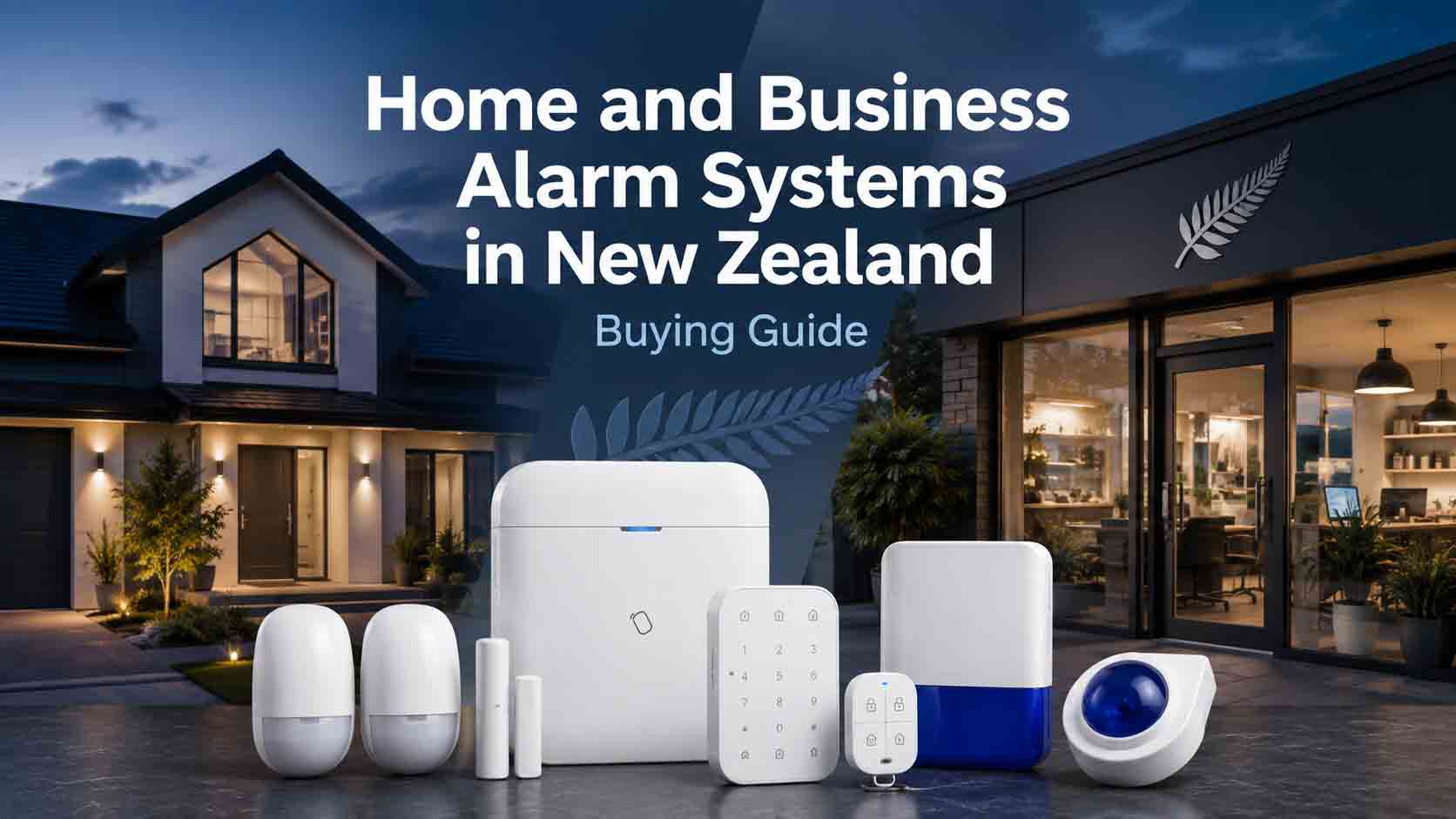
Choosing an alarm system in New Zealand starts with the property, not the brand. A small apartment may need only door protection, indoor motion detection and mobile alerts. A warehouse, clinic or multi-tenancy office may require multiple areas, user permissions, after-hours monitoring and integration with CCTV or access control.
The best alarm system is one that detects the risks relevant to your property, communicates reliably and remains easy enough for everyone to use correctly.
This guide explains the differences between wired, wireless and hybrid systems, the components you may need, and the questions to ask before buying an alarm for a New Zealand home or business.
The short answer
For most existing homes, apartments and small premises, a wireless alarm offers straightforward installation and flexible expansion. Wired alarms remain a strong choice for new builds, renovations and larger sites where cable can be installed properly. Hybrid systems combine both approaches and are particularly useful when upgrading an existing wired alarm.
A practical alarm system usually includes:
A control panel or wireless hub
Door and window contacts
Motion detectors
An internal siren
An external siren or siren with strobe
A keypad, remote or mobile app
Battery backup
Internet, cellular or monitoring connectivity
Cameras, smoke detectors, flood sensors, panic buttons and access control can be added when the use case justifies them.
Start with the risks you actually need to detect
Alarm systems work best when they are designed around likely entry routes and normal property use. Installing more sensors does not automatically produce better protection. Poor placement can create blind spots, nuisance alarms or a system that occupants stop using.
Before comparing products, identify:
-
The main doors and accessible windows
-
Garages, sheds and detached buildings
-
Rooms containing valuable equipment or stock
-
Areas occupied by pets
-
Sections that need to remain armed while other areas are occupied
-
Internet and cellular coverage at the property
-
Who needs permission to arm or disarm the system
-
What should happen after an alarm is triggered
A two-bedroom home in Christchurch will have different requirements from an Auckland retail store with several employees and a rear delivery entrance. The home may need perimeter contacts and pet-aware motion detection. The shop may need individual user codes, opening and closing reports, a panic button and separate protection for its storeroom.
Wired, wireless or hybrid alarm system?
Wired alarm systems
A wired alarm connects detectors, keypads and sirens to a central control panel using cable. It is generally suited to new construction, major renovations and properties with accessible roof or wall cavities.
Its main advantages are dependable device communication and less routine battery replacement. Wired devices are also practical when numerous sensors must operate across one permanent site.
Installation can be more disruptive in a finished building. Adding a detector later may require new cable runs, and poor-quality existing wiring can complicate an upgrade.
CCTV Importers carries Bosch alarm kits, including systems from the Solution 2000, 3000, 4000 and 6000 ranges. The capabilities vary between models, so buyers should confirm zone capacity, communications modules and included accessories rather than choosing on the series name alone.
Wireless alarm systems
Wireless detectors communicate with a hub by radio. This reduces the need to run cables through finished walls and makes the system easier to expand or relocate.
Wireless alarms are commonly suitable for:
-
Existing homes
-
Apartments
-
Rental properties, subject to owner approval
-
Small offices and shops
-
Heritage buildings where cabling would be difficult
-
Sites that may need additional sensors later
The trade-offs include battery maintenance, radio-range limitations and possible signal obstruction caused by reinforced walls, metal structures or the distance between buildings. A wireless system should use supervised communication, device tamper detection and alerts for low batteries or lost connections.
The Ajax alarm kits available from CCTV Importers provide wireless system options with hubs, motion detectors, remotes and sirens. Kit contents differ, and some versions include photo-verification devices, so compare the exact component list before ordering.
Hybrid alarm systems
A hybrid alarm can use both wired and wireless devices. It is often the most practical answer when a property already has usable wired sensors but needs wireless detectors, mobile control or additional zones.
Hybrid systems can also suit larger homes and businesses where wired detectors cover the main building while wireless devices protect an extension, garage or difficult-to-cable area.
For example, the Paradox alarm range includes expandable and hybrid system components. Compatibility still needs to be checked at model level because detectors, receivers, keypads and communications modules are not universally interchangeable.
|
System type |
Commonly suited to |
Main benefit |
Main consideration |
|
Wired |
New builds, renovations and permanent commercial sites |
Stable device connection |
More cabling and installation work |
|
Wireless |
Existing homes, apartments and small premises |
Faster, less disruptive installation |
Battery and radio-range management |
|
Hybrid |
Alarm upgrades and expandable properties |
Reuses wiring while allowing wireless additions |
Compatibility and programming complexity |
The components that make an alarm effective
Door and window contacts
A contact detects when a protected door or window opens. Perimeter contacts can trigger an alarm before someone moves further into the building.
Prioritise frequently used external doors, concealed side entrances and accessible windows. It may not be necessary to place a contact on every upstairs window if it cannot reasonably be reached.
PIR motion detectors
A passive infrared detector, usually called a PIR, responds to changes in heat moving through its detection area. Placement matters. A detector aimed towards direct sunlight, heating equipment or an unstable heat source may be more prone to unwanted activations.
Homes with animals should consider pet-aware detectors, but “pet immune” does not mean every animal can be ignored in every room. Pet size, furniture height, detector position and movement patterns still affect performance.
Dual-technology detectors
Dual-technology detectors commonly use PIR and microwave detection together. They can be useful in more demanding environments, but they are not a substitute for correct installation.
Warehouses, workshops and spaces with changing temperatures may benefit from a detector selected specifically for those conditions.
Sirens and strobes
An internal siren alerts occupants and creates pressure on an intruder. An external siren or siren-strobe can draw attention outside the property.
Check whether the kit includes its sirens, enclosure, backup battery and power supply. Some products are sold as panels or partial kits, and the missing parts can materially affect the final cost.
CCTV Importers also stocks separate alarm parts and accessories for compatible system expansion or replacement.
Panic and duress controls
A panic button allows someone to trigger an alarm deliberately. It may be appropriate at a retail counter, reception desk, medical practice or another workplace where staff could face a threatening situation.
A duress code can appear to disarm a system while quietly sending an alert, provided the panel and reporting arrangement support that function. These features need a clear response plan. An alert has limited value if nobody knows how it will be handled.
Environmental sensors
Some alarm platforms can also support:
-
Smoke or heat detectors
-
Water-leak sensors
-
Temperature monitoring
-
Glass-break detectors
-
Vibration or shock sensors
-
Outdoor motion detection
Life-safety devices require particular care. Do not assume that any wireless smoke detector replaces equipment required by New Zealand building or fire-safety rules. Check applicable requirements and use appropriately qualified professionals.
Self-monitoring or professional monitoring?
A self-monitored alarm sends alerts to the owner or other nominated users, usually through an app. It avoids a monitoring subscription and can work well when someone is consistently available to check alerts.
Its weakness is human availability. A mobile notification can be missed while the phone is silent, out of coverage or with someone who cannot respond.
Professional monitoring sends alarm events to a monitoring centre, where operators follow an agreed response procedure. Depending on the service, that may involve contacting keyholders, arranging a patrol or escalating a verified emergency.
New Zealand Police advises residents to consider a monitored security alarm and recommends servicing alarms regularly to reduce false activations. See the Police guidance on personal safety and rural crime prevention.
Before entering a monitoring agreement, ask:
-
Which communication path reports the alarm?
-
Is cellular backup included?
-
What happens if broadband or mains power fails?
-
Who are the nominated keyholders?
-
Are patrol call-outs charged separately?
-
Is the equipment locked to one monitoring provider?
-
What contract term and cancellation conditions apply?
-
Can the monitoring centre distinguish burglary, panic and environmental events?
Internet, cellular backup and power failure
A smart alarm should not become useless because the router has lost power.
Check the complete communication path. A system may use Ethernet or Wi-Fi for normal app access but cellular communication as a backup. Confirm whether a SIM, data plan, communications module or subscription is required.
The control panel should also have suitable battery backup. Ask how long the panel can operate during a power cut and whether connected devices, network equipment and external communicators remain functional.
For rural New Zealand properties, test cellular coverage at the actual panel location. Coverage shown on a provider’s general map does not guarantee a strong indoor signal inside a metal shed or remote building.
Shop Alarm Kits by Brand
Compare trusted alarm kits for CCTV and alarm system integration, including wired, wireless, smart, and business-ready security solutions.
What businesses should look for beyond basic detection
A business alarm often needs more than a few PIR detectors and a shared PIN.
Separate areas and schedules
Partitioning allows different parts of a property to be armed independently. A warehouse can remain protected while cleaners use the office, or a storeroom can be armed while the retail floor is open.
Individual user credentials
Each authorised person should have an individual code, tag or app identity. Shared codes make it difficult to determine who armed or disarmed the property.
Look for event logs that show the user, action and time. Remove access promptly when an employee or contractor no longer requires it.
Opening and closing reports
Selected systems or monitoring services can report late openings, early disarming or a failure to arm at closing time. This can be useful for retail stores, clinics and multi-site businesses.
Integration with CCTV and access control
An alarm tells you that a sensor has triggered. CCTV provides visual context, while access control records authorised entry. Used together, these systems can produce a clearer account of an event.
Integration can range from viewing alarms and cameras in separate apps to automated video verification or relay-based actions. Compatibility should be confirmed before purchase. Products from the same brand do not necessarily integrate unless the required models, firmware and licences support the intended function.
Businesses planning a layered system can compare access control products alongside the main alarm kit collection.
Alarm and CCTV integration: useful, but not automatic
Adding cameras can help determine whether an alarm was caused by an intruder, an animal or an authorised person who entered incorrectly. Cameras may also provide recorded evidence after an event.
However, an alarm system and CCTV recorder do not automatically communicate because they are connected to the same network. Integration may require:
-
Compatible alarm and camera platforms
-
Physical alarm inputs or outputs
-
Supported software integration
-
Correct event programming
-
A shared mobile application
-
Monitoring-centre support
-
Suitable user permissions
Decide what you want the integration to do. Examples include opening a camera view when a sensor activates, bookmarking recorded footage, triggering camera recording or providing photo verification through an alarm detector.
Privacy considerations for New Zealand properties
Alarm sensors generally collect less personal information than cameras, but a combined alarm and CCTV system can raise privacy obligations.
For businesses and organisations, the New Zealand Office of the Privacy Commissioner states that personal information should be collected only when it is necessary for a purpose connected with the organisation’s activities. Before installing cameras, determine:
-
Why recording is necessary
-
Which areas will be recorded
-
Whether audio is genuinely required
-
How people will be informed
-
Who can view footage
-
How long recordings will be retained
-
How footage will be secured
-
How access requests will be handled
The Office of the Privacy Commissioner provides detailed privacy and CCTV guidance. Requirements and responsibilities can vary according to the site and intended use, so obtain professional or legal advice where necessary.
Home users should avoid directing cameras into areas where neighbours reasonably expect privacy. Clear signage and careful camera positioning can prevent disputes.
Common buying mistakes
Choosing a kit by detector count alone
Three detectors placed well may protect a small home effectively. The same number could leave a large or divided property exposed. Begin with a floor plan and identify entry routes before counting devices.
Assuming every required component is included
Some kits exclude a siren, backup battery, enclosure, power supply, communications module or keypad. Read the full contents list and check what is required for app access.
Depending entirely on Wi-Fi
Wi-Fi is only one part of the communication chain. Consider backup power, Ethernet and cellular reporting where continuity matters.
Mixing products without confirming compatibility
Wireless sensors usually use brand-specific protocols. A detector from one platform will not ordinarily pair with another brand’s hub simply because both are wireless.
Ignoring daily usability
Complicated arming procedures encourage mistakes. Select controls that suit the occupants, such as a keypad, tag, remote or well-designed app, and configure entry delays carefully.
Forgetting maintenance
Test the system routinely, replace batteries when indicated, confirm that all users still receive notifications and update the keyholder list. New Zealand Police specifically advises regular servicing to help prevent false alarms.
Alarm-system buying checklist
Before ordering, confirm:
-
Which doors, windows, rooms and external buildings need protection?
-
Is wired, wireless or hybrid equipment practical for the property?
-
Are pets present, and are the proposed detectors suitable?
-
How many zones, partitions and users are required now and later?
-
What sirens, batteries, power supplies and keypads are included?
-
Does mobile access require an additional module or subscription?
-
Will the system be self-monitored or professionally monitored?
-
Is cellular backup needed?
-
Can the platform integrate with the intended CCTV or access-control equipment?
-
Who will install, configure, test and maintain it?
-
Are New Zealand shipping costs, taxes, product support and warranty arrangements clear?
-
Do local privacy, tenancy, electrical, building or industry requirements apply?
Choosing an alarm system for your New Zealand property
The right alarm systems in New Zealand are designed around the building, its occupants and the response expected after activation. Wireless systems suit many established homes and small premises. Wired systems remain practical for permanent installations, while hybrid panels offer a sensible path for upgrades and expanding sites.
Map the risks first, then compare communication methods, detector types, user capacity, backup power and compatibility. For a starting point, browse the home and business alarm kits available from CCTV Importers and confirm the exact kit contents before selecting a system.
Frequently asked questions
What is the best alarm system for a New Zealand home?
There is no single best model for every home. A typical existing house may suit a wireless system with door contacts, pet-appropriate PIR detectors, sirens, battery backup and mobile alerts. New builds and extensively renovated homes may benefit from wired or hybrid systems.
Can I install a home alarm myself in New Zealand?
Some wireless systems are designed for straightforward setup, but correct detector placement, communications configuration and testing still matter. Use an appropriately qualified professional where fixed electrical work, complex cabling, monitoring integration or regulated work is involved. Tenants should obtain any required permission before altering a rental property.
Do wireless alarms still work if the internet goes down?
Local detection and sirens may continue operating, depending on the system, but app alerts can be interrupted if the hub has no alternative communication path. A compatible cellular backup connection can provide additional resilience. Confirm how the specific hub behaves during internet and power outages.
Is professional alarm monitoring necessary?
It is not mandatory for every property. Self-monitoring may suit lower-risk premises when reliable contacts can respond to notifications. Professional monitoring is more appropriate when alerts must be handled continuously, mobile notifications may be missed or a formal response procedure is required.
Can an alarm system connect to existing CCTV cameras?
Sometimes, but compatibility is not automatic. Integration may require matching platforms, alarm inputs and outputs, supported software or a monitoring service. Confirm the intended actions and compatible model numbers before buying either system.
How often should an alarm system be serviced?
Follow the manufacturer’s maintenance instructions and test the system regularly. Arrange service if detectors, sirens, backup batteries or communications are not operating correctly. New Zealand Police advises regular alarm servicing to reduce false activations.


