
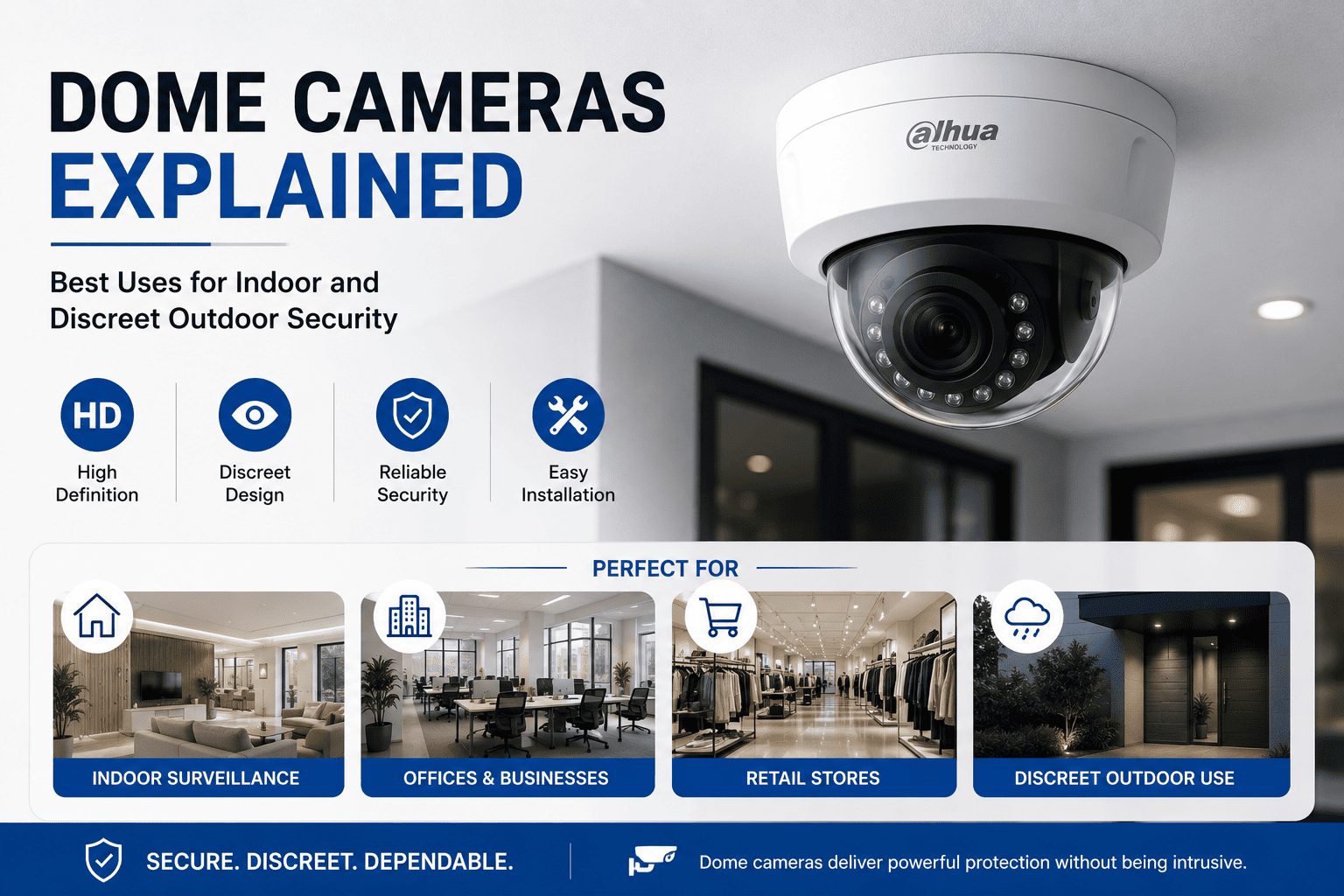
A retail shop wanting ceiling cameras that do not feel intimidating to customers, an apartment lobby needing coverage that blends into the architecture, or a servo forecourt that needs something tough enough to survive a deliberate knock. Dome cameras are the answer to a specific set of problems that a bullet or turret camera does not solve as neatly.
|
TL;DR A dome camera's rounded, low-profile housing makes it discreet and harder to tell which direction it is actually pointing, and vandal-resistant IK10-rated versions are genuinely difficult to damage. It suits ceilings, reception areas, and public-facing sites better than bullet or turret cameras, which are more visible and easier to redirect by hand. |
What makes a dome camera a dome camera
The defining feature is the rounded, low-profile housing that encloses the camera lens inside a dome-shaped cover, usually mounted flush or near-flush to a ceiling or wall. This shape does two things at once. It gives wide-angle coverage suited to open areas, and it hides the exact direction the lens is pointing, since the tinted dome makes it hard to tell from a glance which way the camera inside is actually aimed.
Vandal-resistant dome cameras go a step further, using an IK10-rated impact-resistant housing that can absorb a solid physical knock without the lens cover cracking, which matters a great deal on any site accessible to the public.
Dome vs bullet vs turret at a glance
|
Factor |
Dome |
Bullet |
Turret |
|---|---|---|---|
|
Discretion |
High, direction is hard to read |
Low, clearly visible and directional |
Moderate, compact but still directional |
|
Vandal resistance |
Strong on IK10-rated models |
Moderate |
Moderate |
|
Ease of redirecting angle on install |
Can be fiddly, adjusted inside the dome |
Simple, adjust the visible barrel |
Simple, ball-and-socket adjustment |
|
Typical placement |
Ceilings, reception areas, retail, lobbies |
Long-range outdoor perimeter |
General indoor and outdoor coverage |
|
Weatherproofing |
Good on outdoor-rated models |
Very good, built for exposure |
Good on outdoor-rated models |
If bullet and turret cameras are still the better fit for your job, our turret vs bullet camera comparison covers that decision in more depth.
Where dome cameras genuinely win
-
Retail ceilings, where a visible, obviously directional camera can feel unwelcoming, but coverage still needs to be comprehensive.
-
Reception areas and lobbies, where a discreet, architecturally unobtrusive camera fits the space better than an obvious bullet unit.
-
Apartment corridors and lift lobbies, ceiling-mounted for wide coverage of a shared space.
-
Any site where a would-be tamperer being unable to tell exactly what the camera is pointed at works in your favour.
Shop Dahua Dome Cameras
Explore Dahua dome cameras for indoor areas, entrances, offices, shops, and discreet outdoor security where a compact, low-profile CCTV camera is preferred.
Vandal-proof dome options for public-facing sites
An IK rating measures impact resistance on a scale up to IK10, the highest common rating, which corresponds to withstanding a significant deliberate impact without the housing cracking. This matters for sites with regular public access and higher tamper risk, shopping strips, service stations, and public transport interchanges among them, where a standard housing might not survive an attempted knock or kick.
Indoor vs outdoor dome differences
Indoor dome cameras generally do not need weatherproofing, focusing instead on discretion and wide coverage for a controlled environment. Outdoor domes need a genuine IP66 or IP67 rating, and proper installation with a junction box or conduit run to keep water out of the cable entry point. Condensation venting is worth checking on outdoor models too, since a sealed housing without proper venting can fog up internally after a significant temperature swing, a common issue through an Australian autumn or spring.
Fixed-lens dome vs varifocal dome
A fixed-lens dome camera has a set field of view chosen at the factory, while a varifocal dome allows the zoom to be manually adjusted at install time to frame the shot correctly for that specific location. For a job where the exact mounting distance is not confirmed until the installer is on-site, a varifocal dome gives useful flexibility to tighten or widen the frame without needing a different camera model entirely.
Common mistakes with dome cameras
-
Mounting the camera too low, which makes even a vandal-resistant IK10 dome an easier target simply through proximity.
-
Choosing a heavily tinted dome cover without checking the impact on night vision performance, since a darker dome can reduce infrared effectiveness.
-
Forgetting ceiling cable access on a retrofit install, which can turn a simple dome swap into a bigger job than expected if there is no existing conduit or accessible ceiling void.

Hanwha Wisenet 4 Camera Dome CCTV Kit
Includes 4MP vandal-resistant dome cameras, a 4-channel AI NVR, PoE setup, H.265 recording, and HDD storage.
View ProductBuying guide by setting
|
Setting |
Recommended dome type |
|---|---|
|
Retail shopfront |
Vandal-resistant IK10 dome, ceiling-mounted for wide coverage |
|
Apartment common areas |
Indoor dome with wide-angle lens for corridors and lobbies |
|
Home hallway or porch |
Compact outdoor-rated dome with standard infrared night vision |
Browse Dahua dome cameras and Wisenet dome cameras, or see our full security camera systems range if a dome is one part of a wider setup.
Frequently asked questions
Are dome cameras better than bullet cameras for outdoor use?
Not universally better, just different. Dome cameras suit discretion and public-facing sites, while bullet cameras suit long-range outdoor perimeter coverage where visibility is actually a deterrent.
Can someone tell which direction a dome camera is pointing?
Generally no, which is one of the main advantages of the tinted dome housing. This is precisely why they suit sites wanting coverage without a clearly directional, obvious camera.
Are dome cameras vandal-proof?
Standard domes are not designed for impact resistance, but IK10-rated vandal-resistant dome cameras are specifically built to withstand deliberate physical knocks and are the right choice for public-facing, higher-risk sites.
Do dome cameras have as good night vision as bullet cameras?
Comparable models perform similarly, though a heavily tinted dome cover can reduce infrared effectiveness slightly compared with an equivalent bullet camera, which is worth checking on the specific model before buying.
Is a dome camera a good choice for a shopfront?
Yes, particularly a vandal-resistant IK10-rated model, which balances discreet, customer-friendly styling with genuine durability against tampering.


