
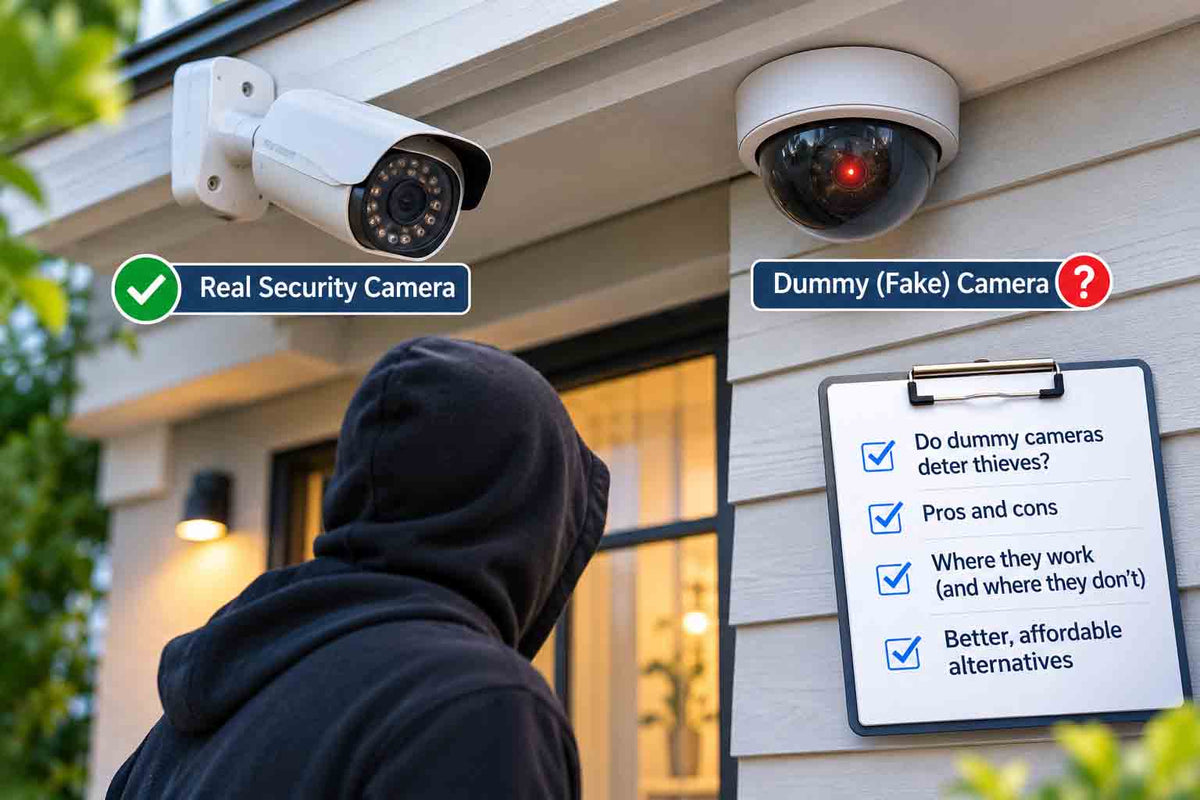
A $15 dummy camera with a blinking red light. It looks like security, costs less than a pizza and takes five minutes to screw on the wall. It's easy to see why fake security cameras sell so well in Australia.
But do they work? We get asked this every week, so here's the honest answer from people who install real systems for a living. Sometimes a fake camera deters a casual opportunist. Against anyone who's done this before, it does nothing. And when something does happen, it gives you nothing at all. This guide explains why, how thieves spot fakes, and what a real camera costs for not much more.
TL;DR
- Fake cameras can deter the most casual opportunists, but experienced thieves spot them quickly.
- They record nothing. No footage for police, insurers or neighbours when something happens.
- Telltale signs: blinking red LEDs, no cable, cheap plastic, odd brand names and wrong mounting positions.
- A real Wi-Fi or entry-level IP camera often costs well under $150 and actually records.
- Best budget approach: one or two real cameras at key points beats five fakes.
Why people buy fake cameras
The logic is simple. Burglars avoid homes that look protected, so a camera that looks real should keep them away. It's cheap, needs no wiring, no app and no subscription. Renters buy them because they can't drill much. Landlords buy them to look like they've done something.
And there's a grain of truth in it. Visible security does influence some offenders. But a deterrent only works if it's believable.
How thieves spot a fake camera
Anyone who has broken into a few houses knows what real CCTV looks like. These are the giveaways:
- A blinking red LED. Real cameras don't flash a red light. Most have no visible LED at all at night.
- No cable. Real wired cameras have a cable or junction box. A camera floating on a wall with nothing going to it is obvious.
- Cheap, light plastic that looks faded and brittle after one Australian summer.
- Silly mounting positions, like pointing at a fence, too low to the ground, or angled at the sky.
- The same camera everywhere, often a dated bullet shape that no installer would use today.
- No signage or matching gear, such as a doorbell camera or alarm siren.
In daylight, a decent look from the footpath is enough. At night, the lack of infrared glow from a real camera gives it away to anyone who knows.
Fake vs real at a glance
| Fake camera | Entry-level real camera | |
|---|---|---|
| Typical cost | $10 to $40 | Around $80 to $200 |
| Records footage | No | Yes |
| Phone alerts | No | Yes |
| Night vision | No | Yes |
| Evidence for police | None | Yes |
| Deters experienced thieves | Rarely | More often, especially with deterrence features |
The real cost of a fake camera
The price of a fake camera isn't $15. It's the cost of the incident it didn't record. When the ute gets broken into, the parcel disappears or the car gets keyed, you have no footage for police, no clip for the insurer and no idea who did it.
Police and organisations like Crime Stoppers rely on usable images to identify offenders. A dummy camera can't help with that. A real one often can.
Affordable real alternatives
You don't need a $2,000 system to get real protection.
A single Wi-Fi camera
For renters or a small unit, one Wi-Fi camera with microSD storage covers the front door and records properly. No drilling beyond a couple of screws. Our TP-Link cameras include good-value options.
An entry-level IP camera
If you'll add more later, start with one or two real IP cameras on a small NVR. HiLook IP cameras, Hikvision's budget brand, are reliable and affordable.
A budget kit
For a whole home, an entry-level kit with four real cameras and a recorder often costs less than people expect. Our guide to cheap CCTV camera systems in Australia covers what you get at each price point, and our clearance range has genuine gear at reduced prices.
When a fake camera might make sense
In fairness, there are a few situations where a dummy does a small job:
- As an extra visual deterrent alongside real cameras, placed where a real camera isn't practical.
- On a temporary site for a few days while a real system is installed.
- In a low-risk spot where you simply want to discourage loitering.
Even then, mix it with real gear and make it believable: no blinking LED, a realistic housing and sensible placement.
Don't forget signage
A "CCTV in operation" sign adds to the deterrent, real or not. For businesses, signage also helps meet privacy expectations around recording. Our guide to CCTV warning signs and the rules in Australia explains where and how to display them.
FAQ
Do fake security cameras work?
They can put off the most casual opportunist, but experienced thieves spot them easily. They also record nothing, so they're no help after an incident.
How can you tell if a security camera is fake?
Look for a blinking red LED, no cable or junction box, cheap plastic, odd placement and no infrared glow at night. Real cameras rarely show visible lights.
Are dummy cameras legal in Australia?
Yes, fake cameras are legal. Just don't point them in ways that would be unlawful for a real camera, such as into a neighbour's bathroom.
What's the cheapest real security camera?
A Wi-Fi camera with microSD storage can cost under $100, and entry-level IP cameras are often under $150. Both actually record.
Is one real camera better than several fake ones?
Yes. One real camera at the front door or driveway records evidence and sends alerts. Several fakes do neither.
The bottom line
Fake cameras are a gamble that only works against the least experienced thieves, and they give you nothing when it counts. A real camera costs a little more and actually protects you. Start with one or two real cameras, then build up. Browse our affordable bullet cameras or ask us for a budget recommendation.


