
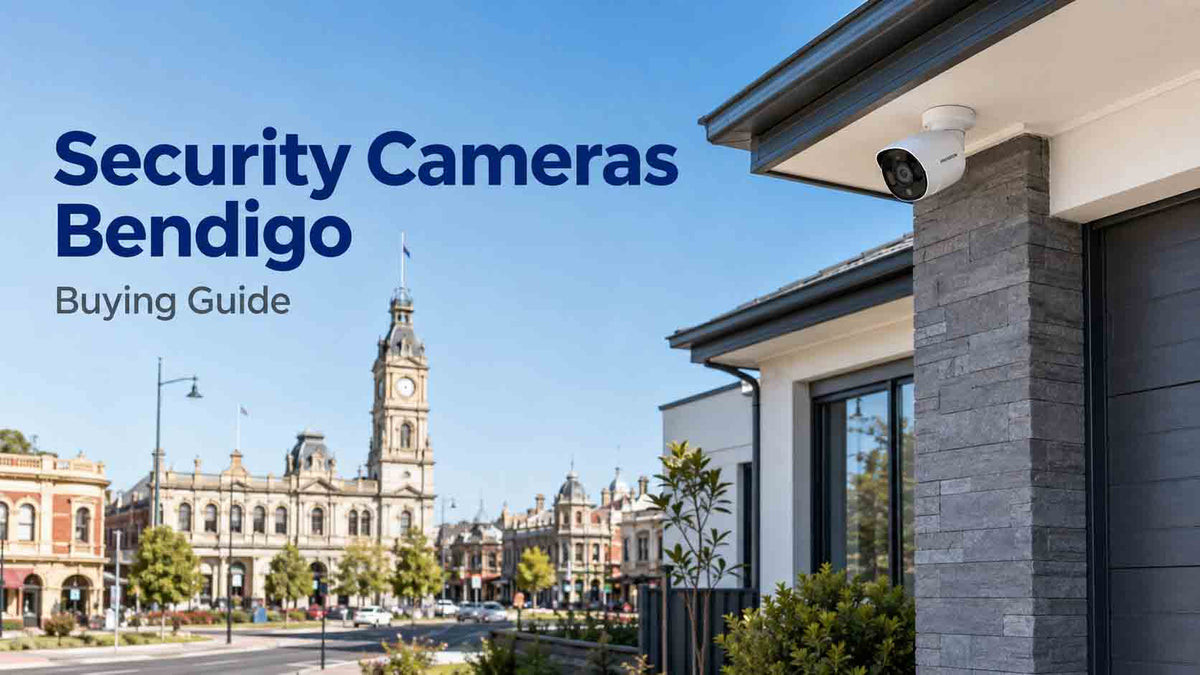
Bendigo's dry summers regularly push past 35 degrees, and its historic streetscapes around View Street and the CBD sit alongside newer estates spreading out towards Strathfieldsaye and Marong. That's a wide spread of property types, and the right camera setup for a heritage terrace isn't the same as what suits a new build on a quarter-acre block.
If you're weighing up security cameras Bendigo locals actually recommend, heat resistance and dust tolerance should be near the top of your checklist, not an afterthought. This guide covers what to look for in a cctv Bendigo system built for the region's climate, where to position cameras on common local property types, and the questions we hear most from Bendigo buyers.
By the end you'll have a clear sense of resolution, wired versus wireless, and storage decisions that actually suit this part of central Victoria.
|
TL;DR
|
Bendigo's Climate and Property Mix
Long, hot, dry summers are the defining feature of Bendigo's climate, and that heat is harder on outdoor electronics than most buyers realise. Cheap camera housings left in direct sun for months at a time can warp slightly or suffer from UV degradation of the plastic casing, which eventually leads to cracking and water ingress even in a low-rainfall climate like this one.
The historic gold-rush architecture around the CBD and inner suburbs like Golden Square and Kangaroo Flat means a lot of properties have heritage-value facades, verandahs, and lace ironwork that owners understandably don't want to damage with clumsy cabling. It's worth planning camera placement around these features from the start rather than working around a mistake later.
Growth areas like Strathfieldsaye, Maiden Gully, and Huntly bring a different profile: larger blocks, longer driveways, and in some cases properties backing onto bushland, which raises different concerns around perimeter monitoring and bushfire-adjacent camera durability.
Matching Resolution to Bendigo Property Types
For a standard suburban home, 8MP is what we recommend as the standard these days, giving you enough clarity to identify faces clearly and hold onto that detail if you need to crop into footage later. 6MP is an acceptable entry-level minimum, but it's no longer the benchmark we point customers towards, this covers the majority of Bendigo's established suburbs without leaving you short on detail when it matters.
Reading number plates is a separate job that a general overview camera, even at 8MP, often can't do reliably, because the plate is a small part of a wide frame. A dedicated 2MP or 4MP plate camera does this properly: mount it low, between 0.5 and 2 metres off the ground, angled close to head-on with the driveway, and positioned 3 to 8 metres from where a vehicle slows down at the entrance. Get the angle or distance wrong and the plate will still be unreadable regardless of the camera's resolution.
Properties on larger blocks in the growth corridors benefit from 8MP cameras, particularly for covering a full driveway length or a wider yard in a single shot rather than needing extra camera positions to fill the gaps.
|
Property Type |
Recommended Resolution |
Key Coverage Areas |
|---|---|---|
|
Heritage CBD terrace |
6-8MP |
Front entry, rear laneway |
|
Standard suburban home |
8MP |
Driveway, front door, backyard |
|
Growth fringe/acreage |
8MP |
Long driveway, perimeter, shed |
|
Retail premises (View St, CBD) |
8MP |
Shopfront entry, till point |
Wired vs Wireless for Bendigo Homes
A lot of Bendigo's older housing stock is solid brick or timber with thick internal walls, which tends to weaken Wi-Fi signal strength the further a camera sits from the router. PoE wired cameras avoid this problem entirely and tend to be the more reliable choice for full-property coverage, especially if you're covering a shed or rear boundary some distance from the house.
Wireless still makes sense for renters or anyone wanting a fast, low-disruption setup, particularly for a single camera covering a front door or parcel delivery area rather than a full property system.
Storage That Suits Local Conditions
Bendigo's power grid is relatively stable compared to storm-prone coastal or tropical regions, so a standard local NVR setup works well for most households without needing elaborate backup power. It also avoids ongoing subscription costs, which suits budget-conscious buyers.
CBD retail businesses along View Street and Hargreaves Mall often benefit from adding cloud backup, since multiple staff may need remote access to footage and a physical break-in could otherwise mean losing both the goods and the recorded evidence if the NVR itself is stolen.
Where to Position Cameras
-
Front entry and verandah, positioned to avoid obstructing heritage features while still capturing face-height footage
-
Driveway, covered by an 8MP camera for the full length plus a dedicated 2MP or 4MP plate camera mounted low near the entrance
-
Rear laneways, a common overlooked entry point on older CBD-adjacent properties
-
Sheds and machinery areas on larger growth-corridor blocks
Shop ANPR Cameras
Explore ANPR cameras for vehicle number plate recognition, car parks, entry gates, driveways, warehouses, and commercial site access monitoring.
View ANPR CamerasCommon Mistakes Bendigo Buyers Make
Choosing a camera based on price alone without checking UV resistance is a frequent issue here. Housings that aren't properly UV-stabilised can degrade faster than expected under Bendigo's intense summer sun, leading to premature failure well before the advertised lifespan.
Another common mistake is neglecting rear laneway coverage on heritage properties. Many older Bendigo homes and shops have rear lane access that's easy to overlook when planning camera positions but is exactly where opportunistic break-ins tend to happen.
Buyers on growth-corridor properties sometimes also underestimate how much driveway or perimeter length they need to cover, ending up with a two-camera kit that leaves large blind spots on a quarter-acre or bigger block.
Frequently Asked Questions
How do I protect cameras from Bendigo's summer heat?
Look for UV-stabilised, well-ventilated housings rated IP66 or higher, and avoid mounting cameras in direct, unshaded north-facing sun where possible to extend their working life.
Can I install cameras on a heritage-listed Bendigo property?
In most cases yes, but check with the City of Greater Bendigo if your property is within a heritage overlay, particularly around visible cabling or mounting on street-facing facades.
How many cameras do I need for a standard Bendigo home?
Four cameras generally covers a standard suburban block: front door, driveway, side access, and backyard. Larger properties on the growth corridor may need five or six for full coverage.
Is wired or wireless better for Bendigo's older homes?
Wired PoE cameras tend to be more reliable in older brick and timber homes, where thick walls can weaken Wi-Fi signal strength at the far end of the property.
What's the biggest security risk for Bendigo CBD businesses?
After-hours break-ins to retail premises along View Street and surrounding lanes are a recurring issue. A combination of entry and till-point cameras with motion alerts, plus an alarm system, is the most effective deterrent.
Do I need a special camera to read number plates?
Yes, a dedicated 2MP or 4MP plate camera mounted low and close to head-on with the driveway, within about 3 to 8 metres of where a vehicle slows down, does this job far better than a wide overview camera regardless of its resolution.
Final Thoughts
Bendigo's heat, dust, and mix of heritage and growth-corridor properties call for cameras built to handle sun exposure and a setup planned around each property's specific layout. Get the housing rating and camera placement right, and your system will hold up through Bendigo summers rather than degrading after a season or two.
Browse our full range of security camera systems, compare PoE camera options for reliable wired coverage, or check out CCTV accessories for mounts and cabling suited to heritage properties.


