
|
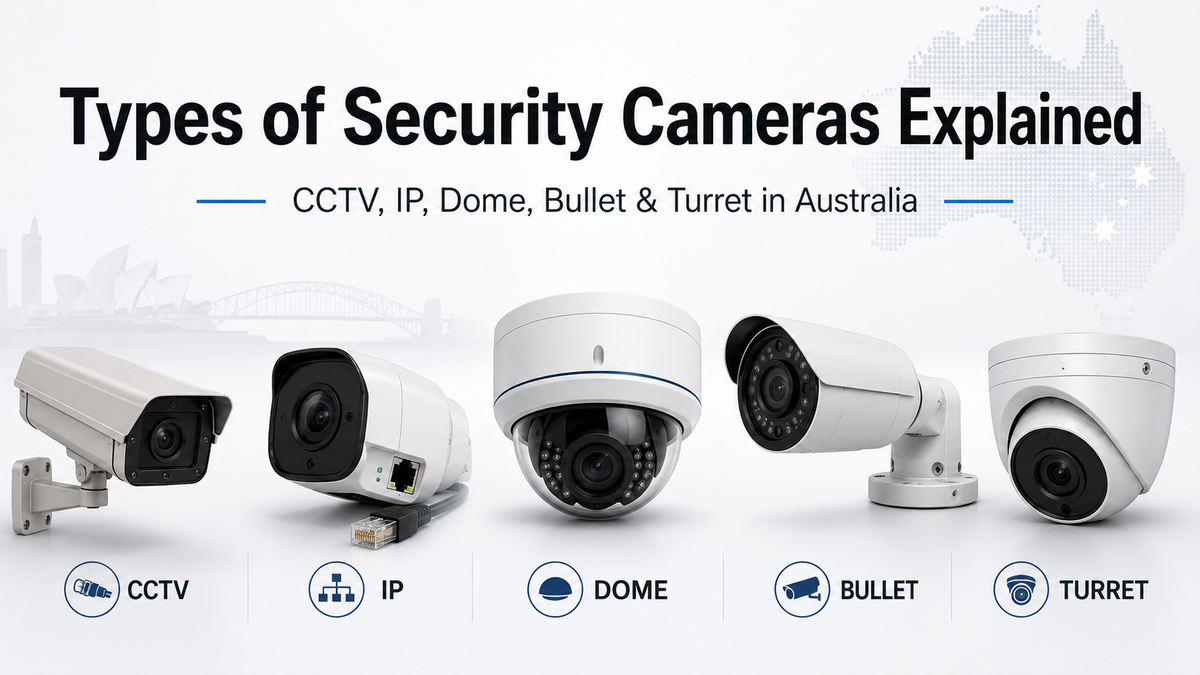
TL;DR Security cameras come in several physical designs (dome, bullet, turret, PTZ) and two main transmission technologies (IP and analogue). For most Australian homes, turret or dome IP cameras on a PoE NVR system give the best combination of image quality, AI detection, and long-term reliability. This guide explains every type so you can pick the right camera for every position on your property. |
Walk into any Australian hardware store and you will see security cameras that look nothing like each other. Some are chunky cylinders on arms. Others are flat pods tucked under eaves. A few spin around on their own. It is easy to assume they are just different styles. In reality, each design exists for a reason, and picking the wrong one for the wrong location is one of the most common mistakes installers see on first-time residential setups.
This guide breaks down every major type of security camera available in Australia, explains what each one is actually good at, and tells you where each one belongs on a property. No jargon. No brand pushing. Just the information you need before you spend a dollar.
The Two Technologies: IP vs Analogue
Before you even look at camera shapes, you need to understand the underlying technology. Every security camera on the market today falls into one of two categories.
IP Cameras (Internet Protocol)
IP cameras transmit video as digital data over a network. They connect via Ethernet cable (usually through a PoE switch or NVR) or via WiFi. The image quality is significantly higher than analogue, starting at 2MP and scaling up to 4K. Most modern IP cameras also include built-in AI detection for people, vehicles, and faces.
IP cameras are the standard choice for any new installation in Australia. If someone is quoting you an analogue system in 2026 without a compelling reason, ask why.
Analogue Cameras (HD-CVI, HD-TVI, AHD)
Analogue cameras transmit video as an electrical signal over coaxial cable to a DVR (Digital Video Recorder). Older analogue systems capped out at terrible resolution, but modern HD analogue formats (CVI, TVI, AHD) can reach 4K. They are mainly useful when you already have coaxial cabling from an old system and want to avoid re-cabling.
For any new property build or full system replacement, go IP. The flexibility, scalability, and AI capabilities simply do not compare.
|
Technology |
Best For |
|
IP / PoE |
New installations, high detail, AI analytics, scalable systems |
|
HD Analogue (CVI/TVI) |
Upgrading existing coax-cabled systems without re-wiring |
|
WiFi IP |
Renters, single cameras, areas where cabling is not possible |
Camera Body Types: Which Shape Does What
Dome Cameras
Dome cameras sit flush against ceilings or mount under eaves inside a rounded housing. The housing conceals which direction the lens is pointing, which is a genuine deterrent advantage in retail environments and public spaces where you want people to know they are being watched but not know exactly where.
The dome cover also makes them harder to tamper with and more vandal-resistant than open-body designs. IK10-rated dome cameras can withstand a direct hit without the lens shifting.
The trade-off is infrared reflection. At night, the IR LEDs bounce off the inside of the dome cover and can wash out the image, particularly on cheaper models. This is worth knowing before you install them in very dark environments.
-
Best for: Shopfronts, offices, apartment foyers, indoor commercial spaces
-
Avoid for: Locations where you need to fine-tune the viewing angle after installation
Bullet Cameras
Bullet cameras have a long cylindrical shape and are designed to be visible. That visibility is part of the value. A bullet camera mounted at the entrance to a driveway sends a clear message that the property is monitored. Australian research consistently shows that visible cameras reduce opportunistic break-ins.
Bullets typically have longer IR ranges than dome or turret cameras because the larger body allows a bigger lens and more IR LEDs. A standard bullet might cover 50 metres in darkness compared to 30 metres for a turret. For perimeter coverage on larger rural properties or warehouses, that extra range matters.
The downside is that they are easier to redirect or damage if someone gets close enough. Mounting height and vandal-resistant housings (IK10) reduce this risk considerably.
-
Best for: Driveways, perimeters, warehouse exteriors, property boundaries
-
Avoid for: Indoor ceiling mounts or locations where aesthetics are a priority
Recommended Bullet Security Cameras
Compare reliable bullet CCTV cameras for outdoor surveillance, including Wisenet, Hikvision, and HiLook options for homes, businesses, entrances, driveways, and commercial security setups.

Hanwha Wisenet 4MP Bullet Camera
A durable 4MP Wisenet HD+ bullet camera with varifocal lens, IR night vision, and weather-resistant housing.
View Product
Hikvision 8MP AcuSense Bullet Camera
An 8MP bullet network camera with AcuSense human and vehicle detection, PoE support, and strong outdoor performance.
View Product
HiLook 6MP Outdoor Mini Bullet Camera
A compact 6MP outdoor mini bullet camera with PoE, IR night vision, audio, and IP67 weatherproof protection.
View ProductTurret Cameras (Eyeball Cameras)
Turret cameras are the most popular choice for Australian homes. They use a ball-and-socket design that lets you point the camera in any direction after mounting without needing to move the base. Installers like them because they can be fine-tuned during commissioning without tools, and repositioned later if your needs change.
Unlike dome cameras, turret cameras do not have an outer glass shell, so there is no IR reflection issue at night. The image quality in low light is consistently cleaner than equivalent dome models. They are compact enough to sit neatly under eaves without looking out of place on a residential property.
The slight trade-off compared to domes is that the ball mechanism is exposed, so a determined attacker with access to the camera could try to redirect it. At proper mounting heights (2.5 to 3 metres), this is rarely a practical concern.
-
Best for: Residential eaves, front entrances, garages, covered outdoor areas
-
Avoid for: High-vandalism environments where IK10 dome housings offer better protection
Shop Turret Security Cameras
Explore reliable turret cameras for homes, businesses, indoor areas, and outdoor CCTV installations.
PTZ Cameras (Pan-Tilt-Zoom)
PTZ cameras can rotate horizontally, tilt vertically, and zoom optically. They are controlled either manually via software or automatically through AI-driven auto-tracking. One PTZ camera can follow a person across a large area in real time, which sounds impressive and genuinely is on the right site.
The catch is that a PTZ camera looking in one direction is not watching the others. On a large open car park or industrial yard where a single camera needs to cover hundreds of metres, a PTZ makes sense. On a standard suburban home where you need consistent coverage of four or five fixed zones, four turret cameras will outperform one PTZ every time.
Cost is also a factor. A quality PTZ starts at three to four times the price of a turret camera, and maintenance is higher due to the mechanical components.
-
Best for: Car parks, industrial yards, large commercial sites, perimeter patrol
-
Avoid for: Residential installations where fixed camera coverage is more reliable
Fisheye / 360-Degree Cameras
Fisheye cameras use an extremely wide-angle lens to capture an entire room or area in a single shot. The footage looks distorted in raw form but can be digitally dewarped in the NVR or viewing software.
They are most useful in large open indoor spaces like warehouses, retail floors, or reception areas where you want to eliminate blind spots with a single device. For outdoor residential use, the wide distortion makes it harder to extract usable detail.
-
Best for: Retail floors, open-plan offices, warehouse interiors
-
Avoid for: Outdoor entrances or anywhere detailed facial recognition is needed
Resolution: What the Numbers Actually Mean
Resolution is measured in megapixels (MP). More pixels means more detail in the footage, but there are practical limits to how much resolution you need.
|
Resolution |
Common Use |
Storage Impact |
|
2MP (1080p) |
General indoor, low-risk areas |
Low |
|
4MP |
Residential standard, good balance |
Moderate |
|
6MP |
Driveways, entrances, face capture |
Moderate-High |
|
8MP (4K) |
Number plate capture, commercial perimeters |
High |
An 8MP camera recording 24/7 uses roughly four times the storage of a 2MP camera at the same frame rate. For most Australian homes, 4MP to 6MP turret cameras hit the sweet spot between useful detail and manageable storage costs.
Night Vision Options
Infrared (IR) Night Vision
Standard IR cameras switch to black and white at night and illuminate the scene with invisible infrared light. It works well in complete darkness and is the most common night vision type. The main limitation is that you lose colour information, which can matter for identifying clothing or vehicle colours.
Full-Colour Night Vision (ColorVu / Full-Color)
Cameras from Hikvision (ColorVu) and Dahua (Full-Color) use a combination of a large aperture lens and a supplemental white light to produce colour footage at night. The scene looks like daylight. Colours of clothing, vehicles, and surroundings are preserved.
The white light is visible, so these cameras also act as a deterrent when triggered. The trade-off is slightly more light pollution and a small ongoing power draw for the LED. On driveways and entrances, the colour detail is worth it.
Smart Dual Light
Some newer cameras combine IR and white light, defaulting to IR for general recording and switching to white light only when motion is detected. This gives you the battery-friendliness of IR with the colour benefit when it matters most.
Infrared vs colour night vision: which should you choose?
Choose infrared for positions with zero ambient light, like a rear boundary or unlit paddock, since it works in total darkness. Choose colour night vision for positions with some ambient light, like a front entry near a streetlight, since it preserves clothing and vehicle colour that infrared's black-and-white footage cannot show.
Infrared cameras illuminate a scene with invisible IR light regardless of available visible light, producing black-and-white footage. Colour night vision cameras (Hikvision ColorVu, Dahua Full-Color/WizColor) use a larger-aperture lens with a supplemental white LED, drawing on whatever ambient light exists to render full colour, but they depend on at least some ambient light, a streetlight, a neighbour's porch light, or their own white LED, to do it. In a genuinely pitch-black rural position with zero ambient light, standard infrared remains the more dependable choice.
Infrared vs colour night vision
|
Factor |
Infrared |
Colour night vision |
|---|---|---|
|
Works in total darkness |
Yes |
Limited, needs some ambient light |
|
Preserves colour detail |
No |
Yes |
|
Visible white light output |
No |
Yes, mild light pollution and deterrent effect |
|
Best for |
Rear boundaries, unlit rural areas |
Front entries, driveways, streetlit positions |
For colour night vision, the HiLook Pro Hi-Color 6MP kit uses an F1.0 lens for genuinely usable colour detail in low ambient light. For unlit rear boundaries or paddocks, a standard infrared-only camera from the Dahua IP camera range is the more reliable pick.
Can I mix both types on the same NVR system? Yes, and it's often the right answer, colour night vision at lit front-of-house positions, infrared at unlit rear and perimeter positions, all recording to the same recorder.
Weatherproofing Ratings
Australian weather is genuinely harsh. Coastal salt air, Queensland humidity, Perth UV, and Darwin monsoonal rain all affect cameras differently. The IP rating system tells you what a camera can handle.
|
IP Rating |
What It Means for Australian Conditions |
|
IP65 |
Protected from dust and low-pressure water jets. Fine for covered outdoor positions |
|
IP66 |
Protected from powerful water jets. Suitable for exposed outdoor positions in heavy rain |
|
IP67 |
Survives brief immersion up to 1 metre. Good for flood-prone areas or ground-level positions |
|
IK10 |
Impact resistant to 20 joules. Relevant for areas with vandalism risk |
Where to Place Each Camera Type: A Quick Reference
|
Location |
Recommended Camera Type |
Why |
|
Front door / entrance |
Turret or doorbell camera |
Flexible aim, compact, colour night vision |
|
Driveway |
Turret or bullet |
Long IR range or colour, covers distance |
|
Rear yard / garden |
Turret |
Wide angle, clean night image |
|
Shopfront |
Dome |
Vandal-resistant, discreet direction |
|
Warehouse perimeter |
Bullet |
Long IR range, visible deterrent |
|
Retail floor / open office |
Fisheye or dome |
Wide coverage, minimal blind spots |
|
Car park / large site |
PTZ or bullet |
Pan/zoom flexibility or long-range fixed |
Frequently Asked Questions
What is the difference between a CCTV camera and a security camera?
The terms are used interchangeably in Australia. CCTV stands for Closed-Circuit Television, which originally referred to systems where footage was only visible on a closed internal network. Modern IP security cameras can be accessed remotely via the internet, so they are technically not 'closed circuit' in the original sense. In everyday use, both terms mean the same thing.
Can I mix dome and turret cameras on the same NVR?
Yes. Any ONVIF-compatible camera can work alongside other ONVIF cameras on the same NVR, regardless of body shape. Hikvision, Dahua, HiLook, and Uniview cameras all work on NVRs from the same brand family without compatibility issues.
How many cameras do I need for a typical Australian home?
A standard three-to-four bedroom home with a garage typically needs four to six cameras to cover the front entrance, driveway, garage, rear yard, and side access points. An eight-channel NVR gives you room to expand without replacing equipment.
Do I need planning permission to install security cameras in Australia?
Generally no, for cameras monitoring your own property. You do need to avoid capturing images of neighbouring properties, public footpaths outside your boundary, or any private spaces without signage. For commercial properties, the Australian Privacy Act applies to how footage is stored and accessed. The Office of the Australian Information Commissioner (OAIC) provides guidance for businesses.
Are analogue cameras still worth buying in 2026?
Only if you already have coaxial cabling installed and a DVR from a recent installation. For new builds, IP cameras on a PoE NVR system offer significantly better resolution, AI analytics, and scalability for a comparable price.
Final Thoughts
The right security camera is the one that matches the job it needs to do. Turret cameras are the workhorse of Australian residential installs. Bullet cameras earn their place on driveways and perimeters. Dome cameras suit commercial and vandal-prone environments. PTZ cameras solve coverage problems on large sites that fixed cameras cannot handle alone.
Start with the locations that genuinely need coverage, pick the camera type that fits each spot, and choose IP over analogue for any new installation. That combination will serve you well for years.
Browse the full range of security cameras at CCTV Importers, including PoE cameras, dome cameras, bullet cameras, and complete NVR kits built for Australian conditions.


