
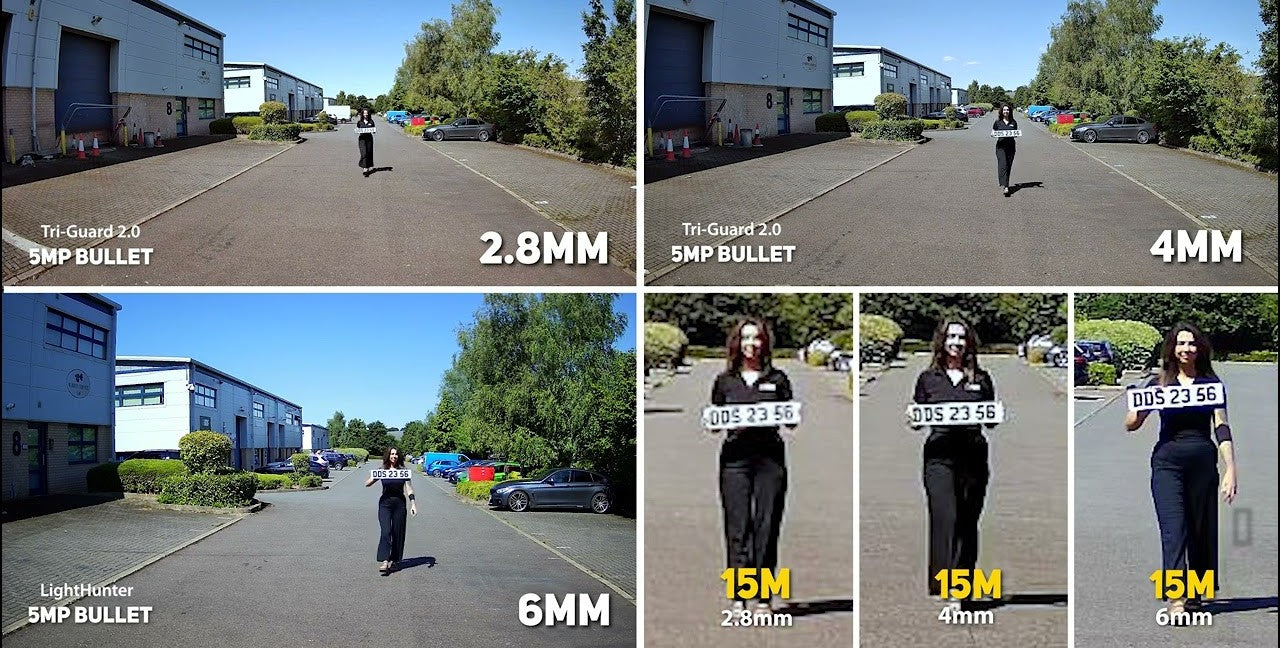
Here is a call we get every week: "The camera is 8MP, so why can't I make out the face at the front gate?" Nine times out of ten the resolution is fine. The problem is the lens. A 2.8mm lens pointed at a gate 10 metres away will show you the whole yard and a very small person.
The 2.8mm vs 4mm CCTV lens choice is the most overlooked spec on a security camera, and it costs nothing extra to get right. This guide explains the real difference, where each lens works best around an Australian home or shop, and how to mix them on one system.
TL;DR
- 2.8mm: wide view (roughly 100 to 110 degrees). Best within about 6 metres: porches, side gates, alfresco areas, small rooms.
- 4mm: narrower view (roughly 80 to 90 degrees) with more detail further out. Best for driveways, long yards and shop counters seen from a distance.
- Most homes use both: 2.8mm close to the house, 4mm for anything further away.
- Neither lens reads number plates reliably. Use a dedicated ANPR camera for that.
What does lens size mean on a CCTV camera?
The millimetre figure is the focal length. A smaller number gives a wider field of view; a larger number zooms in. Same sensor, same resolution, but the pixels get spread over a bigger or smaller scene.
That is the key point. With a 2.8mm lens, a person 8 metres away takes up fewer pixels than they would through a 4mm lens. Fewer pixels on a face means less detail when you zoom in on recorded footage.
| 2.8mm lens | 4mm lens | |
|---|---|---|
| Horizontal field of view (typical 6 to 8MP) | About 100 to 110 degrees | About 80 to 90 degrees |
| Good face detail out to | About 5 to 6 metres | About 8 to 10 metres |
| Best for | Wide coverage close to the camera | Detail at a distance |
| Trade-off | People look small further out | Narrower view, may need extra cameras |
Distances vary with resolution, lighting and mounting height, so treat these as practical guides rather than exact figures. An 8MP camera stretches both numbers a little further than a 6MP one.
Where to use a 2.8mm lens
- Front porch and door: you want the whole porch, the parcel spot and the person standing at the door, usually within 3 to 4 metres.
- Side gates and passages: mounted close to the gate looking across it.
- Alfresco and sliding doors: wide coverage under a patio roof.
- Garages and small shops: one camera can see most of the space.
If you are only buying one lens type for a small home, 2.8mm is the safer all-rounder.
Where to use a 4mm lens
- Driveways: from the house looking down the drive to the street, often 10 metres or more.
- Long backyards: covering the back fence on a deep suburban block or acreage.
- Upper-storey overview cameras: on two-storey homes, a 4mm lens stops the yard looking tiny from up high.
- Shop counters and entrances viewed from across the room.
Two-storey home? Our double-storey CCTV guide shows how to combine both lens types.
What about number plates?
This is a common misunderstanding. A 4mm overview camera on the house will not reliably read number plates, regardless of resolution. Plates need a dedicated ANPR camera mounted low (0.5 to 2 metres), close to head-on, about 3 to 8 metres from where vehicles slow down. See can home CCTV capture number plates? for the full setup.
A typical home setup using both lenses
| Position | Lens | Why |
|---|---|---|
| Front door | 2.8mm | Close range, wide porch |
| Driveway | 4mm | Longer distance to the street |
| Side gate | 2.8mm | Close range across the gate |
| Backyard | 4mm | Reaches the back fence |
| Alfresco | 2.8mm | Wide view under the patio |
Most cameras we sell come in both 2.8mm and 4mm versions at the same price, so there is no penalty for mixing. Just choose the lens per position when you order.
What about varifocal and panoramic cameras?
- Varifocal (motorised zoom): adjust the lens from the app after installation, typically 2.8 to 12mm. Great when you are unsure of distances or need to reach well past 10 metres.
- 180-degree panoramic: two sensors stitched together cover what would normally take two 2.8mm cameras. Ideal on the corner of a house.
Common lens mistakes we see
- 2.8mm on every camera: lovely wide views, but nobody identifiable beyond the front step.
- 4mm too close: on a narrow side passage, a 4mm lens only shows a slice of the path.
- Mounting too high: past about 3 metres, even the right lens sees the tops of heads. Height matters as much as focal length.
Pick your lens per camera
Our turret cameras come in 2.8mm and 4mm versions, and most kits let you choose the lens for each camera. Genuine ANZ stock from Hikvision, Dahua, Uniview and more.
Frequently asked questions
Is 2.8mm or 4mm better for home CCTV?
Use 2.8mm for positions close to the house, such as doors, gates and patios, and 4mm for driveways and long yards. Most homes benefit from a mix of both.
Is 2.8mm or 4mm better for facial recognition?
4mm, once the person is more than about 6 metres away. Within a few metres, a 2.8mm lens gives plenty of facial detail and a wider view.
What is the field of view of a 2.8mm vs 4mm lens?
On a typical 6MP or 8MP camera, a 2.8mm lens covers roughly 100 to 110 degrees horizontally and a 4mm lens roughly 80 to 90 degrees. Check the exact figure on each camera's datasheet.
Can I mix 2.8mm and 4mm cameras on one NVR?
Yes. Lens size has no effect on compatibility. Mixing lenses is how most professional systems are designed.
Will a 4mm lens read number plates?
Not reliably. Plate capture depends on angle, height, distance and shutter speed, which is why dedicated ANPR cameras exist.
Get the lens right for each position and you will see a bigger improvement than jumping up a resolution tier. Wide at the doors, tighter for distance, and an ANPR camera if plates matter. Need a hand planning? Ask our team.


