
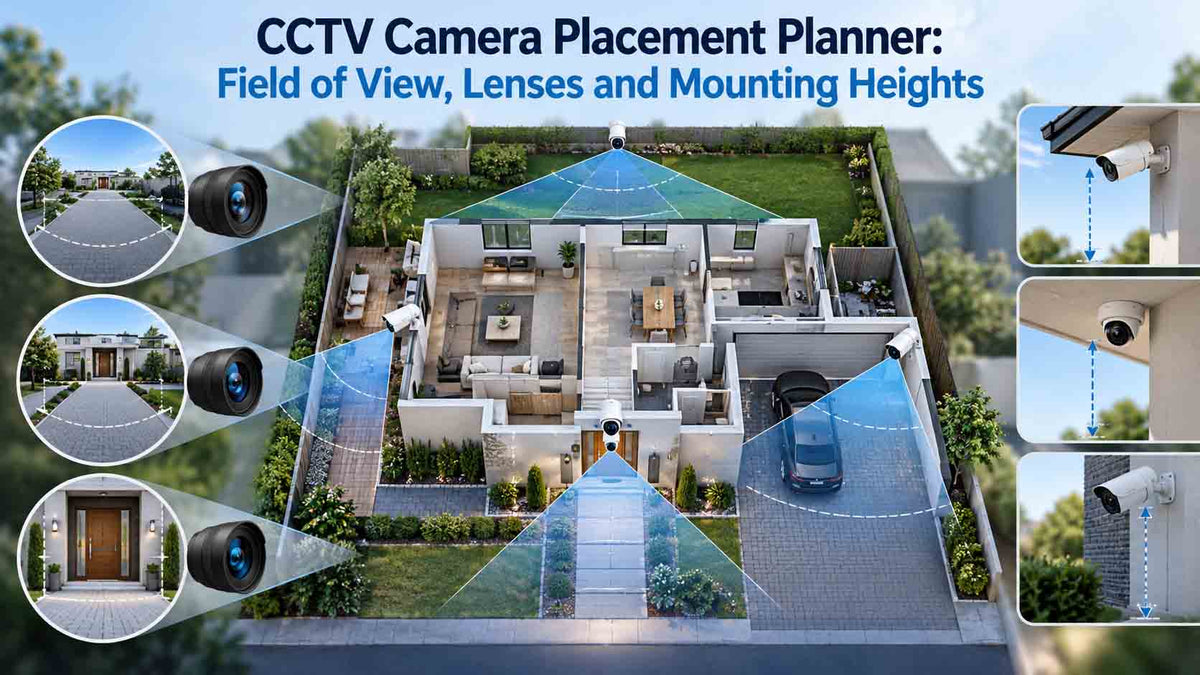
The most common CCTV complaint we hear is not "the camera broke". It is "the camera recorded the whole thing, but you can't tell who it was". That is a placement problem. The camera was too high, too far away, or fitted with a wide lens where a narrow one was needed.
This guide shows how to plan camera positions before you drill a single hole. Download the free planner, sketch your property on the grid, and use the tables below to pick the right lens and distance for each spot.
TL;DR:
Decide what each camera must do: detect movement, recognise a person, or identify a face. Wider lenses (2.8mm) cover more area but identify faces only up to about 5 to 6 metres on 6MP to 8MP cameras. 4mm lenses reach about 7 to 8 metres; 6mm and longer suit driveways and gates. Mount cameras at 2.4 to 3 metres, angle them slightly down, and overlap views so there are no blind spots at doors.

Step 1: decide what each camera needs to see
The international CCTV standard IEC 62676-4 uses four levels of detail, known as DORI. They are measured in pixels per metre (px/m) of scene width.
|
Level |
Pixels per metre |
What you can tell |
Typical spot |
|---|---|---|---|
|
Detect |
25 px/m |
Something or someone is there |
Back fence, paddock |
|
Observe |
63 px/m |
Clothing, general actions |
Yard, side passage |
|
Recognise |
125 px/m |
Someone you know |
Driveway, car park |
|
Identify |
250 px/m |
A stranger's face, with certainty |
Front door, gate, register |
Every camera position should have a job. Front doors, side gates and registers need "identify". Large yards usually only need "observe".
Step 2: pick the lens
Horizontal field of view varies by camera and sensor, but these are typical figures for 6MP to 8MP turret and bullet cameras.
|
Lens |
Typical horizontal FOV |
Scene width at 10m |
Best for |
|---|---|---|---|
|
2.8mm |
100 to 110 degrees |
About 26m |
Yards, porches, wide areas close by |
|
4mm |
80 to 90 degrees |
About 18m |
Driveways, side passages |
|
6mm |
about 50 degrees |
About 10m |
Long driveways, gates |
|
12mm (varifocal) |
about 27 degrees |
About 5m |
Number plates, distant gates |
The scene width formula is simple:
CCTV Camera Field of View Formula
FOV = horizontal field-of-view angle • Distance = distance from camera to subject
Step 3: check the identify distance
This is the table most buyers never see. It shows how far away a person can stand and still be identified (250 px/m).
|
Camera |
2.8mm lens |
4mm lens |
6mm lens |
|---|---|---|---|
|
6MP (3200 px wide) |
about 5m |
about 7m |
about 12m |
|
8MP / 4K (3840 px wide) |
about 6m |
about 8m |
about 15m |
That is why we recommend 6MP as entry level and 8MP as standard. On a 4MP camera with a 2.8mm lens, the identify distance drops to roughly 4 metres, which is barely past the doormat. Figures are approximate and assume good lighting.
Step 4: choose mounting height and angle
|
Location |
Height |
Angle |
Why |
|---|---|---|---|
|
Front door / porch |
2.2 to 2.6m |
Slightly down |
Faces, not tops of heads |
|
Driveway |
2.4 to 3m |
15 to 30 degrees down |
Vehicle and people |
|
Side gate |
2.4m |
Looking along the passage |
Catches faces walking toward camera |
|
Back yard |
2.7 to 3.5m |
Wide, gently down |
Overview, harder to reach |
|
Double-storey eave |
5 to 6m |
Steeper |
Overview only; add a lower camera for faces |
The classic mistake is mounting every camera under a second-storey eave. You get great overviews and no usable faces. Our double-storey camera guide shows how to mix heights.
Step 5: remove blind spots
-
Cover every entry point twice: once from a distance, once close up.
-
Look at each camera's view from the next camera. Can it see the first camera? If so, it can capture anyone tampering with it.
-
Avoid pointing cameras into the rising or setting sun. In Australia, east- and west-facing cameras catch strong glare at certain times of year; use WDR models or adjust the angle.
-
Keep IR cameras away from close walls, eaves and gutters that reflect light back into the lens.
-
Check for trees and shrubs that will grow into the view by summer.
Typical layout for a single-storey home
|
Camera |
Lens |
Job |
|---|---|---|
|
Front door |
2.8mm |
Identify visitors and parcel thieves |
|
Driveway |
4mm or 6mm |
Recognise people and vehicles |
|
Side gate (each side) |
4mm |
Identify anyone entering the passage |
|
Back yard |
2.8mm |
Observe the whole yard |
|
Garage or shed door |
2.8mm or 4mm |
Identify at the door |
That is five to six cameras, which is why an 8-channel NVR is the most popular size. See our single-storey tile roof layout and browse Hikvision 8-camera kits.
What's in the free planner
-
Grid-paper site plan page to sketch your house and boundaries
-
Printable FOV wedge templates for 2.8mm, 4mm, 6mm and 12mm lenses (cut out and place on the plan)
-
DORI identify-distance chart for 4MP, 6MP and 8MP cameras
-
Mounting height guide
-
Camera schedule table: location, lens, job, height, cable run length
Free CCTV Camera Placement Planner
Planning a CCTV installation? Download our free CCTV placement planner to help map camera locations, identify blind spots and plan security coverage for your home or business.
↓ Download CCTV Placement Planner (PDF)Free printable PDF • Camera placement planning • No sign-up required
Frequently asked questions
How high should security cameras be mounted?
About 2.4 to 3 metres for most positions. High enough to deter tampering, low enough to capture faces. Front door cameras can sit a little lower.
What lens size is best for a home security camera?
2.8mm for wide areas close to the house, 4mm for driveways and side passages, and 6mm or varifocal for long driveways and gates.
How far can a security camera identify a face?
An 8MP camera with a 2.8mm lens identifies faces out to roughly 6 metres. A 4mm lens extends that to about 8 metres, and 6mm to around 15 metres.
How do I avoid blind spots in my CCTV system?
Overlap camera views at entry points, make sure cameras can see each other, and cover each door with both a wide and a close-up view.
Should cameras face the street?
Point them at your own property. If the view includes the street or a neighbour's yard, use privacy masking to block out windows and private areas.
Plan first, buy second
Ten minutes with the planner saves hours of moving cameras later. Sketch your property, give each camera a job, match the lens, then choose the kit.
Browse 4-camera kits or send us your completed planner and we will recommend a system.


