
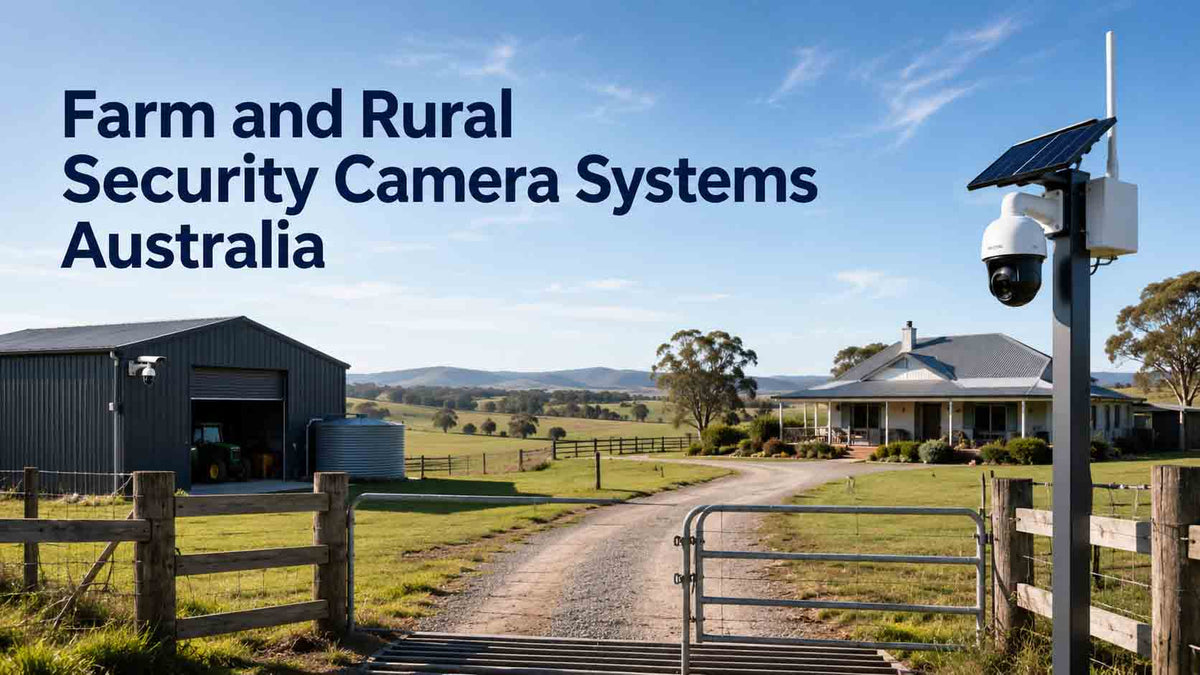
A security camera system for an Australian farm has to solve problems that rarely exist on a suburban block.
The entrance may be hundreds of metres from the homestead. Machinery sheds, fuel tanks, livestock yards and pumps may be spread across separate parts of the property. Fixed internet, mains power and even mobile coverage can become unreliable outside the main buildings.
This means the best farm security system is rarely a single camera type. Most rural properties need a combination of wired cameras around important buildings, long-distance network links between key areas, and solar or 4G cameras at locations where trenching cable is impractical.
TL;DR
Use wired PoE cameras around the farmhouse, office, workshop and machinery sheds where power and network infrastructure are available. They provide the most reliable continuous recording.
Use wireless bridges to connect buildings when there is a clear line of sight but running underground cable would be expensive.
Use 4G and solar cameras at remote gates, tanks, paddocks and equipment areas that cannot connect to the main network. Check mobile signal strength at the exact mounting location before purchasing.
Prioritise entrances, fuel storage, machinery, workshops and livestock handling points. Trying to watch every hectare usually produces distant footage that is expensive to maintain and too unclear to identify anyone.
A well-designed rural system records useful evidence locally, sends alerts for people and vehicles, and continues operating when the property’s internet connection is interrupted.
Farm security camera options compared
|
System type |
Best location |
Main advantage |
Main limitation |
|
Wired PoE cameras |
Farmhouse, sheds and workshops |
Reliable continuous recording |
Requires Ethernet cabling |
|
Wi-Fi cameras |
Areas close to a reliable building network |
Simple connection |
Range and interference limitations |
|
Wireless bridge |
Separate buildings with line of sight |
Connects distant locations without trenching |
Requires correct alignment and power |
|
4G cameras |
Remote gates and isolated assets |
Works without fixed internet |
Requires mobile coverage and a data plan |
|
Solar battery cameras |
Off-grid locations |
No mains power required |
Performance depends on sunlight and power design |
|
PTZ cameras |
Large yards and open operational areas |
Can pan, tilt and zoom |
One PTZ cannot watch every direction at once |
|
Fixed cameras |
Gates, doors, tanks and machinery |
Consistent view of a critical target |
Each camera covers a defined area |
Why rural security needs a different design
Farm theft is not limited to the house. Common targets include:
-
Livestock
-
Fuel
-
Utes and motorcycles
-
Tractors and machinery
-
Tools and spare parts
-
Chemicals and agricultural supplies
-
Copper cable
-
Pumps, generators and batteries
-
Trailers and portable equipment
University of New England research has previously reported that up to 80 per cent of surveyed NSW farmers had experienced rural crime. The Australian Institute of Criminology has also identified livestock, machinery, vehicles, tools, fuel and other farm property as recurring targets.
The property layout creates additional challenges. Activity may not be noticed until hours or days later, and there may be no nearby witness. Cameras should therefore do more than provide a live view. They should create a reliable record showing who entered, when they arrived, what vehicle they used and where they went.
Begin with the assets, not the cameras
Buying cameras before mapping the property often leads to excessive coverage in low-risk areas and weak coverage around the assets that matter.
Start by dividing the farm into security zones.
|
Priority |
Area |
Main recording objective |
|
1 |
Main vehicle entrance |
Capture vehicles, people and direction of travel |
|
2 |
Machinery and workshop area |
Identify access to tools, vehicles and equipment |
|
3 |
Fuel tanks |
Record people and vehicles approaching the tank |
|
4 |
Farmhouse and office |
Monitor doors, driveways and visitor activity |
|
5 |
Livestock yards and loading areas |
Record stock movements and vehicle access |
|
6 |
Chemical and supply storage |
Detect unauthorised entry |
|
7 |
Remote pumps, tanks and generators |
Confirm access and equipment condition |
|
8 |
Internal tracks |
Record movement between important zones |
A camera overlooking an entire paddock may show that a vehicle was present. A correctly positioned camera at the gate is more likely to provide identifiable details.
Wired PoE cameras for buildings and high-value areas
Wired Power over Ethernet cameras should form the core of the system wherever cabling is practical.
A PoE camera receives power and network data through one Ethernet cable connected to an NVR or PoE switch. This provides a stable connection and allows continuous recording without relying on batteries or mobile data.
PoE systems are well suited to:
-
Farmhouses
-
Offices
-
Workshops
-
Machinery sheds
-
Packing areas
-
Stable and livestock buildings
-
Fuel compounds
-
Loading areas
A local network video recorder can continue recording when the external internet connection fails. Remote viewing may become temporarily unavailable, but the footage remains stored on-site.
For critical locations, connect the recorder, network switch and internet equipment to a suitable UPS. This can keep the system operating through short power interruptions and reduce the risk of file corruption during sudden shutdowns.
Wireless bridges between farm buildings
A point-to-point wireless bridge can connect two buildings over a longer distance than ordinary Wi-Fi.
One radio is installed at the main network location and another at the remote building. When correctly aligned with a suitable line of sight, the bridge acts like a network cable between the two points.
This can support several cameras at a remote shed without requiring a separate mobile-data plan for every camera.
A wireless bridge may suit:
-
A machinery shed away from the farmhouse
-
A livestock yard with mains power
-
A second residence
-
A packing shed
-
A gatehouse
-
A pump station with reliable power
The remote building will still require power for the bridge and cameras. Trees, hills, structures and terrain can interrupt the radio path, so distance alone does not determine performance.
Browse wireless bridge equipment for compatible point-to-point connections.
4G cameras for remote farm locations
A 4G camera uses a SIM card and mobile network instead of a fixed internet service. It can send alerts and allow remote viewing without connecting to the farm’s NBN service or local Wi-Fi.
This makes 4G useful for:
-
Remote property entrances
-
Livestock loading gates
-
Fuel tanks
-
Water infrastructure
-
Isolated sheds
-
Equipment parked away from the main buildings
-
Temporary work areas
-
Construction or maintenance zones
Before choosing a 4G camera, test reception at the exact intended mounting height and location. A phone displaying a signal near the farmhouse does not confirm reliable service several kilometres away or behind a hill.
Check:
-
Available mobile networks
-
Signal strength and stability
-
External antenna support
-
SIM compatibility
-
Monthly data allowance
-
Local storage capacity
-
Whether continuous recording is supported
-
Remote-access security
-
Operating temperature and weather rating
Compare available 4G security cameras for remote monitoring without fixed internet.
How much mobile data can a farm camera use?
Continuous video can consume a substantial amount of mobile data.
The following figures are illustrative and assume the camera uploads continuously at the stated average bitrate.
|
Average uploaded bitrate |
Approximate data per day |
Approximate data per 30 days |
|
0.25 Mbps |
2.7 GB |
81 GB |
|
0.5 Mbps |
5.4 GB |
162 GB |
|
1 Mbps |
10.8 GB |
324 GB |
|
2 Mbps |
21.6 GB |
648 GB |
A 4G camera uploading continuously at 2 Mbps could theoretically use more than 600 GB in 30 days. That is why many rural cameras record locally and use mobile data primarily for alerts, short event clips and occasional remote viewing.
Actual usage depends on:
-
Codec and compression
-
Camera resolution
-
Frame rate
-
Bitrate
-
Length and frequency of remote viewing
-
Number of motion events
-
Cloud recording settings
-
Audio
-
Firmware updates
H.265 compression, event recording and a low-resolution mobile sub-stream can reduce data use. Do not select a SIM plan until the camera’s recording and upload behaviour is understood.
What's the best setup specifically when there's no Wi-Fi at all?
The best setup for a farm without Wi-Fi combines solar-powered 4G cameras at gates, sheds and remote assets with local SD card or onboard storage, so footage records and stores independently of any network. Where the homestead has mains power, a wired PoE/NVR system also works with zero Wi-Fi, since it never needed it to record in the first place.
Wi-Fi is only ever needed for remote viewing on a phone app, not for recording itself. A camera with local SD card storage, or a wired camera connected to an NVR, records fine with zero Wi-Fi or internet, provided it has power from mains, PoE, solar or battery. For a remote gate with no mains power nearby, solar with a battery buffer is the standard answer, and a 4G SIM card, not Wi-Fi, handles alert delivery where mobile coverage reaches.
Wi-Fi-dependent vs Wi-Fi-independent farm camera setup
|
Factor |
Wi-Fi camera |
Solar + 4G camera |
|---|---|---|
|
Needs router/Wi-Fi range |
Yes |
No |
|
Works at remote gates/paddocks |
Only within Wi-Fi range |
Yes, wherever mobile coverage reaches |
|
Recording continues with no signal |
Depends on local storage |
Yes, records locally regardless |
For remote, off-grid positions, the Dahua 3+3MP WizColor Hybrid-Zoom PTZ 4G Battery Solar Camera runs entirely on solar and 4G with no cabling or Wi-Fi dependency, with a dual-sensor setup covering both a wide gate view and a zoomed tracking view from one unit.
Do I still need a SIM plan even without home Wi-Fi? Only if you want remote alerts and viewing. For local-only recording with no remote access, a 4G SIM is not required.
Solar security cameras for off-grid areas
Solar cameras are useful where neither mains power nor practical cabling is available.
A complete solar system may include:
-
Solar panel
-
Battery
-
Charge controller
-
Camera
-
4G or wireless connection
-
Local storage
-
Mounting pole or structure
The solar panel must generate enough energy to run the camera and recharge the battery under realistic conditions. A system designed only around an ideal summer day may fail during winter, extended cloud cover or periods of heavy activity.
Solar performance depends on:
-
Camera power consumption
-
Battery capacity
-
Panel size
-
Location and orientation
-
Seasonal sunlight
-
Shade from trees or structures
-
Number of recording events
-
Frequency of remote viewing
-
Infrared and spotlight use at night
-
Mobile signal strength
-
Local temperature
Continuous recording requires more energy than event-based recording. PTZ movement, strong infrared illumination, spotlights and constant 4G transmission can also increase consumption.
Browse solar-powered security cameras, including Dahua solar solutions and Hikvision solar systems.
Solar, 4G and Wi-Fi are separate features
These terms are often treated as if they mean the same thing, but they describe different parts of the system.
-
Solar describes how the camera receives power.
-
4G describes how the camera connects through a mobile network.
-
Wi-Fi describes a local wireless network connection.
-
Battery-powered means the camera stores electrical energy locally.
-
Wire-free usually means no power or network cable is required.
A solar Wi-Fi camera still needs to remain within range of a reliable Wi-Fi network. A 4G camera still requires a suitable power source. A battery camera may need regular charging unless it has a correctly sized solar panel.
Confirm both power and connectivity before selecting a remote camera.
Fixed cameras or PTZ cameras for a farm?
A PTZ camera can pan, tilt and zoom, which makes it useful for observing large yards and operational areas.
However, a PTZ camera only records the direction it is facing at that moment. If it is zoomed towards a loading area, activity behind it may not be captured.
Fixed cameras provide continuous coverage of critical locations. They are usually the better choice for:
-
Gates
-
Fuel tanks
-
Doors
-
Cash or office areas
-
Vehicle identification points
-
Machinery entrances
Use PTZ as an additional overview or live-investigation camera, not as the only camera protecting several directions.
Browse PTZ security cameras for large-area monitoring.
Camera resolution and lens selection
Higher resolution can improve detail, but only when the camera has the correct field of view and target distance.
A wide-angle camera may cover an entire gate area but capture too few pixels across a distant number plate. A narrower lens provides more detail at the target but covers less of the surrounding area.
Consider using two cameras at a main entrance:
-
An overview camera showing the vehicle, people and direction of travel
-
A more tightly framed camera covering the expected vehicle identification point
For general rural monitoring:
-
4MP may be sufficient for close entrances and indoor areas
-
6MP offers additional detail for wider external areas
-
8MP can assist where broader coverage and digital zoom are needed
-
A suitable optical-zoom or ANPR camera may be needed for vehicle plates
Do not assume that an 8MP overview camera will reliably capture fast-moving number plates at night. Plate capture depends on distance, angle, vehicle speed, lighting, shutter settings and specialist camera configuration.
Night-time performance matters more than daytime demonstrations
Many rural locations have little ambient light. Standard cameras may switch to black-and-white infrared recording after dark, while selected low-light cameras can retain colour under suitable conditions.
Useful rural night features include:
-
Strong infrared coverage
-
Low-light sensors
-
Colour night imaging
-
Smart hybrid lighting
-
Wide dynamic range
-
Active-deterrence lights
-
Human and vehicle classification
More illumination is not always better. Strong infrared can reflect from dust, insects, rain, spider webs and nearby surfaces. White lights may also disturb livestock or attract attention to the camera.
Test the actual night footage after installation. Confirm that faces, clothing and vehicle details remain usable at the intended distance.
Compare Hikvision ColorVu systems and other low-light camera options for locations requiring clearer night footage.
AI detection can reduce unnecessary rural alerts
Basic motion detection can be difficult on farms because the scene may include:
-
Moving trees and grass
-
Livestock
-
Wildlife
-
Rain
-
Insects
-
Headlights
-
Machinery
-
Changing shadows
Selected cameras can classify people and vehicles, allowing the system to ignore some irrelevant movement. Detection zones and schedules can further reduce alerts.
Examples include:
-
Alert when a person enters the machinery shed after hours
-
Detect a vehicle approaching a restricted gate
-
Monitor activity around fuel tanks at night
-
Notify when someone crosses a virtual boundary near stored equipment
AI detection should not be treated as infallible. Performance depends on camera angle, target size, lighting, weather and configuration. Test each rule using real people and vehicles at the expected distances.
Recording and evidence retention
Local recording is essential for rural installations because fixed internet and mobile links can fail.
Storage options include:
-
NVR hard drives
-
Camera microSD cards
-
Network-attached storage
-
Cloud or off-site backup
-
A combination of local and remote storage
A central wired system may record continuously to an NVR. Remote 4G or solar cameras may record events to microSD and send notifications to the owner.
Retention depends on camera count, resolution, bitrate and recording schedule. For evidence, the system should preserve footage long enough for delayed losses to be discovered.
A missing tool may be noticed the same day. Missing livestock or fuel may not be identified immediately. Choose retention based on how frequently each area is checked.
Browse surveillance hard drives designed for ongoing video recording.
Shop Solar Powered Security Cameras
Protect farms, sheds, gates, machinery, livestock areas, and remote properties with solar powered security cameras designed for locations where fixed power or internet may not be available.
View Solar CamerasProtecting the security equipment itself
Rural cameras can be vulnerable to theft, vandalism, lightning and harsh weather.
Installation measures may include:
-
Mounting cameras above easy reach
-
Using tamper-resistant fixings
-
Hiding or locking the recorder
-
Installing the NVR in a ventilated cabinet
-
Using vandal-resistant housings where necessary
-
Protecting exposed cable in conduit
-
Adding appropriate surge protection
-
Keeping vegetation clear of cameras and solar panels
-
Securing SIM cards and memory cards
-
Placing the recorder away from obvious office equipment
-
Maintaining an off-site copy of critical events
Do not mount every camera so high that it records only the tops of hats and vehicles. The mounting height must balance tamper resistance with useful identification angles.
An example system for a mixed rural property
A practical system might include:
|
Location |
Recommended approach |
Main purpose |
|
Farmhouse |
4-camera PoE system |
Doors, driveway and immediate yard |
|
Workshop |
PoE cameras connected through a bridge |
Machinery and tool protection |
|
Main gate |
Fixed 4G or bridged camera |
Vehicle and visitor recording |
|
Fuel tank |
Fixed active-deterrence camera |
Detect after-hours access |
|
Livestock yards |
Wide fixed camera plus optional PTZ |
Loading and movement overview |
|
Remote pump |
Solar 4G camera |
Equipment access and condition |
|
NVR cabinet |
UPS and locked enclosure |
Reliable local footage storage |
This layered approach is more reliable than attempting to cover the whole property from one tall pole.
Australian installation considerations
Communications and security cabling connected to telecommunications networks must comply with Australian cabling rules. Regulated customer cabling work must be performed or directly supervised by a registered cabler.
Installers should also consider:
-
Separation between data and electrical wiring
-
Outdoor-rated cable and conduit
-
Lightning and surge exposure
-
Bushfire-prone environments
-
Dust and water ingress
-
Heat inside cabinets
-
Livestock access to poles and cables
-
Local privacy and audio-recording requirements
Camera placement should focus on the property being protected. Avoid unnecessarily recording neighbouring homes or private areas outside the farm.
Farm security camera checklist
Before ordering a system, document:
-
Assets requiring protection
-
Distance between locations
-
Availability of mains power
-
Fixed network availability
-
Mobile coverage at each remote point
-
Clear line of sight between buildings
-
Required night-time distance
-
Vehicle and plate-capture requirements
-
Number of retention days
-
Continuous or event recording
-
Seasonal solar conditions
-
Environmental and weather exposure
-
Alert recipients
-
Future camera expansion
-
Maintenance access
Final verdict
The best farm security camera system is a combination of technologies chosen around the property.
Use PoE cameras and a central NVR where reliable cabling is possible. Connect powered remote buildings with wireless bridges where the terrain allows. Use solar and 4G cameras for gates, tanks and isolated assets beyond the main network.
Focus on recording movement through high-value control points rather than trying to watch every part of the land. Gates, sheds, fuel tanks, workshops and livestock yards usually provide more useful evidence than extremely wide paddock views.
The system should continue recording locally during an internet outage, provide clear footage after dark and send alerts that distinguish people and vehicles from ordinary rural movement.
Explore solar-powered cameras, 4G camera options, PoE switches and network video recorders, or contact CCTV Importers for help designing a system around your farm layout.
Frequently asked questions
What is the best security camera for an Australian farm?
There is no single best camera for every farm location. Wired PoE cameras are generally best around powered buildings. Solar 4G cameras are better for remote areas without power or fixed internet.
Do farm security cameras need Wi-Fi?
No. Wired cameras can connect directly to an NVR or network switch. Remote cameras can use 4G, and separate buildings may connect through a point-to-point wireless bridge.
Will a 4G camera work anywhere in rural Australia?
No. It requires compatible mobile coverage at the installation point. Test the actual network and signal strength before selecting the camera and SIM provider.
Can solar cameras record continuously?
Some professional solar systems can support extended or continuous operation when correctly sized, but many battery-solar cameras are designed mainly for event recording. Check the camera load, battery, panel output and winter sunlight conditions.
How can I monitor a gate far from the farmhouse?
Options include a 4G camera, a solar 4G camera, a long-distance wireless bridge or a fibre connection. The best choice depends on distance, terrain, power and line of sight.
Are PTZ cameras good for farms?
PTZ cameras are useful for viewing large yards and open areas, but they only record the direction they are facing. Fixed cameras should still cover critical gates, doors and assets continuously.
How much data does a rural 4G camera use?
Usage varies considerably. Continuous uploading at 1 Mbps can theoretically consume about 324 GB over 30 days. Event recording, H.265 compression and lower-resolution remote streams can reduce mobile-data consumption.


