
|
TL;DR For most Australian homeowners in 2026, a professionally installed wireless alarm kit (like Ajax or Bosch) with professional monitoring is the best combination of protection, reliability, and long-term value. The monitoring cost is typically offset by home insurance discounts within two to three years. This guide explains every key decision, including what monitored vs unmonitored actually means in practice, and how to connect your alarm to your CCTV system. |
Australia's household break-in rate rose from 1.8 percent to 2.1 percent between 2022-23 and 2023-24 according to ABS data. Most break-ins happen when no one is home. That single fact drives most of the decisions you need to make when buying a home alarm system, because a siren that nobody hears does not actually protect your property.
There are a lot of alarm systems on the market and a lot of misleading marketing around them. This guide explains what actually matters and what is largely sales noise.
How Home Alarm Systems Work
A home alarm system consists of a central control panel, sensors placed around the property, and one or more communication paths for alerting someone when sensors are triggered.
The control panel is the brain. It receives signals from sensors, manages arming and disarming, and communicates with monitoring centres or directly to your phone. The sensors detect intrusion events: door and window contacts (triggered when opened), PIR motion detectors (triggered by heat signatures moving across the field of view), glass break sensors, and in some systems, vibration detectors.
When a sensor triggers, the panel has a programmed response: sound a siren, send a notification to your phone, contact a monitoring centre, or all three depending on configuration.
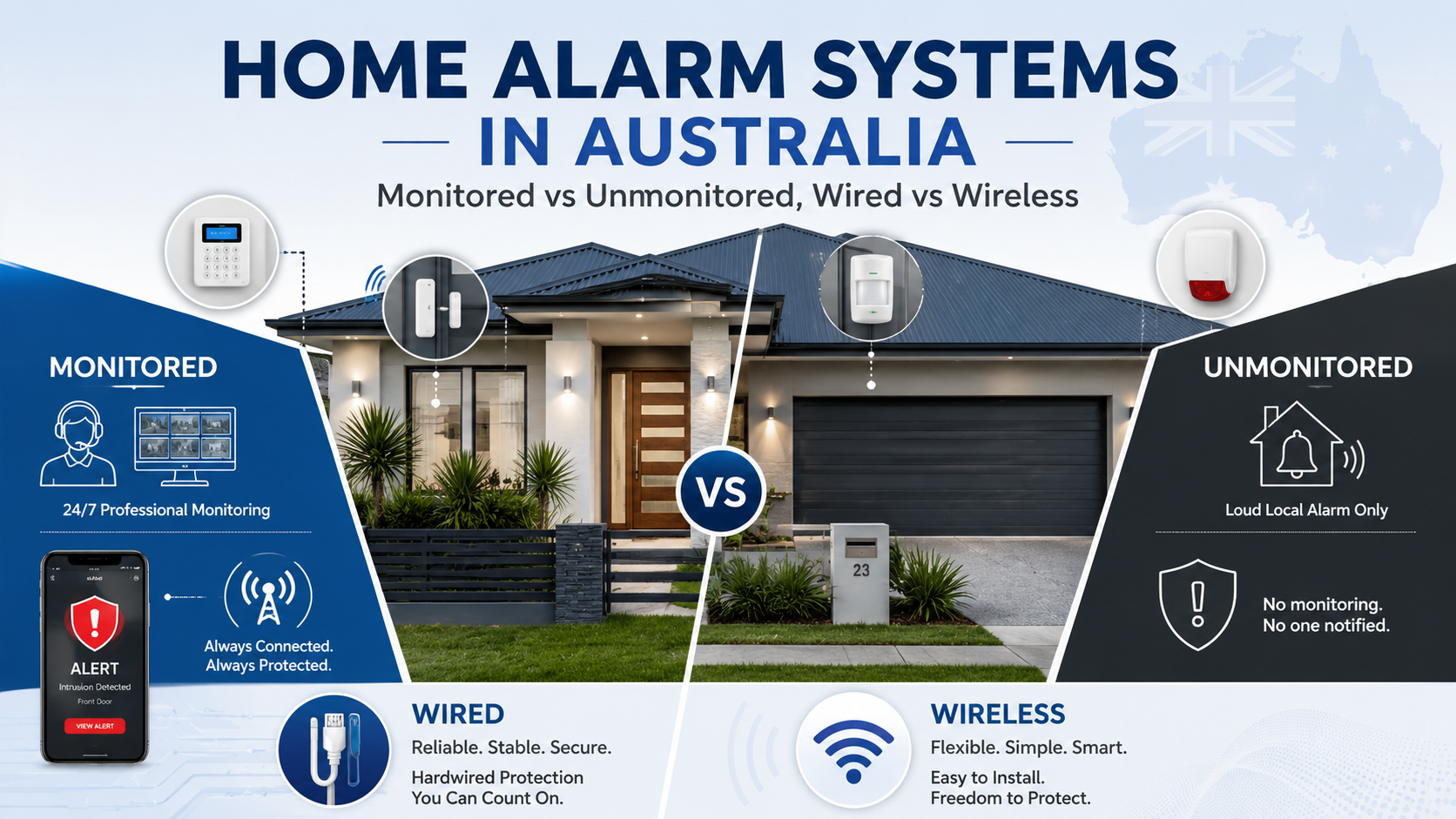
Monitored vs Unmonitored: The Real Difference
This is the most important decision in alarm system buying, and most content online skips over what the difference actually means in practice.
Unmonitored (Self-Monitored) Alarm Systems
An unmonitored system sounds a siren and sends you a push notification when triggered. You decide what to do. You might call a neighbour, call police, or drive home from work to check. If you are asleep with your phone on silent, you might not respond until morning.
Unmonitored systems are cheaper to run because there is no monthly fee. They are effective as deterrents because the siren alone will move most opportunistic burglars on quickly. The limitation is that response depends entirely on you being available, awake, and willing to act on every alert, including the false ones.
Professionally Monitored Alarm Systems
A monitored system sends a signal to a 24/7 monitoring centre when triggered. Trained operators assess the event (sometimes using connected cameras) and contact police or security patrols if warranted. They respond whether you are asleep, overseas, or simply unavailable.
The ongoing cost is typically $25-60 per month depending on the level of service. Most Australian insurers offer premium discounts for monitored alarm systems, and the discount often covers the monitoring cost within two to three years. Beyond the financial offset, the practical protection advantage is significant, particularly for homes with regular travel or long work hours.
|
Factor |
Monitored vs Unmonitored |
|
Monthly cost |
Monitored: $25-60/month. Unmonitored: $0/month |
|
Response when away |
Monitored: Professional response. Unmonitored: Depends on you |
|
Insurance discount |
Monitored: Yes, typically 5-15%. Unmonitored: Rarely |
|
False alarm handling |
Monitored: Operators filter. Unmonitored: You filter |
|
Setup cost |
Similar. Professional installation applies to both |
Wired vs Wireless Alarm Systems
Wired Alarm Systems
Traditional wired alarm systems run cables from each sensor back to the control panel. They are highly reliable, immune to radio frequency interference, and do not depend on batteries in individual sensors. The downside is installation cost, particularly in existing homes where running cables through walls and ceilings is invasive and time-consuming.
Wired systems make the most sense in new builds where cables are run before walls are closed, or in commercial installations where the installation cost is justified by scale.
Wireless Alarm Systems
Modern wireless alarm systems use encrypted radio frequency communication between sensors and the panel. Systems like Ajax and Bosch Solution 3000 use 868MHz radio with AES-128 encryption, making them significantly more secure against jamming than older wireless products.
Wireless systems are faster to install, create no visible cabling, and can be relocated if you move. Battery life on sensors is typically three to five years. For the vast majority of existing Australian homes, a wireless system is the practical and often superior choice.
The relevant comparison is not whether wireless or wired is 'better' in abstract. It is whether the trade-offs of wired installation (cost, disruption) are worth the marginal reliability advantage in your specific situation. For most homeowners not in a new build, they are not.
Shop Home Alarm System Kits
Compare wired, wireless, monitored-ready, and smart alarm system kits from trusted security brands for Australian homes and businesses.

Bosch Alarm Kits
Reliable Bosch alarm kits for home, office, and business security installations.
View Kits
Hikvision Alarm Kits
Smart Hikvision alarm kits including AX PRO options for modern security.
View Kits
HiLook Alarm Kits
Practical HiLook alarm kits for simple home and small business protection.
View Kits


What Makes a Good Alarm System: The Components That Matter
Control Panel
The panel should support both NBN and 4G communication paths, not just one. If your NBN drops, the alarm still needs to communicate. Dual-path panels automatically fail over to 4G if the primary connection is unavailable. This is not a premium feature in 2026; it is a baseline expectation.
Sensors
PIR (Passive Infrared) motion sensors are the standard for interior rooms. Pet-immune PIR sensors reduce false alarms from cats and dogs under 20 kilograms. Door and window contacts are essential for perimeter zones. For external areas, consider outdoor PIR sensors rated for the weather and pet/wildlife movement common in Australian backyards.
Siren
Both an internal siren (inside the property) and an external siren (visible on the exterior) serve different purposes. The internal siren is an immediate deterrent when an intruder is inside. The external siren alerts neighbours and reinforces the visible security presence. Both are worth including in a complete installation.
Smart Home Integration
Modern systems like Ajax integrate with smart home platforms, allowing you to arm and disarm via phone, set automated arming schedules, and receive event notifications with footage if cameras are integrated. This convenience is real but should not be the primary purchasing criterion.
Integrating Your Alarm with CCTV Cameras
An alarm system and a CCTV system that cannot talk to each other deliver less value than systems that are integrated. When an alarm sensor triggers, the integration should automatically switch the nearest camera to high-quality recording, capture a pre-alarm buffer (typically 5-10 seconds before the trigger), and attach the footage clip to the alarm event notification.
This means that when you receive an alert at 2am, you already have video of what triggered it. Operators at a monitoring centre can assess whether the event is genuine before dispatching a patrol, which reduces unnecessary callout costs.
Integration options depend on the brands you choose. Hikvision NVRs integrate natively with Hikvision alarm products. Ajax has open API support for third-party NVR integration. Bosch alarm systems integrate with specific compatible camera platforms. Buying cameras and alarm hardware from a supplier who understands these compatibility requirements avoids expensive surprises during commissioning.
What to Avoid When Buying a Home Alarm System
-
Long lock-in monitoring contracts: Some monitoring providers lock buyers into three-year or five-year contracts for hardware and monitoring bundled together. Understand what you are signing before committing.
-
Alarm systems without 4G backup: A burglary that cuts your NBN cable before entry defeats any NBN-only alarm. Dual-path communication is essential.
-
DIY systems marketed as 'professional grade': Consumer DIY alarm kits can work as deterrents but generally do not meet the reliability or grading standards required for professional monitoring or insurance discount eligibility.
-
Proprietary ecosystems with limited expansion: Some systems only support the manufacturer's own sensors. This limits your ability to expand or replace components later without replacing the entire system.
Frequently Asked Questions
Do alarm systems actually deter burglars in Australia?
Yes, meaningfully. Research from the AIC (Australian Institute of Criminology) consistently shows that visible alarm systems are among the most effective deterrents for opportunistic burglars. Most residential break-ins are not planned by persistent professionals; they are opportunistic. A visible alarm box and siren on the exterior of a property is enough to move most casual intruders to an easier target.
What is the average cost to install a home alarm system in Australia?
A professionally installed wireless alarm system for a standard three-bedroom home typically costs $1,200 to $2,500 for equipment and installation. This range covers the panel, six to eight sensors, internal and external sirens, and basic programming. Higher-end systems with more sensors, smoke detectors, and integration add cost.
Can I install a home alarm system myself?
Some wireless systems are designed for DIY installation. The sensors can be placed and the app configured without a technician. However, professional installation is recommended for several reasons: proper sensor placement to avoid false alarms, correct programming of entry and exit delays, and ensuring the system meets any insurance or monitoring service requirements. Poorly configured DIY installations often generate constant false alarms, which leads most owners to eventually disable them.
What is Ajax and why do installers recommend it?
Ajax is a Ukrainian-developed wireless alarm platform that has become one of the most widely specified systems by Australian security installers over the past three years. Its appeal is a combination of reliable encrypted radio communication (resistant to jamming), a well-designed app, modular hardware that expands easily, no mandatory cloud subscriptions, and broad monitoring centre compatibility. It is available through authorised Australian distributors including CCTV Importers.
Conclusion
A home alarm system is only useful if someone responds when it triggers. That single principle should guide every decision: choose a dual-path panel so the communication cannot be cut, choose professional monitoring so a trained person responds whether you are available or not, and integrate it with your CCTV cameras so every alarm event comes with footage.
The upfront cost of doing it properly is real. So is the long-term payoff in insurance savings, property protection, and the confidence of knowing your home is covered when you are not there to cover it yourself.
Explore alarm kits from Ajax, Bosch, and Paradox at CCTV Importers, with professional installation support available across Australia.


