
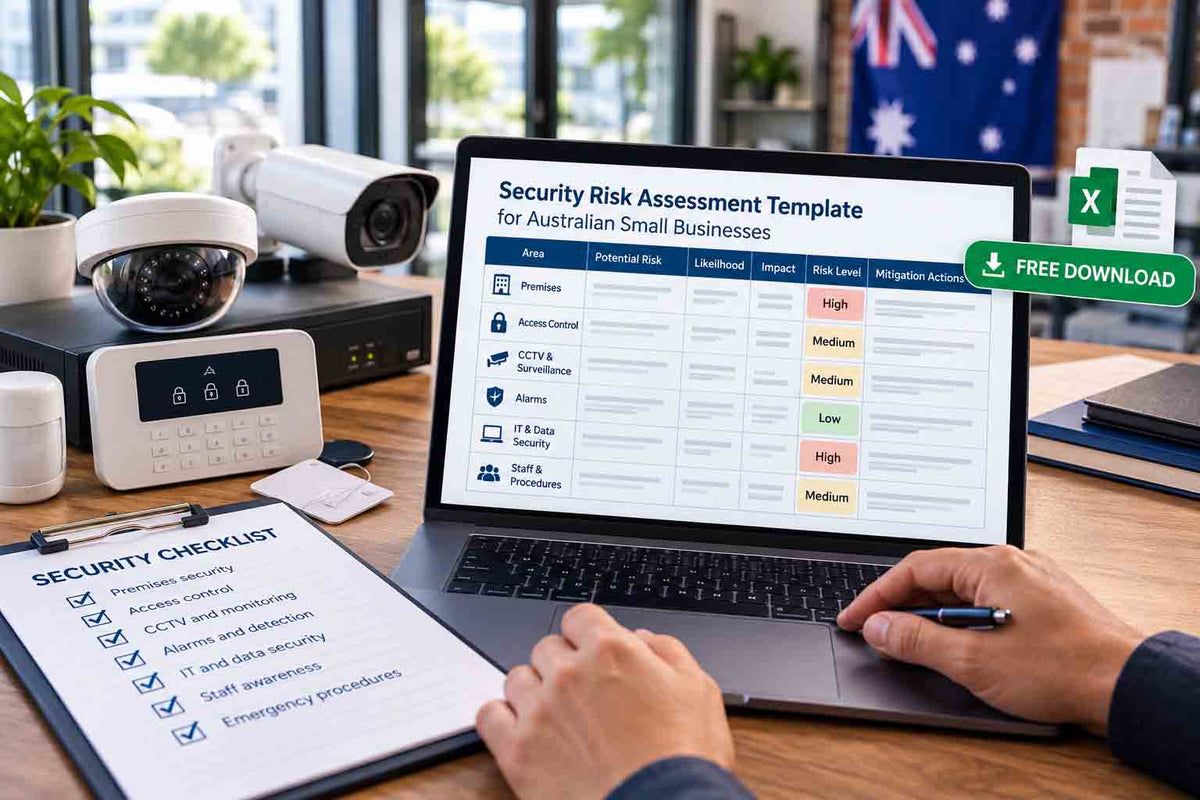
Most small businesses buy security after something goes wrong. The till is short, a ute is stripped overnight, or a staff member is threatened at closing time. A security risk assessment flips that around: you list what could go wrong, rate how likely and how bad it would be, and fix the biggest gaps first.
It sounds like consultant work, but a café, workshop or retail shop can do a useful one in an afternoon. Download our free template and follow the five steps below.
TL;DR:
A security risk assessment has five steps: list your assets, identify threats, rate each risk by likelihood and consequence, choose controls, and review regularly. Use a 5x5 risk matrix to score each risk from 1 to 25. Tackle anything scoring 15+ first. Typical controls include CCTV covering entries and registers, a monitored alarm, access control, lighting and cash-handling procedures.

What is a security risk assessment?
It is a structured review of the physical threats to your people, stock, cash, equipment and information, and the controls you have (or need) to reduce them. It is different from a cyber-security assessment, although the two overlap where cameras and alarms connect to your network.
The method below follows the general risk process in AS ISO 31000 (Risk management guidelines): identify, analyse, evaluate, treat and monitor.
Step 1: list what you are protecting
-
People: staff, customers, contractors, especially anyone opening or closing alone
-
Cash and payments: tills, safes, banking runs
-
Stock: high-value or easily resold items
-
Equipment and vehicles: tools, utes, forklifts, IT
-
Premises: doors, windows, roller doors, roof access
-
Information: customer records, CCTV footage, financial data
Step 2: identify the threats
Walk the site at different times of day and night. Common threats for Australian small businesses include:
-
After-hours break-ins and ram raids
-
Shoplifting and internal theft
-
Vehicle and tool theft from yards
-
Aggression or robbery at opening and closing
-
Vandalism and graffiti
-
Unauthorised access by former staff or contractors
Step 3: rate each risk
Score likelihood and consequence from 1 to 5, then multiply.
|
Score |
Likelihood |
Consequence |
|---|---|---|
|
1 |
Rare (may never happen) |
Insignificant (no injury, minimal loss) |
|
2 |
Unlikely |
Minor (small loss, quick recovery) |
|
3 |
Possible |
Moderate (noticeable loss or disruption) |
|
4 |
Likely |
Major (serious injury or large loss) |
|
5 |
Almost certain |
Severe (critical injury, business at risk) |
|
Risk score |
Rating |
Action |
|---|---|---|
|
15 to 25 |
Extreme / High |
Act now |
|
8 to 14 |
Medium |
Plan controls within weeks |
|
1 to 7 |
Low |
Monitor and review |
Step 4: choose controls
Match each risk to practical controls. Layer them: deter, detect, delay, respond.
|
Control |
Deters |
Detects |
Records evidence |
|---|---|---|---|
|
CCTV at entries, registers, yard |
Yes |
With AI alerts |
Yes |
|
Monitored alarm system |
Yes |
Yes |
Event logs |
|
Access control (cards, fobs, PIN) |
Yes |
Logs every entry |
Yes |
|
Sensor lighting |
Yes |
Partly |
No |
|
Fogging system |
Yes |
No |
No |
|
Cash procedures and safes |
Yes |
No |
No |
Our guide to business CCTV in Melbourne and the small business CCTV guide cover camera layouts. For high-value stock, fogging systems fill a room with harmless fog within seconds of an alarm.
Worked example: a suburban retail shop
|
Risk |
Likelihood |
Consequence |
Score |
Controls |
|---|---|---|---|---|
|
After-hours break-in through rear door |
3 |
4 |
12 |
Alarm with rear PIR, CCTV on rear door, upgrade lock |
|
Shoplifting near entrance |
4 |
2 |
8 |
Dome camera over entry, monitor near counter |
|
Staff robbery at closing |
2 |
5 |
10 |
Two-person closing, duress button, CCTV at register |
|
Internal theft from till |
3 |
3 |
9 |
Camera over register, cash-up procedure |
|
Ram raid on shopfront |
1 |
5 |
5 |
Bollards, CCTV with number plate camera |
Step 5: review and record
Review at least once a year and after any incident, renovation or change in trading hours. Keep the completed template with your WHS records. Insurers sometimes ask what security measures are in place, and a documented assessment answers that quickly.
What's in the free template
-
Asset and threat worksheet
-
5x5 likelihood and consequence matrix with colour scoring
-
Controls planner (CCTV, alarm, access, lighting, procedures)
-
Action register with owners and due dates
-
Annual review sign-off page
[Download the security risk assessment template (PDF + Excel)]
Free Security Risk Assessment Template
Identify potential security risks, assess vulnerabilities and plan improvements with our free security risk assessment template. Available in printable PDF and editable Excel formats.
Free templates • PDF + Editable Excel • No sign-up required
Frequently asked questions
Is a security risk assessment a legal requirement?
There is no single law requiring one for all businesses, but WHS laws require employers to manage risks to workers, which includes threats like robbery and aggression. A documented assessment helps show you have done that.
How often should I do a security risk assessment?
At least once a year, and whenever something changes: an incident, new premises, longer opening hours or new high-value stock.
What's the difference between a security audit and a risk assessment?
An audit checks whether existing controls are in place and working. A risk assessment decides which risks matter most and what controls you need.
Can I use this template for my home?
Yes. The same steps work for a home security assessment. Swap stock and cash for family, vehicles and valuables.
Where should CCTV go in a small business?
Entry and exit doors, the register, stockrooms, rear doors and loading areas, and the car park or yard.
Turn the assessment into action
The point of an assessment is the action list. Fix the high scores first, then work down. If CCTV, alarms or access control are on your list, we can help design them.
Browse commercial CCTV systems, see alarm kits, or read our commercial CCTV guide.


