
Dahua and Hikvision dominate the Australian CCTV conversation because they’re both proven, widely installed, and packed with features that actually matter at home: clear night footage, smart motion alerts, and reliable recording.
Here’s the punchy truth for 2026 Australian homes:
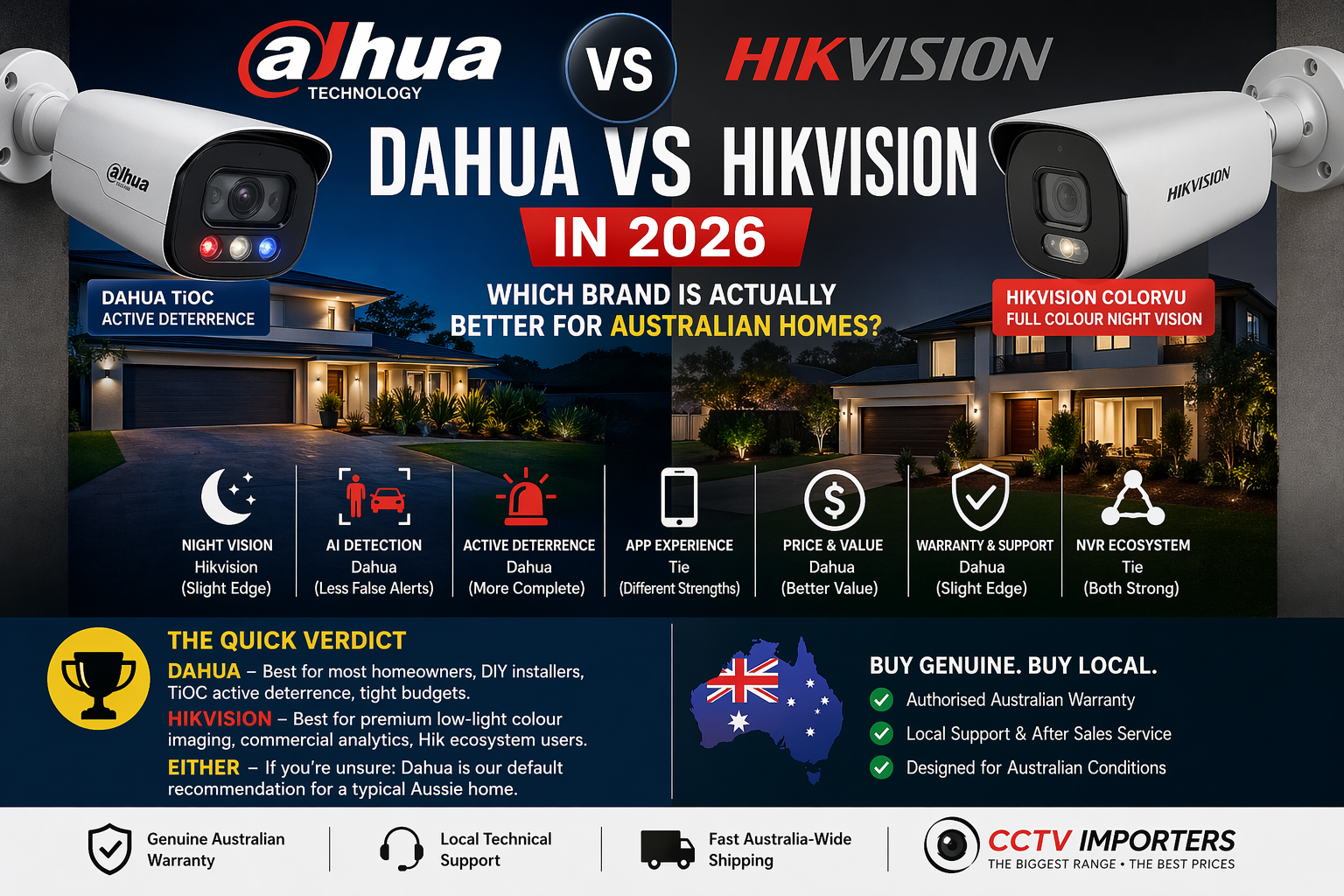
Quick verdict (read this before you scroll):
- Dahua — best for: most homeowners, DIY installers, fewer annoying false alerts, TiOC active deterrence, better value.
- Hikvision — best for: premium low-light colour imaging (ColorVu), and buyers who want the “best-looking night video” even in darker blocks.
- Either (if you’re unsure): if this is a typical suburban home, Dahua is our default recommendation in 2026.
Not because Hikvision is “bad” — but because Dahua’s home-focused combo (AI filtering + deterrence + value) usually delivers the best real-world experience for families.
Who are Dahua and Hikvision? (what Australians need to know)
Both Dahua and Hikvision are Chinese manufacturers and two of the biggest names in video surveillance globally. Independent market analysis varies by definition and segment, but one 2026 industry report estimates Hikvision and Dahua together held ~39.2% of the surveillance camera market share in 2025, which is enormous for two brands.
“What about the government bans?”
You’ve probably heard about restrictions overseas — and you may have seen headlines about Australia removing these cameras from some government facilities. That’s real: Australia’s Defence Department announced removal of Hikvision and Dahua cameras from defence buildings, reflecting government-level national security risk management (not a “your house is illegal” situation).
For Australian private homes and typical small businesses: both brands are legal to buy and widely used. The government concern is mostly about government and sensitive/critical environments, not suburban homes.
If you’re doing government/defence work (or tenders that require NDAA compliance): look at alternatives that are commonly used in compliance-driven projects (e.g., Axis, Hanwha/Wisenet, and some Uniview lines). NDAA Section 889 compliance is a common procurement requirement in some environments, and it explicitly restricts certain manufacturers in those contexts.
Local warranty matters in Australia (avoid grey imports)
One big thing Australians often miss: local distribution + local warranty matters more than the brand logo. CCTV Importers states it supplies authorised AU/NZ equipment through official distribution partners, designed for local standards/firmware/support networks, and backed by warranty.
That’s especially important when you need firmware guidance, compatibility advice, or after-sales support.
Head-to-head: 7 factors that actually matter for Australian homes
This is the section most comparison posts avoid. We won’t.
1) Night vision and low-light performance
If your key concern is “Can I see faces clearly at night?”, this is the battlefield.
Hikvision’s edge: ColorVu is designed for full-colour imaging in low light, using a large F1.0 aperture lens and advanced sensors (Hikvision positions it as vivid full-colour day/night).
Dahua’s approach: TiOC and active deterrence ranges blend warm light + IR-style behaviour so you can get colour evidence when you need it, without running bright lights all night. Dahua’s TiOC pages describe modes that can reduce light pollution (e.g., IR mode or warm light mode) and switch behaviour based on detection.
The Aussie reality (streetlights change everything):
-
In a typical suburban street-lit driveway, both brands can perform extremely well.
-
On rural blocks / dark side access / no street lighting, Hikvision ColorVu tends to win for pure “always-colour” imaging quality.
Winner badge:
-
Winner for pure night imaging: Hikvision (slight edge)
-
Winner for practical home use: Dahua (hybrid lighting is less annoying for neighbours)
2) AI motion detection and false alerts
This is where real homeowners either love their CCTV… or mute it forever.
Hikvision AcuSense: Hikvision explicitly markets AcuSense as reducing false alarms from things like animals, leaves, heavy rain, and other moving objects, and focusing attention on people and vehicles.
Dahua WizSense / SMD 4.0: Dahua’s SMD 4.0 is designed to filter irrelevant objects and explicitly mentions filtering small and large animals to reduce false alarms.
What matters most for an Aussie home:
-
Trees moving in wind (common in front yards)
-
Insects near IR at night
-
Headlights and reflections on driveways
-
Cats/dogs in side access
Both brands can do human/vehicle classification well when configured properly. But Dahua’s home-focused SMD approach plus its event workflows are often easier to tune for “family life” (alerts you actually want, not 47 junk pings).
Winner badge: Dahua
3) Active deterrence (TiOC vs “active deterrence” ranges)
If you want the camera to do more than record — if you want it to stop the behaviour — deterrence matters.
Dahua Active Deterrence / TiOC: Dahua’s active deterrence positioning includes built-in mic/speaker (two-way audio), and warning features like siren plus white or red/blue lights.
This works brilliantly in Australia for common home scenarios:
-
someone testing your side gate at 2am
-
teenagers cutting through the yard
-
package tampering at the porch
-
“checking car doors” behaviour in the driveway
Hikvision’s deterrence ecosystem: Hikvision has deterrence-capable ranges too (and related lines like HiLook ACDC marketing in AU mention red/blue strobe + two-way audio in some models).
Where Dahua tends to feel more “home-ready”: Dahua’s TiOC emphasis on switching lighting behaviour and reducing light pollution is very practical for homes where you don’t want a floodlight permanently annoying the neighbours.
Winner badge: Dahua
4) App usability (DMSS vs Hik-Connect)
Apps sound boring until you’re trying to check an alert at Coles.
Hik-Connect: The Hik-Connect app is designed to work with DVRs/NVRs/cameras, supports live view + playback, and sends alarm notifications.
DMSS (Dahua): DMSS similarly supports live view, playback, and push notifications; it also emphasises finding events by date and event category.
The practical difference in 2026:
-
Hik-Connect tends to feel a bit more polished for everyday users.
-
DMSS is strong on event review workflows (especially when the recorder/cameras are configured with smart event types).
A note on “Pro platforms”: Hikvision runs installer/service ecosystems like Hik-ProConnect / Hik-Partner Pro; their service terms explicitly discuss paid services/subscriptions in that ecosystem. For most homeowners this is “behind the scenes,” but it’s relevant if you expect ongoing managed support.
Winner badge: Tie
-
Hikvision for UI polish
-
Dahua for straightforward event workflows
5) Pricing and value (the honest bit)
For most Australians, CCTV is a “do it once, do it right” purchase — but nobody wants to overspend for bragging rights.
On CCTV Importers, you can see Dahua kits and components offered at aggressive pricing across multiple tiers (including TiOC/WizSense kits).
Hikvision’s collection is also broad, with many options, but equivalent “premium low-light” setups commonly sit at a higher price point.
Rather than promising a fixed “10–20% cheaper” (it changes week-to-week), the clean advice is:
-
If you want the best value for a typical Aussie home: Dahua usually wins.
-
If you want the prettiest low-light colour video: Hikvision ColorVu may justify a premium.
Winner badge: Dahua
6) Australian warranty and local support
This is where people get burned.
Both brands can be excellent when you buy genuine AU/NZ distribution stock. CCTV Importers states it supplies authorised equipment through local distribution partners and backs products with warranty.
Grey import problem (plain English):
-
You may save a little upfront.
-
But you can lose local warranty coverage and end up with messy firmware/support outcomes.
If you’re comparing Dahua vs Hikvision for a home, warranty support isn’t about which brand is “nicer” — it’s about whether your seller can actually help when you need it.
Winner badge: Dahua (slight edge) — mainly because Dahua’s home-focused ecosystem + support approach tends to be easier for typical residential setups, but only when bought from proper local channels.
7) NVR ecosystem and mixing cameras
Yes, you can mix brands in many situations… but here’s the catch:
When you mix brands, you often lose the smart features.
AI classification, smart search, and deterrence linkages typically work best when the cameras + recorder are in the same ecosystem.
Dahua standout (home use): AcuPick / smart search
Dahua positions AcuPick as a smart way to locate humans/vehicles quickly by using pre-search and target search features.
For a home user, that matters because it turns “scrub through 4 hours of footage” into “find the person/vehicle event fast.”
Hikvision ecosystem advantage (commercial leaning):
Hikvision’s ecosystem is deep across intercom, alarms, and commercial analytics. Their marketing and product family integration is a strong fit for business requirements and multi-site users.
Winner badge: Tie
-
Dahua for home-friendly smart search workflows (AcuPick)
-
Hikvision for broader ecosystem polish and commercial analytics direction
Summary table (quick scan)
|
Factor |
Winner |
|
Night vision quality (pure low light colour) |
Hikvision |
|
AI / false alert reduction |
Dahua |
|
Active deterrence |
Dahua |
|
App usability |
Tie |
|
Price / value |
Dahua |
|
Aus warranty & support (when bought genuine) |
Dahua (slight) |
|
NVR ecosystem |
Tie |
Which brand should YOU choose? (by situation)
Here’s the “choose your path” version — no fluff.
1) Typical home (3–4 bed suburban house)
Choose: Dahua TiOC / WizSense.
You get strong AI filtering, practical deterrence, and great value.
2) Double-storey or large property
Choose: Dahua WizSense 6MP + AI NVR.
More cameras, more entry points, more time saved reviewing footage — this is where smart search features (AcuPick workflows) shine.
(Internal link idea: “How many cameras do I need?” — see link map below.)
3) Small business (shop, café, warehouse)
Choose: Hikvision (AcuSense) if you need business-style analytics and integration.
AcuSense focuses on reducing false alarms and distinguishing people/vehicles, which is useful in busy environments.
4) Premium home buyer who wants the best night imaging
Choose: Hikvision ColorVu 3.0.
If your driveway and yard are dark and you want the best “always-colour” look, ColorVu is hard to beat.
5) Rental property / Airbnb
Choose: Dahua (simple handover + practical features).
You want reliable recording, sensible alerts, and easy ongoing support from an AU-based supplier.
The one thing that matters more than brand choice
A well-installed Dahua system beats a poorly installed Hikvision system every time.
Here’s why:
-
Camera angle and mounting height determine whether you get faces or hats.
-
Network layout affects whether remote viewing is stable on real Aussie connections.
-
Recording settings determine whether you have 7 days of footage… or 2 days.
Also: don’t underestimate the “source of purchase” factor. CCTV Importers positions itself as an authorised supplier using local distribution partners, with warranties, compliance with Australian standards, and local support.
CTA (soft, honest): If you’re not sure which brand suits your home layout, get a recommendation from a team that will still answer the phone after install.
FAQ: Dahua vs Hikvision
Can I mix Dahua cameras with a Hikvision NVR?
Technically, sometimes yes, but you often lose the smart features (AI filtering, smart search, deterrence triggers). Best practice: pick one ecosystem for cameras + recorder.
Are Dahua and Hikvision banned in Australia?
Not for normal residential and commercial use. Australia has removed these brands from some government environments as part of national security risk management.
If you’re working in government/defence or compliance-driven procurement, you may need NDAA-compliant alternatives.
Which has better night vision, Dahua or Hikvision?
Hikvision generally wins for “pure low-light full-colour” (ColorVu design focus).
Dahua often wins for practical home deterrence + hybrid lighting behaviour (TiOC approach).
Is Dahua cheaper than Hikvision?
Often, yes on like-for-like home kits — but pricing changes weekly. Best move: compare current kit pricing from the Dahua and Hikvision collections on the same store.
Which brand has a better app in Australia?
Hik-Connect is very user-friendly and supports live view, playback, and alarm notifications. DMSS also supports live view, playback, and push notifications and is strong on event-based playback workflows.
Do both brands work in Australian heat and climate?
Generally yes — many outdoor models across both brands are built for outdoor conditions (look for IP ratings and operating temp ranges on the exact model you choose). If you’re coastal or high-heat inland, model selection and installation quality matter most.
Conclusion (clear verdict + next steps)
If you’re buying CCTV for a typical Australian home in 2026, Dahua is the smarter buy: fewer annoying alerts, strong deterrence options, and better value for money.
If you’re the buyer who cares most about the best-looking low-light colour footage — and you’re happy to pay for it — Hikvision ColorVu 3.0 is worth the premium.
Either way: buy genuine AU/NZ stock from an authorised supplier, because warranty and support matter more than spec-sheet bragging.


