
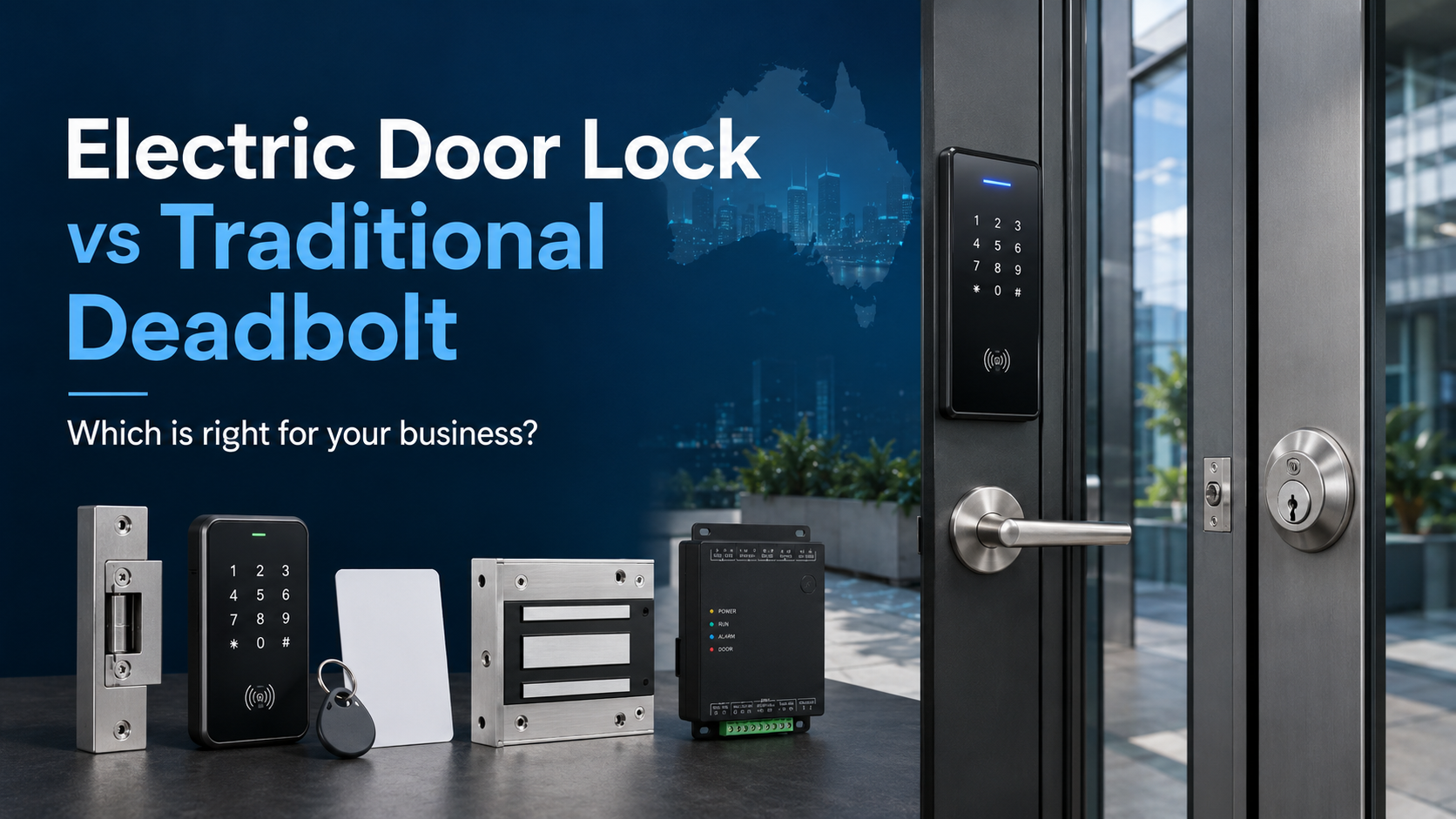
A staff member finishes their shift, locks up, and heads home. Two days later you find out they kept a copy of the key. It happens more than business owners like to admit, and it's one of the main reasons commercial properties are increasingly moving away from traditional deadbolts.
But the decision is not as simple as "electric is better." The right door lock depends on your premises, your team size, your budget, and how much risk you can live with. This guide covers both options honestly: how they work, where they shine, where they fall short, and what a realistic installation looks like for an Australian business.
What Is a Traditional Deadbolt?
A deadbolt is a mechanical lock. Turn the key, throw the bolt, and the door is secured. No power required, no network connection, no software. It is about as simple as a lock gets.
The bolt extends into the door frame when locked, which makes it far more resistant to forced entry than a standard spring latch. That is why deadbolts became the default for external commercial doors. A quality deadbolt from a reputable brand, properly installed in a solid door frame, provides genuine physical resistance.
Most Australian businesses still rely on them. Retail shops, small offices, storage rooms, tradies' sheds. Walk down any commercial strip in the suburbs and the majority of those front doors have a deadbolt on them.
They work. The problem is what they do not do.
What Is an Electric Door Lock?
An electric door lock replaces the mechanical throw-and-bolt mechanism with an electrically operated one. Instead of a physical key, access is granted through a PIN pad, keycard, fingerprint reader, smartphone app, or remote release from a control panel.
There are a few different types worth knowing about:
Electric strike locks sit in the door frame where a standard lock strike would go. The frame releases electronically when a valid credential is presented, allowing the door to open. The door itself still has a physical latch or lock.
Magnetic locks (maglocks) use an electromagnet mounted on the door frame, held against a steel plate on the door. When powered, the magnetic force holds the door shut. Cut the power and the door releases. This matters for fire safety, which is something to plan around carefully.
Electric deadbolts work like a standard deadbolt but are driven by a motor rather than a key. They can be operated remotely or via keypad, and many also include a key cylinder as a backup.
Keypad and smart locks cover a broad category of consumer and commercial-grade locks that use PIN codes, Bluetooth, or Wi-Fi to control access. Quality varies significantly in this category.
Shop Electric Locking Products
Explore electric locking products for secure access control installations, including electric strikes, magnetic locks, drop bolts, door locks, and related locking accessories for Australian homes and businesses.
View Electric Locking CollectionElectric Door Lock vs Deadbolt: The Core Differences
Security Rating
A good traditional deadbolt, say a Grade 1 commercial unit from a brand like Lockwood or Schlage, offers solid physical security. The bolt is typically made from hardened steel, and the mechanism is simple enough that there is very little to fail electronically.
Electric door locks vary. A budget smart lock from a consumer brand might offer less physical resistance than a quality deadbolt. A commercial-grade maglock rated at 600kg holding force is a different story altogether. It will not be defeated by shoulder force, a credit card, or a bump key.
The honest answer is that security ratings depend on the specific product, not the category. A cheap electric lock is not inherently more secure than a good deadbolt. A quality commercial electric lock, properly specified and installed, usually is.
What electric locks add is something deadbolts cannot: the ability to revoke credentials instantly. A stolen key still works until you change the lock. A deactivated keycard or PIN code stops working the moment you say so.
Cost
This is where deadbolts win clearly on upfront cost.
A quality commercial deadbolt typically runs $80 to $300 for the hardware. A licensed locksmith to install it adds $100 to $200. You are looking at $200 to $500 total for a single door, done.
Electric door locks have a wider cost range. A basic keypad deadbolt starts around $150 to $400. A commercial-grade maglock or electric strike with a keycard reader, wired in properly with a controller, runs $800 to $2,500 per door installed. Cloud-connected systems with multi-door management are higher again.
Over time, though, the maths shifts. Every time a key is lost or a staff member leaves without returning theirs, you either re-key the lock (typically $80 to $150 per lock) or accept the security risk. Electric locks eliminate that recurring cost entirely.
Convenience and Practicality
Traditional deadbolts require a physical key. That means key cutting when new staff start, key collection when they leave, managing multiple copies, and occasionally locking yourself out. For a business with five employees, manageable. For a business with fifty, a constant low-level administrative headache.
Electric locks remove the key from the equation. Staff tap a card or enter a PIN. No key to cut, no key to lose, no locksmith required when someone leaves. Access is granted and revoked from a computer or phone.
There is also the after-hours dimension. With a traditional deadbolt, letting a contractor into the building while you are not there means physically being present or leaving a key with someone. With an electric lock, you can grant temporary access remotely, see when the door was opened, and revoke access when the job is done.
Reliability and Power Dependency
Deadbolts do not need electricity. This is a genuine advantage in a power outage. The lock still works exactly as it always has.
Electric locks depend on power. Most commercial systems have battery backup, and many use fail-safe or fail-secure configurations to handle outages. A fail-safe lock releases when power is cut, which is required on fire egress routes under Australian building codes. A fail-secure lock stays locked, which suits non-egress doors like server rooms or storage.
Understanding the difference matters. Installing a fail-secure maglock on a fire exit is not just impractical, it is a compliance issue. Your installer should know this, but it is worth confirming before any hardware goes in.
Installation
A locksmith can fit a deadbolt in under an hour. No cabling, no controllers, no network configuration. If you are renting and your landlord is particular about modifications, a deadbolt is unlikely to cause issues.
Electric locks require more work. Depending on the type, you may need low-voltage cabling run through the door frame, a power supply, a door controller, and potentially network connectivity. In older commercial buildings, this can get complicated quickly. In a new or recently fitted-out office, it is usually straightforward.
You will also need a licensed electrician in most states for anything involving fixed wiring, plus potentially a licensed security installer depending on your jurisdiction.
Where Each One Makes Sense for Australian Businesses
Deadbolts are still the right call for:
Storage rooms and back-of-house areas where a handful of trusted staff need access and turnover is low. A quality deadbolt on a solid door frame does the job without any complexity.
Rental properties and leased premises where you need a clean, reversible installation. Many commercial leases restrict the type of modifications you can make, and a deadbolt is unlikely to trigger any issues.
Low-risk secondary doors that are never used as main entry points. Not every door in a building needs an electric lock.
Electric door locks are the better choice for:
Main entry and exit points where staff turnover happens regularly. The ability to deactivate a credential without changing the physical lock is worth the upfront cost many times over for businesses that hire casually or seasonally.
Offices managing multiple sites. A cloud-connected electric lock on every entry point means you can manage access across your whole operation from one dashboard. That is simply not possible with physical keys.
Any business where you need an audit trail. Knowing that the back door was opened at 11:47pm on a Tuesday is information a deadbolt cannot give you. Paired with security camera systems, that audit trail becomes genuinely powerful.
Buildings that already run access control systems. If you have keycard readers on most doors, adding a deadbolt on one door creates an inconsistent and weaker overall setup. Keep the system consistent.
High-security areas like server rooms, pharmaceutical storage, or cash-handling areas. A commercial-grade maglock or electric strike is harder to defeat than a mechanical deadbolt and gives you full control over who gets in.
Pairing Door Locks With the Right Security Setup
A good door lock, electric or mechanical, works best as part of a broader setup rather than a standalone measure.
Most break-ins targeting Australian commercial premises are opportunistic. Visible deterrents matter: a doorbell camera at the front entry, PoE cameras covering the car park and back access points, and a monitored alarm kit all reduce the likelihood that someone tests your lock in the first place.
If your lock does get tested, your camera system provides evidence. If it is defeated, your alarm provides notification. None of those layers work as well in isolation.
The other piece worth thinking about is who gets alerted when something happens. A lock that keeps a door shut is one layer. A security camera system that records what happens at that door is another. An alarm that notifies someone when the door is forced is the third. Together they cover each other's gaps.
Shop Access Control Products
Explore access control products for secure residential and commercial installations, including door controllers, card readers, keypads, exit buttons, electric locks, access cards, and related security accessories.
View Access Control CollectionWhat to Budget For
Here is a realistic cost range for single-door installations in an Australian commercial context:
|
Setup |
Hardware |
Installation |
Total Estimate |
|
Quality deadbolt only |
$100 to $250 |
$100 to $200 |
$200 to $450 |
|
Basic keypad deadbolt |
$150 to $400 |
$150 to $250 |
$300 to $650 |
|
Electric strike with keycard reader |
$400 to $800 |
$300 to $600 |
$700 to $1,400 |
|
Commercial maglock with controller |
$500 to $1,000 |
$400 to $700 |
$900 to $1,700 |
|
Cloud-connected system (per door) |
$600 to $1,200 |
$400 to $800 |
$1,000 to $2,000 |
These are rough guides. Older buildings with limited conduit access, fire-rated doors, or complex frame configurations can push installation costs up significantly. Always get two or three quotes and ask each installer to walk you through exactly what is included.
Common Mistakes to Avoid
Buying a consumer smart lock for a commercial door. The locks you see advertised for home use are not built for the same duty cycle as a commercial entry point. A retail door that opens 200 times a day will wear out a consumer-grade lock quickly. Commercial-rated hardware costs more for a reason.
Installing a fail-secure lock on a fire exit. This is both a safety hazard and a code violation. Any door on a designated fire egress route needs a fail-safe lock that releases when power is cut or when the fire alarm activates. Confirm this with your installer before anything goes in.
Skipping the backup power. Electric locks without battery backup create a vulnerability during power outages. Most commercial systems include a backup, but budget installs sometimes skip this to cut costs. It is not worth the saving.
Not changing credentials when staff leave. This applies to electric locks too. Deactivating a keycard takes thirty seconds. Most businesses that have had a post-departure security incident admit the credential was never actually removed. Build it into your standard offboarding process.
Treating the lock as the only layer. A lock, electric or mechanical, is one component. Without cameras, without an alarm, and without a clear response plan, even the best lock leaves gaps. Browse our CCTV accessories if you are looking to round out your setup.
FAQs: Electric Door Locks for Australian Businesses
Are electric door locks more secure than deadbolts?
It depends on the specific products being compared. A commercial-grade electric lock, properly installed, typically provides equal or better physical security than a standard deadbolt, with the added advantage of instant credential revocation and access logging. A budget consumer smart lock may not match a quality mechanical deadbolt. Specify commercial-rated hardware for any external or high-traffic door.
What happens to an electric door lock during a power outage?
Most commercial electric locks include battery backup to maintain operation during short outages. Beyond that, the lock defaults to either fail-safe (releases, allowing egress) or fail-secure (stays locked). Which behaviour you need depends on the door's function. Fire exits must be fail-safe under Australian building codes. Your installer should configure this correctly for each door.
Can I install an electric lock myself?
Basic keypad deadbolts can sometimes be fitted as a DIY job. Anything involving fixed low-voltage wiring, door controllers, or integration with an alarm or access control system requires a licensed electrician in most Australian states. Getting this wrong can create compliance issues and void your insurance in the event of a claim.
How much does it cost to re-key a deadbolt in Australia?
Re-keying a single lock typically runs $80 to $150 through a licensed locksmith. If you have multiple locks on a master key system, re-keying becomes more involved and more expensive. Across a business that re-keys every time a staff member leaves, those costs accumulate quickly compared to the one-time cost of an electric lock with revocable credentials.
Do electric locks work with existing access control systems?
Many do, but compatibility needs to be confirmed before purchase. If you are already running a keycard or PIN-based access control system, look for electric locks that use the same credential standard. Mixing incompatible systems creates management headaches and security gaps.
Are maglocks legal on fire exits in Australia?
Electromagnetic locks can be used on fire exits but must be installed in a fail-safe configuration that releases on power cut, fire alarm activation, and manual override. The Building Code of Australia and relevant Australian Standards (AS 1905, AS 4600) cover the requirements. Your installer should be familiar with these. If they are not, find one who is.
What is the lifespan of a commercial electric door lock?
A quality commercial-grade electric lock, properly maintained, typically lasts 10 to 15 years. Consumer-grade smart locks have a significantly shorter service life, particularly on high-traffic commercial doors. Factor the replacement cycle into your total cost of ownership when comparing options.
Conclusion
For most Australian businesses, the question is not really "electric or deadbolt" but rather which doors need which solution.
A traditional deadbolt still makes sense on low-traffic secondary doors, storage areas, or any situation where simplicity and low cost matter more than remote management. It is reliable, independent of power, and requires no ongoing subscription or software.
Electric door locks make sense wherever staff turnover happens, wherever you need an audit trail, or wherever managing physical keys has become a genuine administrative burden. The upfront cost is higher, but the running costs are lower and the control is meaningfully better.
If you are building or upgrading a commercial security setup, start with your highest-risk entry points and work outward. Combine your door hardware with security cameras, a solid alarm kit, and doorbell cameras on front entries, and you will have a setup that actually deters, detects, and records, rather than one that just slows someone down by thirty seconds.
Browse our full range at CCTV Importers Australia or get in touch and we can help you spec the right combination for your premises.


