
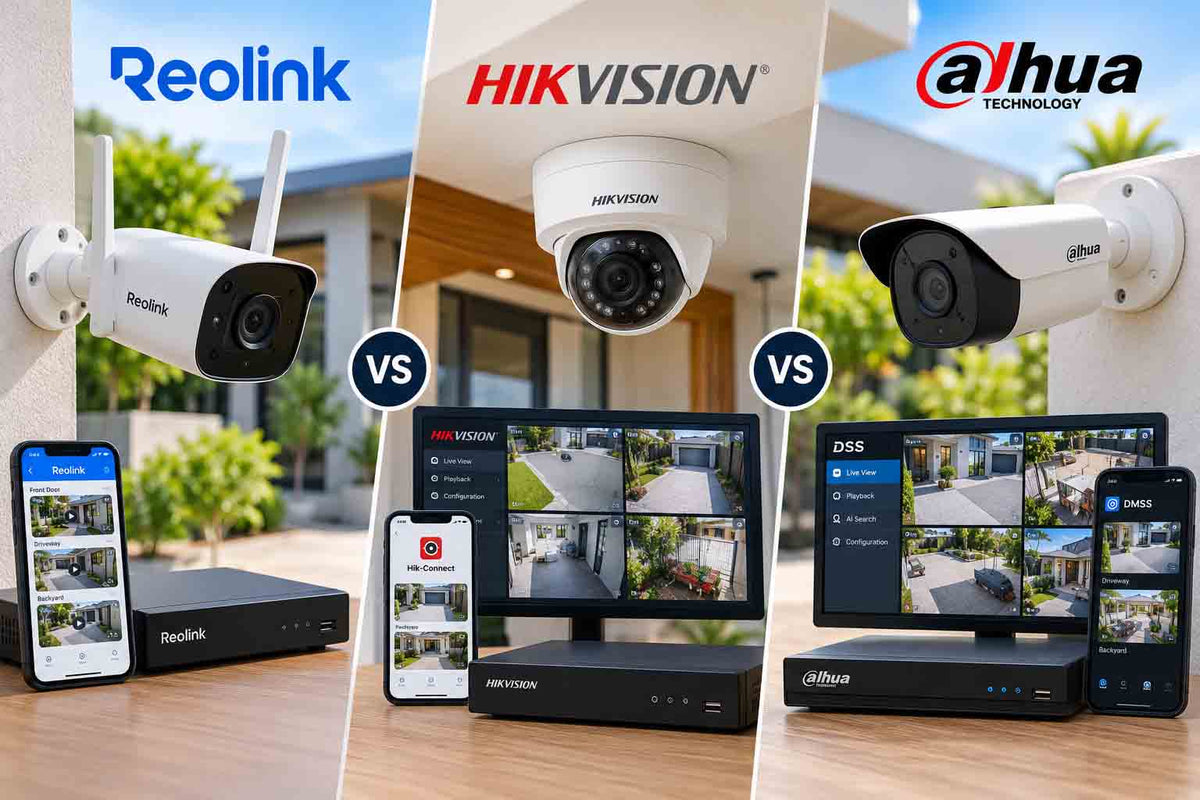
Reolink vs Hikvision vs Dahua: An Installer's Honest Comparison for Australian Homes
Reolink is now one of the most searched camera brands in Australia. Semrush data shows around 14,800 monthly AU searches for "reolink", compared with 6,600 for "hikvision" and 3,600 for "dahua". Plenty of buyers see a Reolink camera on a marketplace, then wonder whether a "pro" brand is worth the extra money.
We sell and support Hikvision and Dahua every day, so we will be upfront about that. This comparison still gives Reolink credit where it is due, and tells you when a Reolink camera is the sensible buy.
TL;DR:
Reolink is a solid consumer brand with easy Wi-Fi and battery options and no forced subscription. Hikvision and Dahua are professional brands with stronger low-light performance, better AI detection, wider product ranges and NVRs that scale to 16 or 32 cameras. For one or two cameras on a rental, Reolink is fine. For a whole-property system you will keep for 7 to 10 years, Hikvision or Dahua usually delivers more.
Quick comparison table
|
Feature |
Reolink |
Hikvision |
Dahua |
|---|---|---|---|
|
Market focus |
Consumer / DIY |
Professional + residential |
Professional + residential |
|
Typical resolutions |
4MP to 12MP |
4MP to 12MP+ |
4MP to 12MP+ |
|
Colour night vision |
Spotlight models |
ColorVu (F1.0 lens, warm light) |
Full-colour / TiOC |
|
AI detection |
Person, vehicle, pet |
AcuSense, AcuSeek search |
WizSense SMD Plus, AcuPick |
|
Active deterrence |
Spotlight + siren on some |
Strobe + siren (AcuSense 2.0) |
Red/blue light + siren (TiOC) |
|
Free app |
Reolink app |
Hik-Connect |
DMSS |
|
Subscription needed |
No (cloud optional) |
No |
No |
|
NVR scale |
8 to 16 channels |
4 to 64+ channels |
4 to 64+ channels |
|
Battery / solar range |
Large |
Growing |
Growing (incl. 4G solar) |
|
Installer support in AU |
Limited |
Extensive |
Extensive |
Image quality: where the gap shows
In daylight, a modern 8MP Reolink camera looks surprisingly close to an equivalent Hikvision or Dahua model. The difference appears at 2am. Hikvision ColorVu and Dahua full-colour cameras use large-aperture lenses and bigger sensors, so they hold colour and detail with very little light.
That matters on Australian streets where council lighting is patchy. If you need to identify clothing colour or a car outside the front fence, the pro models win. Our guide to ColorVu and AcuSense explains why.
AI detection and false alerts
All three brands offer person and vehicle detection. The difference is how well it filters the junk. Palm fronds in a Brisbane storm, possums on the fence and headlights sweeping across a driveway are the classic false-alert triggers.
From our installs, Hikvision AcuSense and Dahua SMD Plus filter these better, mainly because the detection runs on both the camera and the NVR. Dahua's Smart Motion Detection setup guide shows how much control you get.
Apps and ease of use
Reolink wins here for beginners. Its app is clean and setup is fast. Hik-Connect and DMSS have more menus, but they also give you more control: line crossing, intrusion zones, scheduled arming and multi-site viewing. Once a system is set up by an installer, most owners find the pro apps just as easy day to day.
Storage and subscriptions
Good news for all three: none forces a subscription. Each records to SD cards or an NVR. Reolink offers optional cloud. Hikvision and Dahua lean on local NVR storage, which suits 24/7 recording. See our no-subscription camera guide for the 5-year cost maths.
Compatibility: the installer's hidden issue
This is the one most buyers miss. If you mix brands later, you need ONVIF support and an NVR that plays nicely with other cameras. Hikvision and Dahua NVRs accept a wide range of third-party ONVIF cameras, though smart features work best with matching brands. Reolink cameras support ONVIF on many wired models, but battery and some Wi-Fi models are designed for the Reolink ecosystem only.
If you think you might grow from two cameras to eight, start on a platform built to scale.
Security and compliance questions
Australian buyers often ask about the NDAA. Hikvision and Dahua are both named in the US National Defense Authorization Act, which restricts US federal procurement. That does not make them illegal for Australian homes or businesses. Government and defence sites may have their own procurement rules. If you need NDAA-compliant gear, Hanwha Wisenet and TP-Link VIGI have options, and our NDAA buyer's guide explains the details.
Whatever brand you choose: change default passwords, update firmware and keep the NVR off public port forwarding.
Which one should you buy?
|
Your situation |
Our pick |
Why |
|---|---|---|
|
Renting, 1 to 2 cameras, no drilling |
Reolink battery or Wi-Fi |
Fast setup, easy to take with you |
|
Family home, 4 to 8 cameras, 24/7 recording |
Hikvision or Dahua 8MP NVR kit |
Better night images, smarter alerts, scales later |
|
Dark street or rural block |
Hikvision ColorVu or Dahua TiOC |
Low-light colour and active deterrence |
|
Small business with staff and stock |
Hikvision or Dahua |
Multi-user access, longer retention, installer support |
|
Off-grid shed or construction site |
Dahua or Reolink 4G solar |
Depends on budget and data plan |
Common mistakes when comparing brands
-
Comparing megapixels only. Sensor size and lens aperture matter more for night footage.
-
Judging on daytime YouTube clips. Ask for night samples.
-
Forgetting cable runs. PoE cameras outperform Wi-Fi in large brick homes.
-
Buying 4MP to save money. We now recommend 6MP as entry level and 8MP as standard.
Comparing Reolink, Hikvision and Dahua?
The right security camera depends on your property, budget and recording needs. Compare Hikvision and Dahua CCTV kits for PoE connectivity, AI detection, night vision and local NVR recording before making your decision.
Buying tip: Compare camera resolution, low-light performance, storage capacity and ongoing costs rather than choosing by brand alone.
Frequently asked questions
Is Reolink as good as Hikvision?
For daytime footage and simple setups, Reolink is competitive. Hikvision generally performs better at night, offers smarter detection and scales to larger systems with more NVR options.
Is Reolink a Chinese brand?
Yes, Reolink is headquartered in China, like Hikvision and Dahua. Data privacy depends more on how you configure the system than on the brand.
Can I use Reolink cameras on a Hikvision NVR?
Many wired Reolink cameras support ONVIF, so they can record to a Hikvision NVR. Smart detection features may not carry across, so test before committing.
Which brand has the best night vision?
Hikvision ColorVu and Dahua full-colour TiOC models lead for colour night footage. Reolink's spotlight models work well within shorter ranges.
Do any of these need a subscription?
No. All three record locally to SD cards or an NVR. Reolink offers optional cloud storage.
The verdict
Reolink is a reasonable buy for small, simple setups. For a whole-property system that will last, Hikvision and Dahua remain the brands most Australian installers trust.
Browse Hikvision 8-camera kits, compare Dahua IP CCTV kits or start smaller with a HiLook bundle.


