
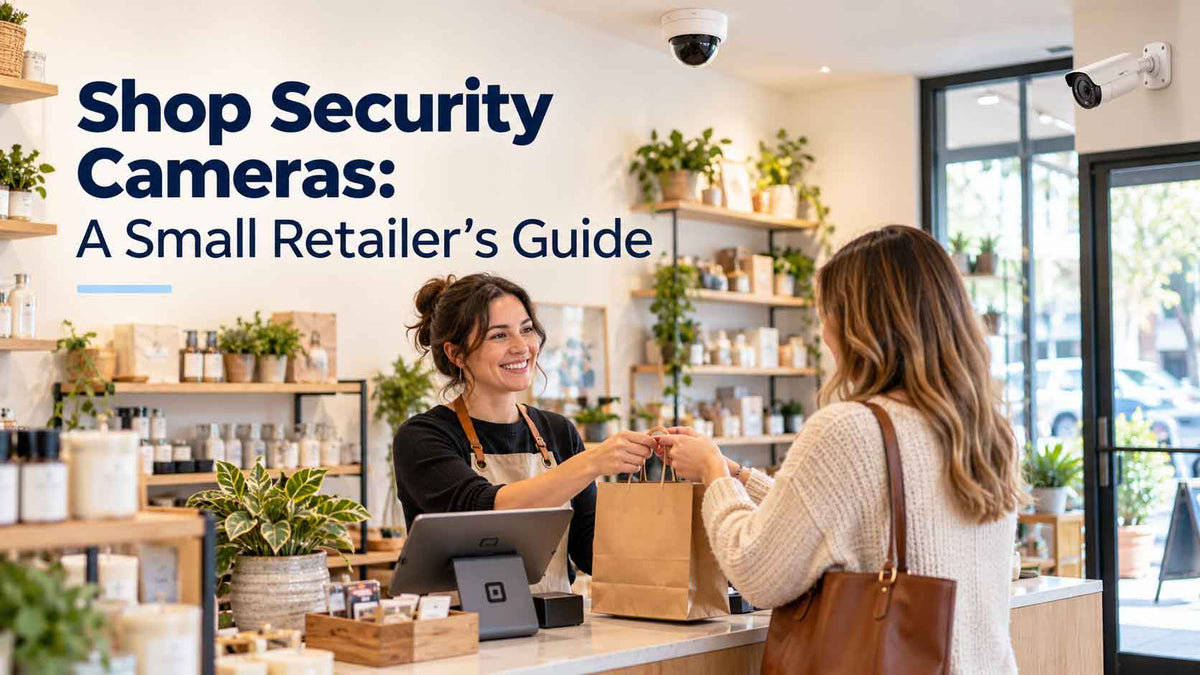
Most small retailers have a camera or two pointed at the door. The problem is that shoplifting rarely happens there. It happens mid-aisle, at self-checkout, and in the two minutes a staff member spends serving one customer while the rest of the store goes unwatched.
If you run a bottle shop in Parramatta, a pharmacy in suburban Adelaide or a homewares store in a Gold Coast shopping strip, you probably already know the feeling. Stocktake comes back short, and nobody can say when or how. Shop security cameras will not stop every theft, but placed properly they deter a lot of it, catch repeat offenders, and give police something to work with.
|
TL;DR: Cover the till, entry/exit, high-value stock aisles, and blind spots created by shelving, not just the front door. Retail theft is rising across Australia, and small independent retailers are hit harder than chains that absorb losses across many stores. A well-placed 6 to 8 camera system with at least two to three weeks of storage (30 days to match your stocktake cycle) is a realistic baseline. |
Why Retail Theft Hits Small Shops Harder
NSW crime data shows store theft rising more than 9% over the two years to the end of 2025, concentrated in Greater Sydney. Victorian data shows reported store thefts nearly doubling between 2022 and 2024. Industry estimates consistently note reported figures understate the real scale.
For small and independent retailers, the impact is disproportionate. A single-site shop cannot absorb losses the way a chain can, and industry data points to theft representing a meaningfully higher share of turnover for smaller, more exposed businesses. Losing $200 of stock a week is over $10,000 a year, often more than the cost of a quality camera system.
Where to Place Shop Security Cameras
Till and POS. Resolves cash discrepancies, refund fraud, short-change disputes. Make sure it captures the drawer and hands, not just a wide counter shot.
Entry and exit. Identifies repeat offenders and matches entry footage against what later goes missing from a specific aisle. Mount the entry camera inside the shop, facing the door, at around 2.2 to 2.5m. Mounting it too high gives you hats and hoods, not faces.
High-value, easily concealed stock. Cosmetics, liquor, small electronics, fragrances and vapes need direct aisle coverage, not a wide overview shot.
Blind spots from your own fit-out. Shelving, racks and displays block staff view and camera view at once. Walk your floor and check every spot a staff member at the till cannot see.
Self-checkout. Scanning avoidance at self-serve terminals is one of the fastest-growing theft categories in Australian retail.
Stockroom and back door. Internal theft and delivery discrepancies are real losses, and they happen out of customers' sight.
Deterrence: Let People See the Cameras
Visible cameras deter opportunistic theft. A public view monitor near the entrance, showing shoppers their own face as they walk in, is one of the cheapest and most effective deterrents available to small retailers. Combine that with clear signage and a staff greeting at the door, and most casual shoplifters move on.
Hidden cameras have their place for internal theft investigations, but for general loss prevention, visible beats hidden.
AI Features: What Is Worth Paying For
AI smart-detection cameras are heavily marketed, and loitering/dwell-time alerts near high-value stock are genuinely useful. People counting is handy for staffing decisions. Smart search, where you can search hours of footage for "person in a red top" or motion in one area, saves real time when you are investigating a stocktake loss.
But placement still matters more than features. A basic camera correctly positioned beats an expensive AI camera pointed at the wrong aisle. For most shops, 6MP cameras are the sensible starting point, with 8MP at the till and entry where identification matters most. Browse our IP cameras to compare AI features across brands.
Sizing Your System
|
Shop size |
Typical cameras |
Suggested recorder |
Priority positions |
|---|---|---|---|
|
Under 100sqm |
4 |
4-channel NVR |
Till, entry, 1 to 2 aisles |
|
100 to 300sqm |
6 to 8 |
8-channel NVR |
Till, entry, exit, high-value aisles, blind spots |
|
300sqm+ or multi-level |
12 to 16 |
16-channel NVR |
All of the above plus stockroom and back door |
Retention matters too, since stocktake discoveries can be weeks after the actual theft. Two to three weeks is the minimum, but match your storage to your stocktake cycle. If you count stock monthly, keep at least 30 days.
What to Do When You Catch Someone on Camera
Staff safety comes first. In most states, staff cannot lawfully detain or search a suspected shoplifter, and confronting someone can quickly turn dangerous. The safer process:
-
Observe and note the time, aisle and description.
-
Preserve the footage by exporting it straight away, before it records over.
-
Report to police with the footage and a stock list.
-
Keep a record of repeat offenders to share with staff.
FAQ
How many cameras does a small shop need?
Most 100 to 300sqm shops need 6 to 8: till, entry, exit, and 2 to 4 covering high-value stock and blind spots.
Can staff legally intervene?
No. In most states, staff cannot lawfully detain or search a suspected shoplifter. Observe, document, preserve footage, call police.
Biggest placement mistake?
Covering the door well and leaving the rest of the store thin.
Do shop security cameras actually deter theft?
Visible cameras, especially with a public view monitor at the entry, deter a lot of opportunistic theft. They will not stop determined or organised offenders, but they give police evidence to act on.
Do I need to put up CCTV signs in my shop?
In practice, yes. Signage at every entry is standard for businesses and in some states is part of workplace surveillance requirements for staff notice.
Get Your Shop Covered
Browse security camera systems for retail aisle and till coverage, NVR kits with stocktake-cycle storage capacity, and CCTV accessories for mounting around awkward shelving layouts.


