
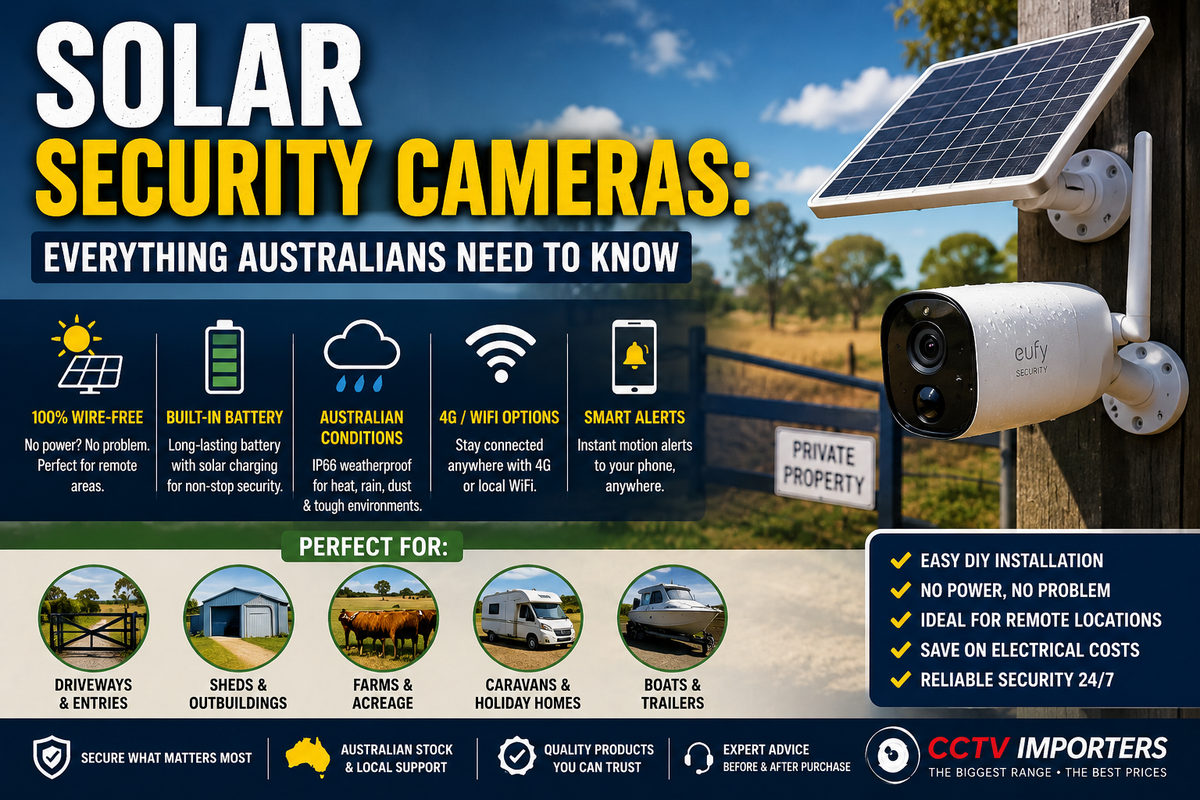
I've been fitting security cameras across suburban homes, rural properties, and commercial sites in Australia for over a decade. And lately, one question comes up more than any other: "Should I go solar?" The short answer is almost always yes. But here's the longer, more useful answer — no marketing spin, no brand shilling. Just honest guidance from someone who's seen what works in the actual Australian climate.
Australia: The World's Best Country for Solar Security
Let's start with the obvious: Australia gets a lot of sun. We're talking about one of the highest solar radiation levels on the planet. While Europeans struggle through grey winters, most Australians enjoy reliable solar charging year-round. That changes the economics of every security camera decision you'll make.
|
4.5–6 kWh/m² Daily solar radiation across most of Australia |
1 in 3 Australian homes now have rooftop solar |
19.2% CAGR Global solar security market growth to 2030 |
Source: Clean Energy Regulator, Australian Energy Regulator, Cognitive Market Research 2024
But it's not just sunshine hours. Australia's property landscape is uniquely suited to solar surveillance. We have sprawling rural properties where running power cables to a front gate costs thousands in electrical work. We have coastal holiday homes sitting empty for months. We have construction sites, farms spanning hundreds of hectares, and remote commercial properties where grid power simply isn't practical. Solar solves all of it.
How Solar Security Cameras Actually Work
There's a common misconception that solar cameras only work during daylight hours. Let's clear that up immediately, because it affects every buying decision you'll make.
A solar security camera system works in three stages:
1. The solar panel (typically 3W–10W for residential units) converts sunlight into electricity during daylight hours.
2. That electricity charges an internal rechargeable lithium battery — think of it as a power reservoir.
3. The camera draws from that battery around the clock — not just when the sun is shining.
A quality modern system holds enough charge to record for 12 or more hours on battery alone, without any sunlight. That's more than enough to handle a cloudy Darwin day or an overnight storm in Melbourne.
Motion-Activated vs Continuous Recording
Most solar cameras default to motion-activated recording — and for good reason. Running 4K video 24/7 would drain any battery within hours. Motion detection keeps the camera in low-power standby until something triggers it: a person, a car, a sensor alert. This is what makes solar power work in practice.
Installer's tip: When someone tells me their solar camera 'stopped working at night,' the real issue is almost always placement, not the camera. A panel partially shaded by a roof overhang for even a few hours a day will lose 30–50% of its daily charge. Proper north-facing orientation is everything.
The Real Pros and Cons — No Marketing Spin
I've seen too many Australians buy a solar camera based on glossy product photos, then return it within a month. Here's my honest breakdown.
|
ADVANTAGES |
LIMITATIONS |
|
• Install anywhere with sun — no power point needed • Saves $100–$300/year on electricity vs wired systems • Keeps recording during blackouts • 30–50% faster to install than wired cameras • No sparky, no conduit, no electrical permits • Ideal for farms, sheds, and remote properties • Lower long-term maintenance costs |
• Higher upfront cost than basic plug-in cameras • Performance drops in heavily shaded locations • Poor panel placement kills battery life • Wi-Fi dependent — doesn't work with poor signal • Cheap models cut corners on battery capacity • Wireless connectivity needs proper security config • May require separate panel mount in some setups |
What to Look for When Buying
The solar camera market is flooded with cheap imports that look great in product photos and fall apart in their second Australian summer. Run through this checklist before you buy:
• IP Rating: IP65 minimum, IP67 preferred. Australia's climate swings from cyclones to outback dust storms. You need protection against both.
• Battery Capacity: 5,000mAh minimum; 10,000mAh+ for reliable overnight operation, especially in southern states with shorter winter days.
• Solar Panel Efficiency: 15–22% conversion rate. Higher efficiency charges faster in winter when sunlight hours are shorter — even in Queensland.
• Video Resolution: 2K minimum; 4K for driveways and entry points. You need to read number plates and identify faces as potential evidence.
• Connectivity: Wi-Fi for suburban use. 4G/LTE for rural properties. If your camera location is more than 20m from your router, plan for 4G.
• Night Vision: Colour night vision or spotlight mode. Basic infrared gives you grainy black-and-white footage that's nearly useless for identification.
• AI Detection: Person/vehicle detection over basic motion sensors. Without it, Australian wildlife — kangaroos, possums, birds — will trigger constant false alerts.
• Storage: Local storage (SD card or onboard) with no ongoing fees. Cloud storage adds cost and puts your footage on overseas servers.

Recommended Solar 4G Security Camera
The Dahua 3+3MP WizColor Hybrid-Zoom PTZ 4G Battery Solar Network Camera is a strong option for remote outdoor surveillance, farms, construction sites, large properties, and areas without fixed power or internet access.
View ProductTop Solar Security Camera Brands in Australia
Here are the cameras I'd genuinely recommend to a mate — not just list for the sake of it.
|
Brand / Model |
Price (AUD) |
Best For |
Key Features |
|
Suburban homes |
$188.50 was $398 |
Suburban homes & families |
4K Wi-Fi, colour night vision, 10,400mAh battery, PIR detection, IP65. Biggest saving in the range. |
|
Budget pick |
$149 was $199 |
Budget buyers & renters |
2K Wi-Fi with solar panel kit included. Free 64GB SD card. Best entry-level solar package in AU. |
|
360° coverage |
From $269 was $310 |
Full property coverage |
360° pan & tilt, 2K+, battery-powered with solar panel option. Auto-tracks movement across the frame. |
|
Commercial grade |
$3,399 was $4,300 |
Commercial & remote farms |
4K ColorVu, 4G, 64GB eMMC onboard storage, lithium battery, IP67. Full professional solar kit. |
|
Rural |
$577 was $699 |
Rural & large properties |
3+3MP WizColor hybrid-zoom PTZ, 4G connectivity, solar-powered. Ideal where Wi-Fi doesn't reach. |
|
Off-grid |
$718 was $900 |
Off-grid locations |
4G solar bullet camera, 4MP fixed lens. Built for zero Wi-Fi or power infrastructure environments. |
|
Multi-camera |
$659 was $735 |
Multi-camera commercial setups |
60W panel + 20.8Ah battery, MPPT smart charging, IP66 weatherproof, aux heating for cold climates. |
|
EZVIZ EP7 Solar Video Doorphone Smart home |
$399 was $611 |
Smart home front doors |
Solar-powered 2K video doorbell with 7" touchscreen indoor unit. No wiring or electrician needed. |
5 Installation Tips From Someone Who's Done Hundreds
Most Australian homeowners can install a solar security camera in under an hour. But I've seen simple installs fail repeatedly because of easily avoidable mistakes.
1. Face your solar panel north
Australia is in the Southern Hemisphere — the sun tracks across the northern sky. A south-facing panel generates a fraction of what a north-facing panel produces. Angle it between 15–30 degrees depending on your latitude. This single change can increase your daily charge by up to 40%.
2. Ensure 4–6 hours of direct sun daily
Before drilling a single hole, observe the proposed panel location throughout the day. A spot that looks sunny at 9am may be in full shade by 2pm from a roofline or neighbouring tree. You need at least 4 hours of direct (not dappled) sun for reliable daily operation.
3. Mount the camera 2–3 metres above ground
This height delivers the best combination of wide coverage and face-level detail. Too low and the camera can be blocked or tampered with. Too high and you're recording the tops of heads rather than faces. Position cameras slightly to the side of entry points so faces are caught as people approach.
4. Test Wi-Fi signal strength first
Walk to your proposed camera location and run a speed test on your phone. Under 5 Mbps means you'll likely have dropped connections and missed footage. Use a Wi-Fi extender or mesh node — or switch to a 4G camera for locations more than 20m from your router.
5. Update firmware and change default passwords immediately
This is the one step most people skip. The moment you connect a new camera, update its firmware through the app, then set a unique admin password. Not the same as your Wi-Fi password. This takes five minutes and prevents the vast majority of camera hacking incidents.
"Solar security cameras will account for 30% of the global surveillance market by 2030, driven by IoT integration and hybrid power systems."
— Growth Market Reports, Global Solar Security Camera Market 2025–2033
How long does the battery actually last, region by region?
A fully charged solar security camera battery typically runs 3 to 5 days with zero sun input, covering most short cloudy spells across Australia. In consistently sunny regions the panel keeps the battery topped up indefinitely. In regions with extended multi-day cloud cover, such as southern Victoria or Tasmania in winter, a larger panel (18W or more) and larger internal battery are needed for reliable year-round coverage.
What actually drains the battery fastest is motion-triggered recording frequency, not idle standby time. A camera in a high-traffic position triggering dozens of times a day drains meaningfully faster than the same unit in a quiet paddock corner. Panel size determines whether the battery ever gets a chance to recharge: a small 6W panel struggles to keep up in low-sun winter regions even with a large battery, while an 18W+ panel comfortably recharges through most Australian winters outside the far south.
Battery reserve by region and panel size
|
Region type |
Recommended panel |
Reserve without sun |
|---|---|---|
|
Northern/central Australia, high sun year-round |
6–8W standard panel |
3–5 days |
|
Southern states, winter cloud cover |
18W+ panel |
5–7 days recommended reserve |
|
Tasmania, extended overcast periods |
18W+ panel, larger battery |
Plan for 7+ days |
Standard units like the EZVIZ CS-BC1C PRO 8MP 4K 3-pack ship with 12W and 6W solar panel options depending on the bundle. For southern or high-cloud regions, pairing with a larger dedicated panel such as the Dahua 100W integrated solar panel gives meaningfully more reserve than a stock 6W panel.
Does AI detection reduce battery drain compared to basic motion sensing? Yes, since it triggers fewer false recordings from wind, animals and passing traffic, directly extending battery life between charges.
The Bottom Line
Solar security cameras make more sense in Australia than almost anywhere else on earth. We have the sunshine, the property types, and the infrastructure challenges that make them the natural choice for both urban and rural surveillance.
The key is buying the right system for your specific situation. A suburban Brisbane homeowner has very different needs to a sheep farmer in outback New South Wales. Match the camera to the context — battery size, connectivity type, AI detection capability, and IP weatherproofing — and solar-powered surveillance will serve you well for years.
If you're still unsure which system suits your property, the questions in the FAQ below are the exact ones I work through with every new client before recommending a solution.
Frequently Asked Questions
Do solar security cameras work on cloudy days in Australia?
Yes. Solar panels still generate electricity on overcast days — just at reduced efficiency. A quality camera with a 10,000mAh+ battery will handle two to three consecutive overcast days before performance dips. Battery capacity matters more in Victoria and Tasmania than in Queensland.
Can I use a solar camera in a shaded area?
This is the most common installation mistake. Cameras with integrated panels won't work well in shade. The solution is a camera with a separate solar panel on an extendable cable — you mount the panel somewhere sunny while positioning the camera where you need it. Hikvision and Uniden both offer this.
How long do solar cameras last in Australian conditions?
A quality camera should last 3–5 years before battery capacity noticeably degrades. The solar panel itself typically lasts 10+ years. UV degradation is the main enemy of cheap housings in the Australian sun — look for IP-rated polycarbonate or aluminium, not bare plastic.
Do I need a subscription?
Not necessarily. Many cameras include free cloud storage (Uniden offers 7-day free cloud backup for life), and most support local SD card storage at zero ongoing cost. Paid cloud plans cost $5–$15 per camera per month and are only worthwhile if you need extended storage history or professional monitoring.
Is solar camera footage admissible as evidence in Australia?
Yes, provided the footage is timestamped accurately, the resolution is sufficient for identification, and there's a clear chain of custody (no editing). Store footage on local SD card or a cloud service with access logs. Privacy laws around CCTV placement vary between states — check your local regulations.


