
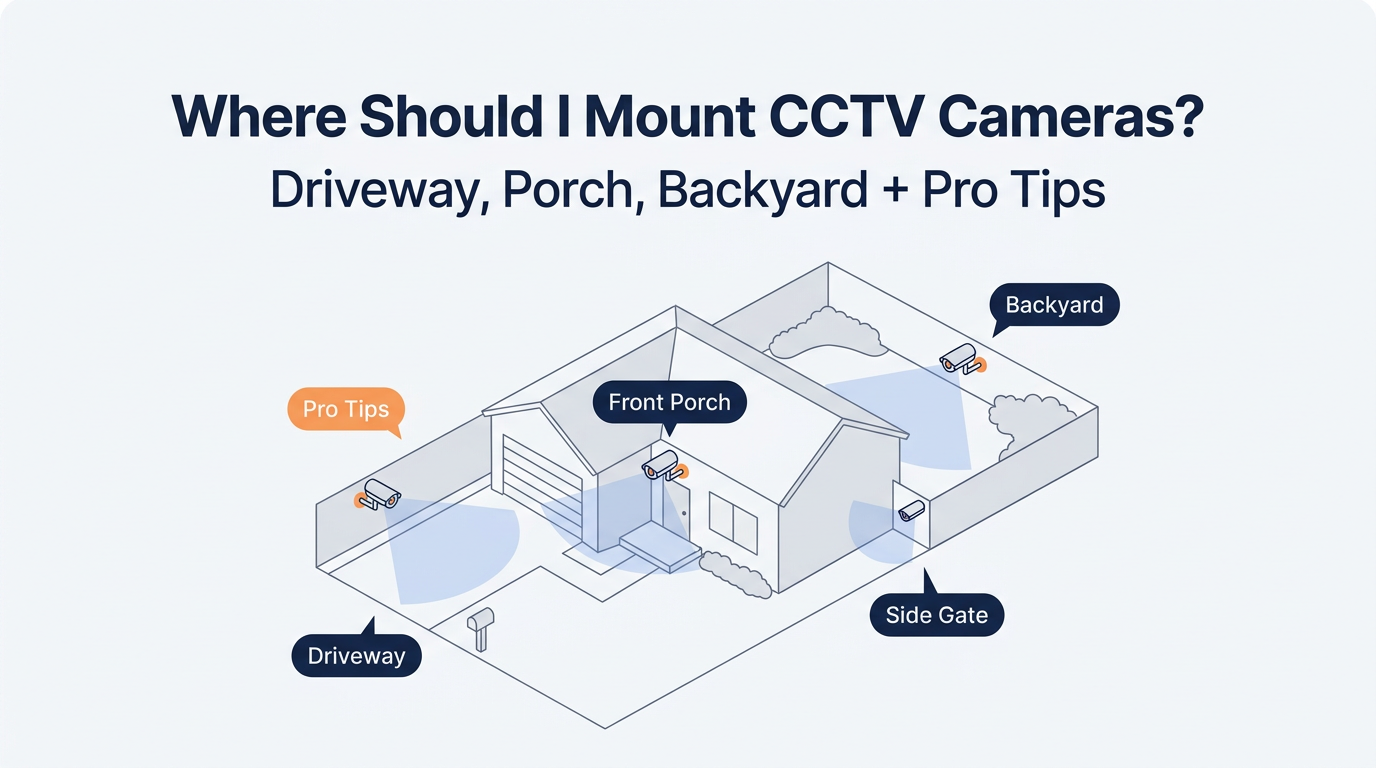
If you’re asking where to place CCTV cameras, you’re already ahead of most people.
Because a “random camera on each corner” usually gives you:
-
nice wide video… but no usable faces,
-
too much glare at night,
-
and blind spots right where people actually walk.
In Australia, home break-ins rose to 2.1% of households in 2023–24 (about 218,000 households), so getting your camera placement right isn’t just a “nice-to-have.”
This guide shows the best mounting locations for the three most common areas:
-
driveway
-
porch/front door
-
backyard/rear entry
Plus the key placement rules we use every day when specifying kits for Aussie homes and small businesses.
The “3-zone” rule (simple way to choose placements)
Before we talk exact spots, decide what each camera is meant to do:
-
Detection – “Something moved” (wide view is OK)
-
Recognition – “That’s a person / delivery driver / familiar face”
-
Identification – “That’s the face we can use”
This matters because identification needs enough pixel density on the face, not just a wide shot. Axis explains pixel density planning based on IEC 62676-4 standards, which is why “too high + too wide” often fails when you zoom in.
Best practice: use at least one camera per property that’s clearly set up for identification, not just overview.
Best mounting height in 2026 (don’t guess)
For most outdoor fixed cameras, a practical height is:
-
about 2.5–3m high, angled slightly down (high enough to deter tampering, low enough for face detail).
If you want a broader “acceptable range,” Hikvision’s installation guidance for certain camera analytics features lists:
-
2.5m to 6m height range, with a recommended tilt angle ~25° to 60° (feature-dependent, but a helpful real-world guide).
For video doorbells specifically (porch/visitor capture):
-
install around 1.22m (48 inches) for best detection and framing.
1) Where to place CCTV cameras for the driveway
Your goal in the driveway
Driveways are where you want:
-
vehicle movement + parking area coverage (overview), and often
-
a usable angle for faces near the car (and sometimes plates)
Best driveway placement (most homes)
Mount point: under eaves/soffit on the front corner of the house, aimed down the driveway, not straight across it.
Why: it captures the approach path and keeps the camera out of direct headlight glare.
“Best results” driveway setup (2-camera approach)
If driveway security matters (vehicles, tools, deliveries), do this:
-
Driveway overview camera
-
Wider lens, shows full driveway and verge entry.
-
Driveway detail camera (closer / tighter angle)
-
Positioned closer to where people exit vehicles or approach the garage/door.
This is how you keep your wide coverage and get identification-level footage when it matters.
Driveway mistakes to avoid
-
Mounting too high (you get heads and caps, not faces).
-
Pointing directly into headlights or rising sun (constant exposure issues).
-
One camera trying to do everything (usually ends up doing nothing well).
Product-fit internal links (only if relevant):
-
Shop IP Cameras: https://cctvimporters.com.au/collections/ip-cameras
-
Prefer long “down-the-driveway” coverage? Start with Bullet cameras: https://cctvimporters.com.au/collections/bullet-cameras-1
-
Want a neat under-eaves mount with flexible aiming? Turret cameras: https://cctvimporters.com.au/collections/turret-cameras
Quick pro tip: if number plates are a priority
Plate capture is its own discipline (angle, distance, lighting, shutter). Axis notes plate capture performance depends heavily on mounting position/angle and distance-to-lane. If plates matter, consider a dedicated ANPR/LPR approach, not “one wide driveway cam.”
2) Where to place CCTV cameras for the porch/front door
Your goal at the porch
The front door is your #1 identification zone:
-
door knocks
-
deliveries
-
unknown visitors
-
most “we need to see a face” moments
Best porch placement options (choose one)
Option A: Video doorbell height (most consistent for visitors)
Mount at ~1.22m so the camera sees faces, not just the top of heads.
Option B: Under-eaves camera aimed at the door approach
Mount ~2.5–3m, angled down so it captures:
-
face as someone approaches
-
packages being placed
-
door area
Porch mistakes to avoid
-
Mounting above the door and aiming straight down (you’ll mostly record hats/hair).
-
Only covering the door itself and missing the approach path (where faces are clearest).
Porch “two-angle” trick (high-value, low-cost)
If you want the best evidence:
-
One camera covers the approach (faces)
-
One camera covers the doorstep area (packages + tampering)
It’s a simple way to avoid the “zoomed-in door cam” problem.
3) Where to place CCTV cameras for the backyard/rear entry
Your goal in the backyard
Rear areas are where you want:
-
back door/patio slider coverage
-
side gate coverage
-
shed/asset coverage if you’ve got tools or equipment
Best backyard placements
-
Back door / patio slider
-
Mount under eaves, angled to capture the door and the area someone stands before entering.
-
Rear fence line or yard overview (optional)
-
Useful for bigger blocks, pools, or detached sheds—just avoid “too wide to be useful.”
-
Shed / tool area (asset camera)
-
This is your “high consequence” zone—keep it closer, tighter, and clearer.
Backyard mistakes to avoid
-
Placing a camera deep in the backyard aiming back at the house (often becomes a glare/night reflection issue).
-
Ignoring side access (most “quiet entry” paths are down the side).
Don’t forget side paths (the most-missed placement)
If someone can walk from the front to the back without being seen, you’ve got a blind spot.
For many Aussie homes, the best upgrade isn’t “another backyard cam” — it’s a side path camera covering:
-
side gate
-
narrow walkway
-
access to backyard/garage
This single camera often reduces your risk more than adding a second “wide backyard” view.
Wiring tip: when a PoE switch helps camera placement
If your best camera locations are far apart (long runs) or it’s hard to route lots of cables back to the NVR (double-storey access, limited conduits), a PoE switch can let you terminate camera runs locally and uplink back with fewer cables.
We’ll explain the full PoE switch setup in a dedicated blog—this is just the “why.”
PoE switches: https://cctvimporters.com.au/collections/poe-switches
Privacy note for Australia (place cameras smartly)
As a general guide, OAIC notes the federal Privacy Act typically doesn’t cover cameras used by individuals in a private capacity, but state/territory laws and council rules may apply. It’s also smart practice to angle cameras to focus on your property and minimise neighbours/public areas where possible.
If you’re a business or organisation, signage/notice expectations can apply depending on your situation. Queensland OIC guidance (for agencies) notes signage near cameras is a key way to meet notice requirements good practice even beyond government contexts.
Quick placement templates (copy/paste)
Typical home (best minimum coverage)
-
Front door/porch (identification)
-
Driveway (overview)
-
Backyard rear door/patio
-
Side path / side gate
Small business starter coverage
-
Front entry (identification)
-
Customer/service counter (if relevant)
-
Stock/asset area
-
Carpark/driveway line
What to buy next (internal links)
-
IP Cameras: https://cctvimporters.com.au/collections/ip-cameras (CCTV Tradie)
-
CCTV Kits (fastest way to start): https://cctvimporters.com.au/collections/cctv-kits (CCTV Tradie)
-
NVRs: https://cctvimporters.com.au/collections/nvrs (CCTV Tradie)
-
Surveillance Hard Drives: https://cctvimporters.com.au/collections/surveillance-hard-drives (CCTV Tradie)
-
Need a placement plan? Tell us what you need: https://cctvimporters.com.au/pages/tell-us-what-you-need (CCTV Tradie)
-
Prefer supply + install? CCTV Tradie: https://cctvimporters.com.au/pages/cctv-tradie (CCTV Tradie)
FAQs
Where to place CCTV cameras outside a house?
Start with the “must-cover” zones: front door, driveway, rear entry, and side access. Then add an asset camera (garage/shed) if needed.
How high should I mount CCTV cameras?
A practical outdoor range is often around 2.5–3m, angled slightly down. Doorbells are typically best around 1.22m for face framing.
Should cameras point at the street?
Try to keep coverage focused on your own property and minimise neighbours/public areas where you can. Check local rules if you’re unsure.


