
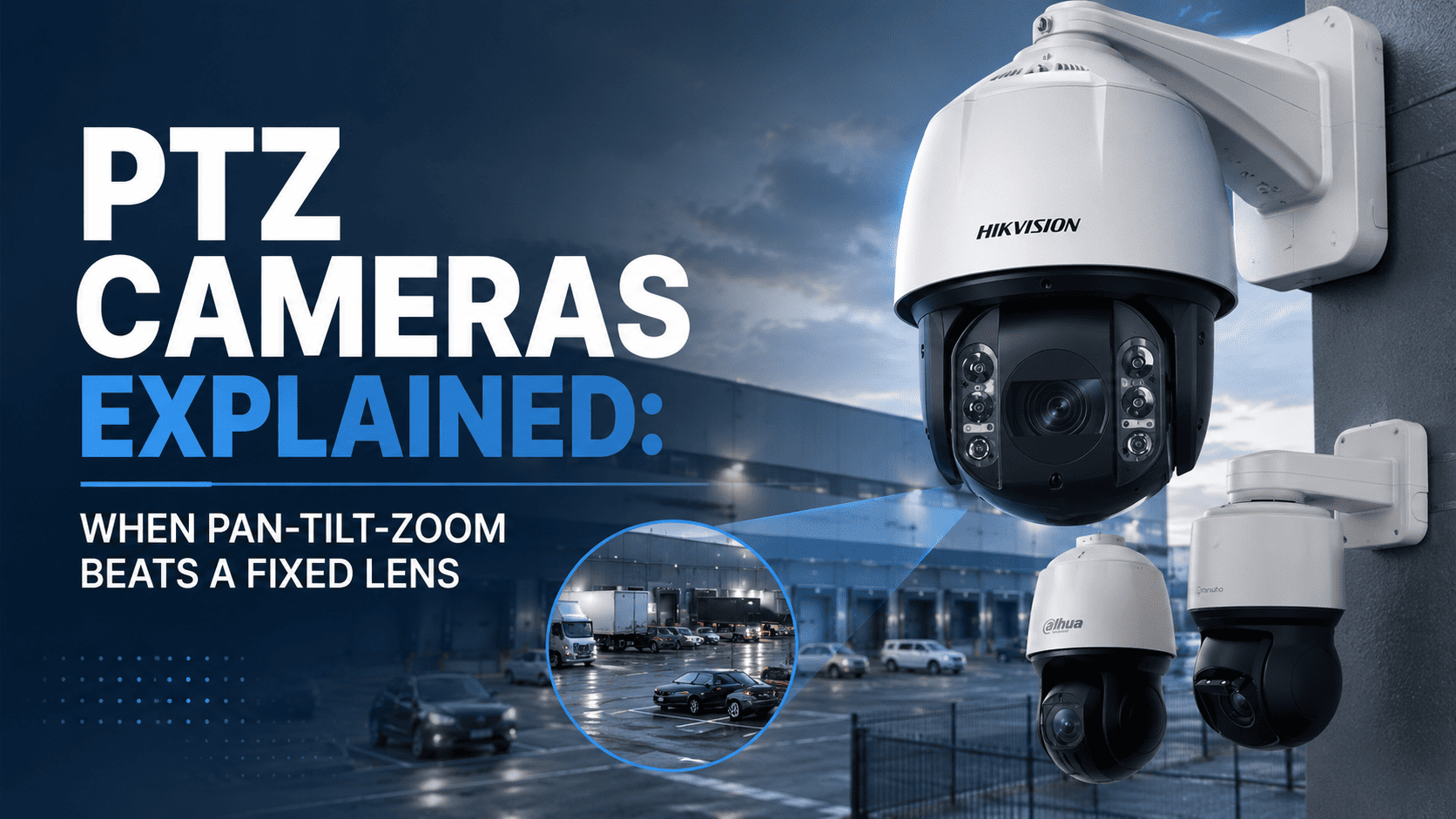
A long rural driveway, a busy warehouse yard, or a car park that stretches further than any single camera can cover in useful detail. These are the jobs where a fixed camera keeps coming up short, and where a PTZ camera starts to make financial sense despite costing several times more than a standard fixed unit.
|
TL;DR A PTZ camera physically pans, tilts, and optically zooms, either on a preset patrol or under manual and automatic control, letting one camera cover ground that would otherwise need three or four fixed units. It costs more per camera, so it earns its keep on large open areas rather than single doorways. |
What a PTZ camera actually does
PTZ stands for pan, tilt, zoom. Unlike a fixed camera locked to one field of view, a PTZ camera has a motorised head that can rotate side to side, tilt up and down, and use an optical zoom lens to bring distant detail closer without losing image quality. It can be steered manually from an app or NVR interface, run on a scheduled patrol between preset positions, or in higher-end models, automatically track a moving person or vehicle across its zoom range.
Optical zoom vs digital zoom, and why it matters
Optical zoom is a physical lens movement that brings the image closer while keeping full resolution and clarity. Digital zoom simply crops and enlarges pixels that are already there, which is why a heavily digitally zoomed image on a fixed camera turns into a blurry mess the moment you need to actually identify a face or number plate.
A 25x or 40x optical zoom PTZ camera can pick out real detail from a genuine distance in a way no amount of digital zoom on a fixed camera will match. This is the entire value proposition of a PTZ unit, and it is worth confirming a listed zoom figure is optical, not a combined optical-plus-digital number, before comparing prices.
Auto-tracking and preset patrols
Most current PTZ cameras support preset positions, which are saved angles the camera can jump between on a schedule, for example scanning the front gate, then the car park, then the loading dock every few minutes. Higher-end models from Dahua's TIOC PTZ range and Hikvision's DeepinMind PTZ line add automatic tracking, where the camera detects a moving person or vehicle and follows it across its full zoom and pan range without anyone touching a joystick.
For a business with a large open yard, this auto-tracking feature alone can do the job that would otherwise take several fixed cameras stitched together, and it produces a single continuous clip of an incident rather than a person walking out of one camera's frame and into another's.
Where PTZ genuinely earns its price
-
Long rural driveways and semi-rural boundaries, where one PTZ at the gate can cover ground several fixed cameras would be needed for.
-
Large car parks and yards, tracking movement across an open area rather than one fixed frame.
-
Ports, warehouses, and industrial sites, where perimeter coverage needs to flex with what is happening on any given day.
-
Sites wanting to read number plates or faces at real distance, where optical zoom actually delivers usable detail.
Where a fixed camera is still the smarter buy
A PTZ camera typically costs three to five times what a comparable fixed camera does, and that premium only pays off when there is genuinely more ground to cover than one fixed frame can manage. For a single front door, a straightforward driveway, or a small shopfront, a fixed camera with a good lens will do the job for a fraction of the price and with less to go wrong mechanically over time.
It is also worth noting a PTZ camera watching one spot on patrol is, by definition, not watching everywhere else at that moment. For a site with several genuinely important fixed points, like a till, a back door, and a loading dock, dedicated fixed cameras on each point are more reliable than hoping a single PTZ swings past at the right second.
The hybrid approach most installers actually recommend
In practice, the best-value commercial setups rarely rely on PTZ alone. Fixed cameras cover the choke points, the doors, tills, and gates where continuous coverage matters most, while a single PTZ handles the open ground in between and gives an operator the ability to zoom in on anything unusual as it happens. This combination usually costs less than trying to cover the same area with PTZ cameras alone, while giving better coverage than fixed cameras alone could manage over a large site.
Weatherproofing and mounting in Australian conditions
Outdoor PTZ cameras need to hold IP66 or IP67 weatherproof ratings given they are exposed and constantly moving mechanically, which introduces more seal points than a sealed fixed housing. Mounting matters more than people expect too. A PTZ camera on a tall, unbraced pole in an exposed rural or coastal location can pick up enough wind sway to blur footage during gusts, so a properly braced mount or a shorter, sturdier pole is worth the extra effort on exposed sites.
Featured PTZ & Panoramic Security Cameras
Compare advanced PTZ, panoramic, dual-lens, and TiOC security cameras for wide-area CCTV coverage, active deterrence, full-colour monitoring, and smart outdoor surveillance.

Dahua 180° TiOC Duo Camera
A dual-lens 2x4MP AI camera with 180° coverage, full-colour imaging, WDR, and active deterrence.
View Product
Dahua 10x Panoramic PTZ
An 8MP + 4MP Starlight TiOC panoramic PTZ camera with 10x zoom for wider outdoor coverage.
View Product
HiLook TandemVu PTZ Camera
A 4MP + 4MP dual-lens PTZ camera with 4x zoom, DarkFighter, strobe, audio, alarm, and PoE.
View Product
Dahua 25x Panoramic PTZ
A powerful 8MP + 4MP panoramic PTZ camera with 25x zoom, Starlight imaging, and TiOC deterrence.
View ProductBuying guide by property type
-
Home with a long driveway: one PTZ at the gate or driveway entry, paired with fixed cameras at the front door and any side access.
-
Small to mid-size business with a yard: a single PTZ covering the open yard, fixed cameras on the till, back door, and loading dock.
-
Large industrial or port-style site: multiple PTZ units on preset patrol routes, integrated with a wider fixed camera perimeter.
Compare current PTZ camera options across Dahua and Hikvision ranges, or browse our full security camera systems if a fixed camera setup suits your property better.
Frequently asked questions
Can a PTZ camera record continuously or only when controlled?
Both. Most PTZ cameras can run continuous or motion-triggered recording on a preset patrol route without any manual control, and can also be manually steered live when someone wants to zoom in on a specific event.
Do I need to man a joystick to use a PTZ camera day to day?
No. Preset patrols and auto-tracking handle the vast majority of everyday use without anyone actively steering the camera. Manual control is there for when you want to zoom in on something specific.
Is a PTZ camera worth it for a home?
Usually only if the property has a genuinely large area to cover, like a long rural driveway or a wide acreage boundary. For a standard suburban home, fixed cameras almost always deliver better value.
How far can a PTZ camera zoom and still see clearly?
It depends on the optical zoom rating, commonly 25x to 40x on current models. As a rough guide, a 25x optical zoom can pick out reasonable facial or number plate detail at distances a fixed camera lens would render as an unreadable blur.
Can a PTZ camera track a moving person automatically?
Higher-end models with auto-tracking features, such as Dahua's TIOC PTZ and Hikvision's DeepinMind PTZ ranges, can detect and follow a moving person or vehicle automatically across their zoom and pan range.
Do PTZ cameras work at night?
Yes, most current PTZ cameras include infrared or starlight low-light sensors, though performance at extreme zoom levels in very low light is generally a step behind their performance at closer range.


